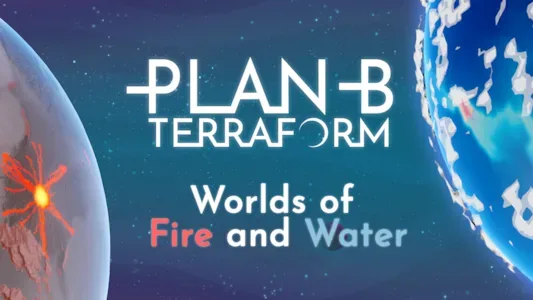
Plan B: Terraform has expanded on PC with the paid Worlds of Fire and Water DLC and a large free update for the base game. The add-on introduces two new planets built around sharply different environmental pressures: one defined by volcanic heat and limited resources, the other by an overwhelmingly oceanic surface that changes as temperatures and ice caps shift.
Gaddy Games has listed Worlds of Fire and Water at $4.99, with a 15% launch discount during its first seven days. The base game is listed at $15.99 and is included in a 30% Steam Daily Deal. Both the DLC and the update are available now through Steam.
The headline feature may be the two new worlds, but the free update is consequential in its own right. It replaces the prior level system with a tech tree, adds a broad set of upgrades and introduces new transport, extraction and terraforming tools. In practical terms, the package changes both where players build and the systems they use to develop a planet.
Two worlds, two different logistical problems
Fire World is the harsher of the pair on paper. Extreme temperatures, scarce minerals and continual volcanic eruptions present a three-part problem: keeping a developing planet cool, securing the resources necessary to expand and responding to a landscape affected by volcanic activity.
Terraforming, in the context of Plan B, means altering planetary conditions to make a world habitable. Fire World’s design suggests that this process cannot simply be treated as a straight expansion path. Cooling becomes a central concern, while limited mineral availability means extraction and distribution choices carry extra weight. The DLC specifically requires new tools and approaches to cool the world and make it livable.
Water World reverses the spatial issue. It is almost entirely covered in water, leaving only small islands available for construction at the outset. That limitation makes buildable land a defining strategic resource rather than a given.
Its geography is also dynamic. As temperatures decline, polar ice caps expand and water levels recede, exposing further land for development. Players therefore have to adapt to both the cold and a coastline that evolves over time. Land that does not initially exist may later become available, but the process is tied to falling temperatures and growing ice.
The contrast is clear: Fire World puts pressure on heat management, mineral scarcity and eruptions; Water World asks players to work around restricted land, changing sea levels and low temperatures. They are not merely visual biome swaps. Each is built around conditions that affect planning and infrastructure placement.
Related coverage includes Plan B: Terraform Expands With Worlds of Fire and Water DLC.
The level system gives way to a tech tree
For every Plan B: Terraform player, including those who do not buy the DLC, the free update replaces the old level system with a tech tree. A tech tree is a structured set of technologies that players unlock over time, typically organizing development choices around prerequisites and progression routes. The update confirms the change in structure, though it does not detail every branch or unlock condition.
The important point is that advancement is being reframed around technologies rather than the former level-based arrangement. That sits alongside several upgrade categories:
- One-time upgrades for container capacity and depot flotation.
- Repeatable upgrades for vehicle and drone speed.
- Repeatable upgrades for extraction efficiency.
Container capacity directly concerns how much material a container can hold. Depot flotation relates to a depot’s ability to stay afloat, making it particularly relevant to a game now introducing a world with limited land and extensive water. Extraction efficiency concerns the output or effectiveness of resource-gathering operations, while speed upgrades affect how quickly vehicles and drones move through the logistics network.
Repeatable upgrades are especially notable because they imply that some progression can continue through multiple improvements rather than ending after one purchase. The update does not specify caps, costs or exact numerical effects, so players should not assume details beyond the announced categories.
New ships and airships broaden transport options
The update adds new vehicles at opposite ends of progression: small ships for the early game and airships for the late game. The timing is meaningful alongside Water World’s island-based starting conditions. Small ships provide a new early-game vehicle type at a point where waterborne movement could matter immediately.
Airships arrive later in the game, adding another transport option once a planet’s development has advanced further. No capacity, routing behavior or construction requirements have been outlined, but their addition expands the vehicle lineup beyond the existing framework.
These systems also connect with the new upgrade categories. Faster vehicles and drones can affect the pace at which materials move between extraction, storage and construction. In a logistics-focused terraforming game, that makes movement speed more than a minor quality-of-life detail: it is one of the levers available for managing a growing network.
Water is becoming an active system, not just a map boundary
Water World is supported by several free-update features that make water a more active part of the simulation. The update adds dynamic polar ice caps and snow, along with sea plants and plankton that move with water currents. It also introduces water farms, seabed extractors and depot flotation upgrades.
Dynamic polar ice caps means the polar ice is not presented as a permanently fixed feature. On Water World, its growth is tied to falling temperatures and lower water levels, with the result that new ground is revealed. Snow similarly brings cold conditions into the planet’s changing appearance and systems.
Plankton are tiny organisms that live in water. Here, sea plants and plankton follow water currents, indicating that their placement or movement is linked to the direction of water flow rather than being entirely static. The announced information does not define their specific gameplay yields or interactions, but it establishes currents as relevant to those aquatic elements.
Seabed extractors are resource extraction tools that operate on the seafloor. Combined with water farms, small ships and floating depots, they give the update a clear set of systems for building and gathering resources in water-dominant environments.
For an adjacent example of how water and atmosphere can become a focal point of discussion in PC games, players can also see why environmental presentation has been debated in this look at water and fog in The Witcher 3 Remaster. Plan B’s update is concerned with simulation and terraforming rather than ray-traced visuals, but Water World makes clear that water conditions are central to its new gameplay scenario.
More tools for changing a planet
The update further expands Plan B: Terraform’s terraforming toolkit with rockets that can launch shades and mirror satellites, as well as rockets able to retrieve ice comets. It also adds greenhouse gas neutralization plants, long-range drone extractors, new extraction systems and further terraforming technologies.
A shade, in this context, is a device launched to reduce incoming light or heat. A mirror satellite is the inverse kind of concept: an orbital mirror intended to direct sunlight. The update announces both as rocket-launched options, though it does not lay out their exact effects, research requirements or how they interact with each planet’s temperature.
Ice comets are another announced target for rocket activity. Retrieving one points to a new space-linked operation connected to planetary resources or conditions, but the specific outcome has not been detailed. Likewise, greenhouse gas neutralization plants are clearly intended to reduce greenhouse gases, while the announcement does not specify their rates, inputs or broader climate calculations.
Long-range drone extractors add a version of resource gathering that can operate over greater distances. Their arrival fits the larger emphasis on logistics: resource sources may not always be close to established infrastructure, especially when minerals are scarce or usable terrain is fragmented by water.
What is free and what requires the DLC
The division is straightforward. Worlds of Fire and Water is the paid expansion containing the two new planets, Fire World and Water World. The companion content update is free for the base game and includes the technology-tree replacement, upgrades, vehicles, dynamic polar systems, aquatic life and currents, water-focused buildings and extractors, rockets, climate-oriented infrastructure and other extraction and terraforming technologies.
That distinction matters for returning players. Someone who owns the base game can access the revamped progression structure and the new systems in the update without buying the expansion. The paid DLC is the route to the two explicitly announced challenge planets.
The combined release gives Plan B: Terraform a broader range of ways to approach a world’s central constraint. Fire World is about bringing down dangerous heat while operating amid scarce minerals and eruptions. Water World makes usable ground a changing resource shaped by cold, ice and retreating water. The free update supplies new means of moving, extracting and modifying conditions around those challenges.
Worlds of Fire and Water and the free content update are available now for Plan B: Terraform on PC via Steam.