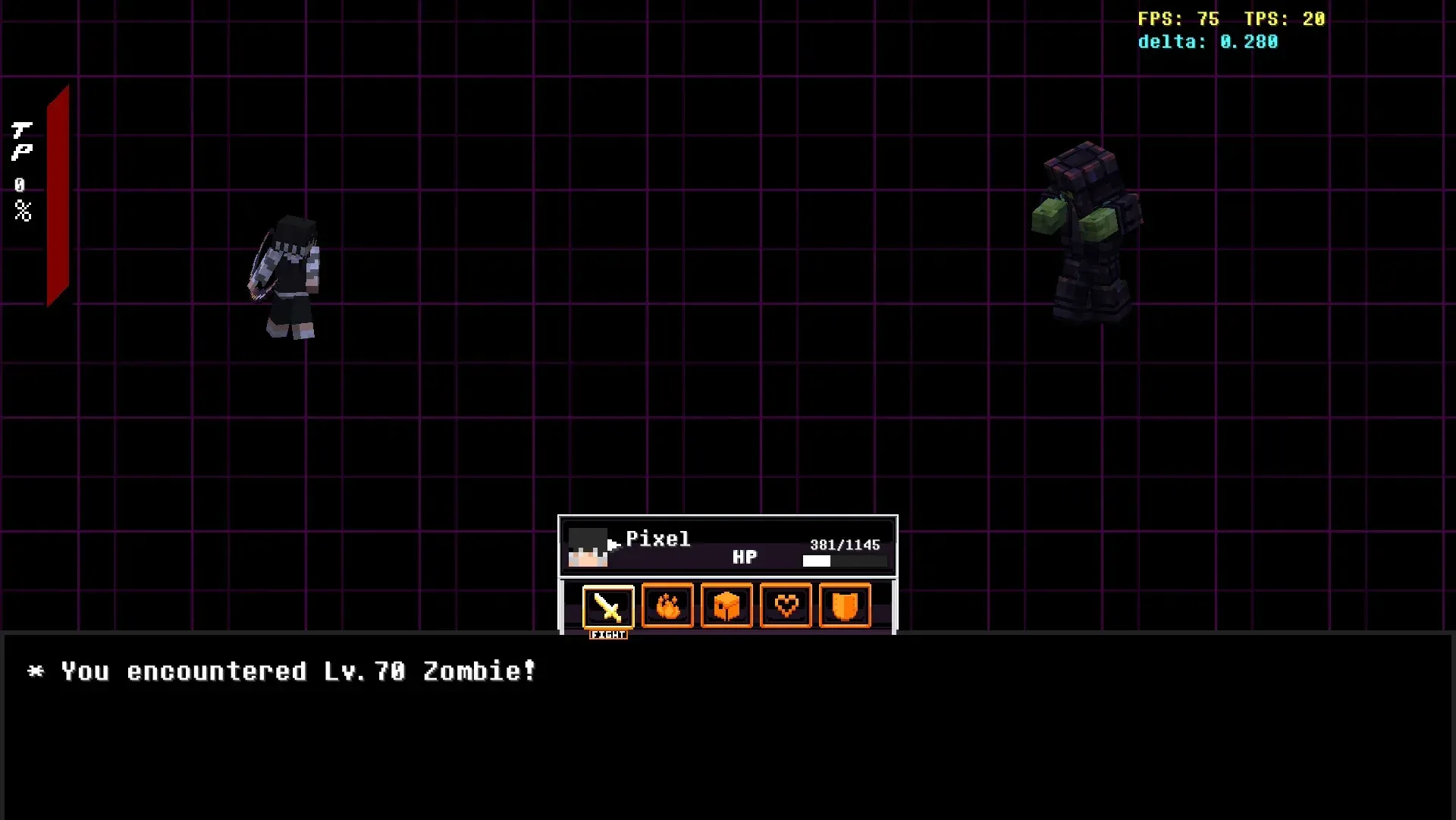
Minecraft is built around a wonderfully direct survival-game loop: gather materials, make tools, build shelter, and fend off whatever is attempting to remove you from that shelter. Combat is part of that loop, but Soulbound takes the bold position that swinging a weapon at a hostile creature need not be the final word. Pixelcite’s Minecraft mod instead remakes combat as a turn-based role-playing system visibly inspired by Undertale and Deltarune.
That is a far more ambitious change than adding a weapon or adjusting enemy damage. Soulbound reframes encounters around RPG decisions, character setup and active dodging. Its recent 2.0 update has helped push the project into wider view: the mod has reached 140,000 downloads on Modrinth after being released roughly seven months earlier.
The result is not simply Minecraft wearing a familiar RPG costume. The available details point to a mod that attempts to connect a structured battle system to Minecraft’s open-ended world, while also adding its own themed, procedurally generated dimensions. For players who want Minecraft’s building and exploration alongside more deliberate fights, Soulbound’s pitch is unusually specific: bring a prepared character build, then survive an encounter that asks for more than good aim and a full hunger bar.
A combat overhaul rather than another weapon mod
Many Minecraft combat modifications focus on the moment-to-moment mechanics of attacking: new gear, altered moves or extra effects. Soulbound goes much further by changing what combat fundamentally is. Rather than treating a battle as a continuous exchange in the overworld, it uses turn-based RPG structure associated with Deltarune.
Turn-based combat means players make choices in discrete phases instead of acting continuously. That distinction matters because it makes preparation and selection part of the fight itself. A player can consider a combat option before committing, rather than relying solely on reflexes, positioning and repeated attacks. It also gives character-building decisions a clearer job: the choices made before entering the world can affect the options available once a battle begins.
Soulbound’s character creation reportedly includes allocating statistics, selecting buffs and choosing between several combat styles. Those systems introduce a vocabulary that vanilla Minecraft does not usually foreground:
- Stats are character values that define or modify capabilities.
- Buffs are beneficial effects or bonuses applied to a character.
- Combat styles imply different approaches to encounters rather than a single universal fighting method.
That combination makes Soulbound sound closer to an RPG framework installed inside Minecraft than a small combat add-on. It asks players to establish an identity for their character before the first confrontation. In practical terms, that can make a new world feel less like a blank slate in combat terms and more like the beginning of a build: a set of choices that can shape how the player approaches danger.
The mod also populates the otherwise familiar Minecraft setting with human enemies. The contrast is part of the appeal. A player can still begin in a blocky sandbox world, but an encounter can shift into an entirely different kind of game language: menus, turns and avoidance patterns.
Bullet hell brings the action back during enemy attacks
Turn-based does not mean passive. Soulbound incorporates original bullet-hell attack patterns in its battles. Bullet hell is a term for action sequences in which players navigate dense or carefully arranged waves of projectiles. In the battle systems that inspired Soulbound, these sequences turn an enemy’s attack phase into an active dodge challenge.
That hybrid is central to why the concept fits better than a simple genre swap. The player pauses to make RPG decisions, then must react in real time when it is time to defend. Thoughtful choices and mechanical execution become complementary rather than competing demands. The system retains a sense of action without making every encounter depend on Minecraft’s usual repeated swings.
Importantly, the attack patterns described for Soulbound are original. The mod’s influences are overt, and it can be adjusted to resemble EarthBound, but the project is not presented as a direct attempt to transplant another game wholesale into Minecraft. That distinction is meaningful in a crossover-heavy modding scene. Borrowing a recognizable design language is one thing; building a combat system that has to operate in a sandbox with its own rules is another.
For prospective players, the practical implication is straightforward: Soulbound is likely to appeal most to people who enjoy both character planning and reactive dodging. A Minecraft player seeking only faster or more elaborate melee may find the structural change larger than expected. Someone who finds standard encounters repetitive, however, may see the additional decision-making as the whole point.
Dark worlds turn the sandbox into a themed RPG space
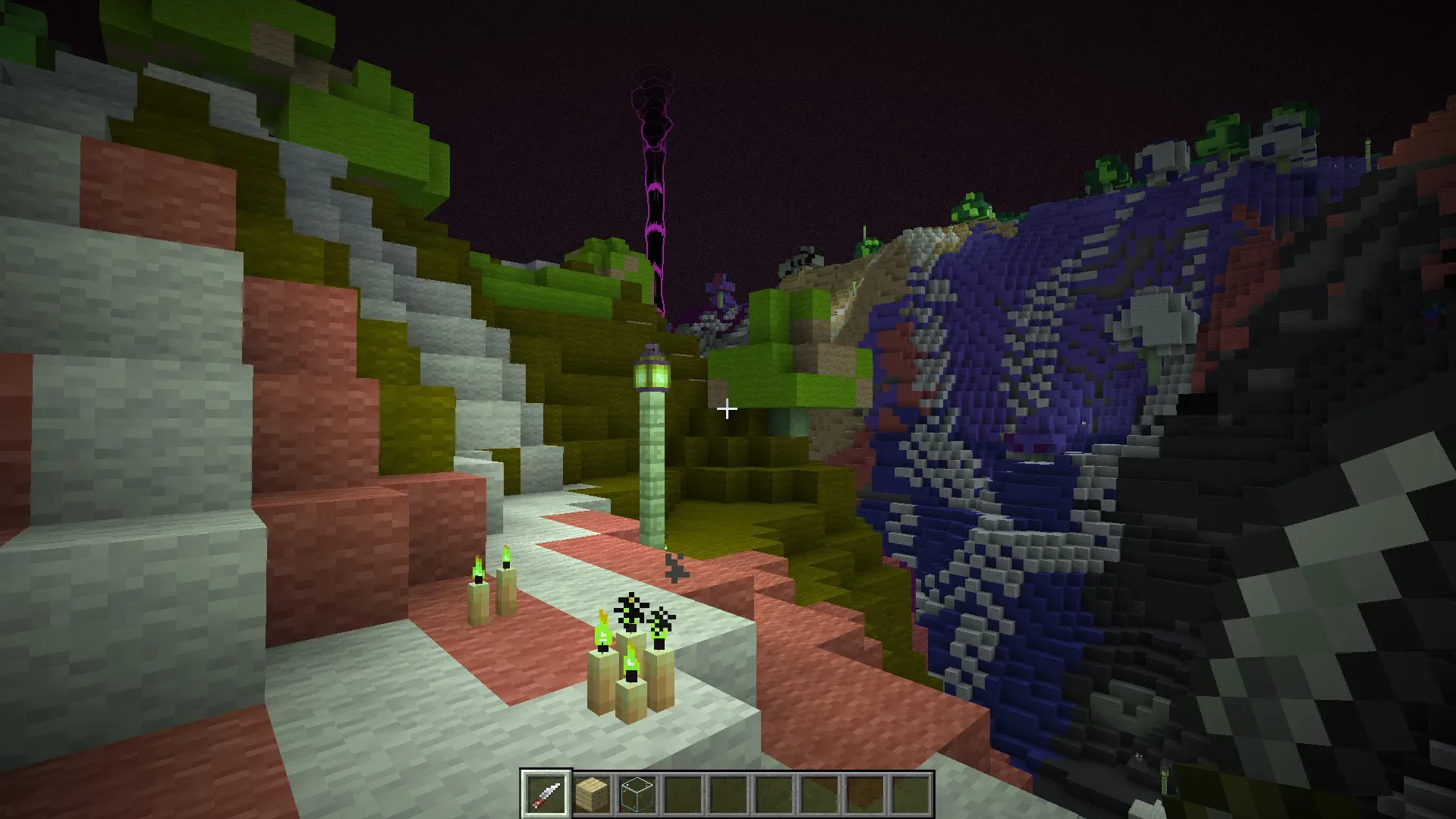
Soulbound’s other headline feature is the ability to create dark worlds. In Deltarune, dark worlds are alternate dimensions. Soulbound adapts that idea as procedurally generated Minecraft worlds with themes that the player can choose.
Procedural generation refers to content being created through systems and rules rather than being entirely hand-built area by area. Minecraft already relies heavily on generated worlds, so the idea of a generated alternate dimension is a natural fit for the base game’s sandbox identity. What makes Soulbound’s version notable is the thematic control layered over that generation.
One example is a wool-themed dark world created by stabbing the ground of a makeshift hut with a knife. That image communicates the mod’s playful, theatrical interpretation of its inspirations: mundane Minecraft materials can become the seed for an unfamiliar realm. Rather than offering only a standard overworld with modified combat, Soulbound gives players a route into spaces designed around a selected theme.
This feature may also be where the mod’s two sides—Minecraft sandbox and turn-based RPG—meet most effectively. Minecraft encourages players to create places, experiment with materials and give personal meaning to a build. The dark-world system appears to turn that instinct into a world-generation prompt. The player is not merely entering a preselected dungeon; they are involved in defining the premise of the destination.
There are still sensible limits to what can be concluded from the available information. Specific dark-world themes beyond the wool example, the full rules governing their creation and their long-term progression are not established here. But customizable themed dimensions are a substantial idea on their own, particularly beside a combat overhaul that already pushes the game beyond its standard survival structure.
Why the 2.0 update appears to be the turning point
Soulbound was released around seven months before the recent 2.0 update, but that major update is the point at which the mod’s visibility accelerated. Its 140,000 Modrinth downloads show strong interest in the project, though a download total should not be confused with a measure of active players or a review score. It is best read as evidence that a considerable number of people have chosen to obtain it.
The timing makes sense. A large-numbered update can be an effective moment for a mod to reach new players, especially when the mod’s core premise is easy to explain. “Minecraft, but with a Deltarune-style turn-based battle system” is immediately legible, while the character creation and dark worlds give that elevator pitch more substance.
It also arrives at a moment when game mashups can attract attention simply by invoking major games. Soulbound’s more encouraging quality is that its reported systems are connected. Character stats support turn-based battles; bullet-hell defense gives those battles active tension; customizable dark worlds give the Minecraft sandbox a themed destination. The pieces point toward a coherent design rather than a list of references.
Players interested in role-playing games with ambitious systems may also want to keep an eye on other PC-facing projects in the genre, including The Lich Wars and its long-span Gothic RPG premise. Soulbound’s approach is distinctly different, of course: its identity depends on modifying an existing sandbox rather than building a standalone RPG world.
What is known—and what is not—about generative AI claims
The scale of Soulbound has prompted questions about whether generative AI helped make it. Messages from moderators in the project’s Discord server have said that it was not developed with generative AI. Modrinth also requires uploaders to disclose generative-AI use.
Those are relevant pieces of information, but they are not identical to a direct statement from the lead developer. A request for confirmation from that developer did not receive a response. The careful reading, then, is that moderators have denied generative-AI assistance and that the hosting platform has an AI-disclosure requirement; direct developer confirmation was not available in the supplied information.
That nuance is worth keeping. “Generative AI” is a broad label for systems that produce material such as text, images, code or audio from prompts and patterns in data. Claims about its use in a project should be separated from assumptions based on a mod’s size, polish or popularity. Soulbound’s systems can be discussed on their own merits without treating technical ambition as proof of a particular production method.
A more considered kind of Minecraft crossover
Soulbound’s central achievement, based on the features described so far, is not that it recognizes two influential RPGs. It is that it selects elements that can create a new rhythm within Minecraft. The standard loop of exploring and building remains the stage, while character-building, turn choices and projectile dodging reshape what happens when danger arrives.
Its dark worlds push that integration further by making alternate dimensions procedural and player-themed rather than merely decorative. Add the reported range of combat styles and the mod has a premise with room for players to approach it differently, not just observe a novelty once.
That is a promising answer to the question of how radically a Minecraft mod can alter combat without abandoning Minecraft entirely. Soulbound does not appear content to drop another game’s surface onto blocks. It uses familiar RPG ideas to give the blocky world a different set of stakes, decisions and places to go.