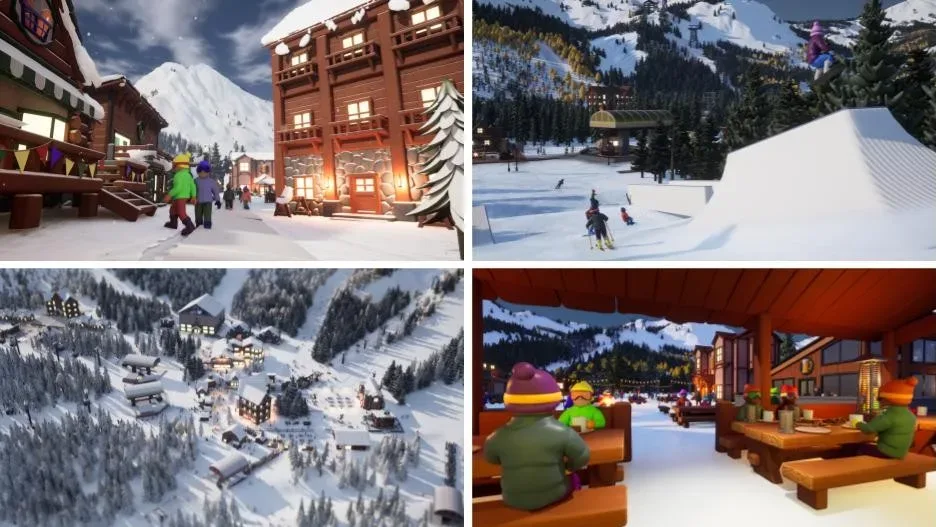
Ski-E-O! Resort Tycoon has updated its demo ahead of Steam Next Fest, bringing several additions that sharpen the game’s identity as a mountain-building and operations simulation. The refreshed demo is live now and will be playable during the event, running from October 19 through October 26, before the game heads toward Steam Early Access.
The headline features are Terrain Parks, double black runs, and cliff jumps, all of which give prospective resort operators more options for defining what kind of mountain they want to build. The update also introduces a restoration scenario: rather than beginning with a blank canvas, players take over a neglected mountain and work to restore it. New animations for guests and slopes round out the demo revision.
That package matters because Ski-E-O! is not framing skiing terrain as a set of interchangeable tiles. Its core premise is a non-grid system in which trails are painted directly onto a mountain using real-world environments and actual elevation data. In a genre full of building games where players snap pieces neatly into squares, the promise here is a messier, more topographical design problem—one shaped by the mountain already beneath the player’s cursor.
A demo update built around terrain identity
Terrain Parks, double black runs and cliff jumps are three distinct additions, but together they expand the range of experiences a resort can offer. A Terrain Park is generally a designated area built around features and jumps for riders and skiers looking for that style of run. Within Ski-E-O!, its addition signals that resort planning extends beyond simply routing visitors from the top of a slope to the bottom.
Double black runs occupy the other end of the accessibility spectrum. The name denotes the most advanced category of ski trail, so their presence gives players a way to designate especially demanding terrain. Cliff jumps add an even more dramatic route-shaping option. The announcement does not spell out how guests evaluate, use, or avoid these features, and it is important not to assume systems that have not been detailed. But their inclusion clearly broadens the visual and structural vocabulary available when creating a ski area.
For a management game, that variety can be important even before the financial or operational layer enters the picture. A resort with only straightforward slopes risks becoming visually uniform. Adding specialist spaces and expert terrain lets players establish contrast between beginner-friendly zones, conventional routes, park-focused sections, and high-difficulty mountain faces. The question for demo players will be how naturally those choices fit the contours of each mountain.
The restoration scenario changes the starting question
The new scenario may be the update’s most useful addition for players who prefer a defined management challenge to starting entirely from scratch. Instead of asking only, “What should this resort become?”, the restoration setup asks a more immediate question: “What can be saved and improved here?”
Taking responsibility for a neglected mountain creates a scenario with a built-in theme and a clear direction. It gives the act of construction a purpose beyond expansion, while still leaving room for players to determine how they want the revitalized resort to look. The available information does not identify the mountain’s starting facilities, objectives, failure conditions, or progression structure. Still, the scenario establishes a different kind of creative constraint, which is often valuable in a simulation where open-ended building can otherwise feel daunting.
Related coverage includes Ski-E-O! Resort Tycoon Demo Adds Terrain Parks and Restoration Scenario.
The inclusion of new guest and slope animations is also notable in this context. Management simulations often need to communicate whether an operation feels alive, and animated visitors and active slopes can help make a resort’s changing state readable at a glance. No specific behaviors have been outlined, so these additions should be understood as presentation updates rather than confirmation of new guest-management mechanics.
What “non-grid” building means for Ski-E-O!
Grid-based construction systems organize a game world into fixed squares or tiles. They can make placement legible and tidy, but they can also limit how closely paths, buildings, or terrain features follow a natural landscape. Ski-E-O! instead uses a non-grid approach for trails, with players painting runs directly onto the mountain.
In practical terms, that means the available topography should be central to design rather than merely a backdrop. A run’s route can follow the shape of a slope instead of following a square-by-square construction pattern. Because the game uses actual elevation data, the mountain is intended to bring its own physical character to the problem of resort layout.
“Actual elevation data” refers to information about changes in height across a location. In this setting, it supports mountains that reflect real changes in incline and relief rather than entirely flat or abstract terrain. The announcement identifies the environments as real-world mountain settings, though it does not specify which individual mountains will appear in the demo or at launch.
The emphasis on terrain makes Ski-E-O! a potentially appealing fit for players who enjoy planning routes as much as placing infrastructure. It also distinguishes the game from another kind of construction project, such as the miniature scene-building focus of Hokko Spaces. Both center creative building, but Ski-E-O!’s design is tied to slope, snow and winter operations rather than arranging a contained diorama.
Snow is presented as an operating system, not scenery
The game’s snowpack simulation is a major part of that simulation pitch. A snowpack is the accumulated layer of snow on the ground. Here, it is GPU-simulated, meaning the game uses a graphics processing unit for the simulation work. A GPU is the component commonly associated with rendering graphics, but it can also be used for certain large-scale calculations that benefit from substantial parallel processing.
What matters to players is not simply the terminology. Ski-E-O! connects its snow system to dynamic weather and several resort responsibilities: snow depth can change, grooming is affected, and snowmakers may be needed. Snow depth is self-explanatory at a basic level—the amount of snow covering a surface—but it becomes operationally meaningful when trail conditions and maintenance depend on it.
Groomers are the machines used to prepare and maintain ski slopes. Snowmakers are used to produce artificial snow when natural conditions are not sufficient. The announcement does not establish precise rules for weather patterns, machine costs, staffing, damage, or guest reactions. It does establish the more important broad principle: winter conditions are meant to affect how a resort is maintained rather than serving as a static visual filter.
That creates a useful tension at the heart of the game’s concept. Players are offered creative control over trails and resort character, but the mountain and its weather are not entirely under their control. A plan that looks elegant on a map still has to coexist with snow conditions and the work of keeping slopes prepared.
A worldwide launch ambition
At launch, Ski-E-O! is planned to feature mountains across major ski regions worldwide. The regions and areas cited include Utah, the Colorado Rockies, the Sierras, the Pacific Northwest, Japan, the Alps, the Andes, Canada, Australia, New Zealand and China.
This is an ambitious geographic spread, and it is relevant to the game’s central use of real-world elevation data. Different regions should offer different mountain contexts in which to approach trail design, though no individual terrain specifications or mountain roster have been confirmed. For now, the list is best read as the intended scope of the launch offering, not a detailed map selection guide.
The planned breadth also reinforces why a flexible, direct trail-painting system is a sensible match for the project. If mountains vary widely in shape, a fixed-grid approach could struggle to preserve their character. A system centered on following terrain theoretically gives the designer more room to respond to each location’s distinct layout.
What Steam Next Fest players can assess
Steam Next Fest provides the immediate opportunity to see how these systems combine in the updated demo. The event window runs October 19–26, while the demo itself is already live. Players interested in the game can focus on a few concrete questions without expecting the demo to answer every Early Access or launch question.
- How intuitive is it to paint and revise trails across uneven terrain?
- Do Terrain Parks, expert runs and cliff jumps make mountains feel meaningfully different from one another?
- How clearly does the game communicate snow depth, weather changes, grooming needs and snowmaking pressure?
- Does the restoration scenario provide satisfying direction while preserving room for individual design decisions?
- How effectively do the new animations help convey a working, populated resort?
Those are usability and design questions rather than promises about content breadth. The announcement does not provide an Early Access date, a full launch date, or a final feature list beyond the planned regional mountain scope. It does, however, give the demo a substantially clearer set of features to explore before the game’s arrival in Early Access.
A gameplay trailer accompanies the demo update, offering another look at the project’s mountain-resort premise. Between the new scenario and more varied trail options, Ski-E-O! is using its Steam Next Fest build to show that its simulation is about more than laying down ski runs: it is about deciding what a resort is for, working within the terrain available, and responding to the conditions that make mountain operations unpredictable.