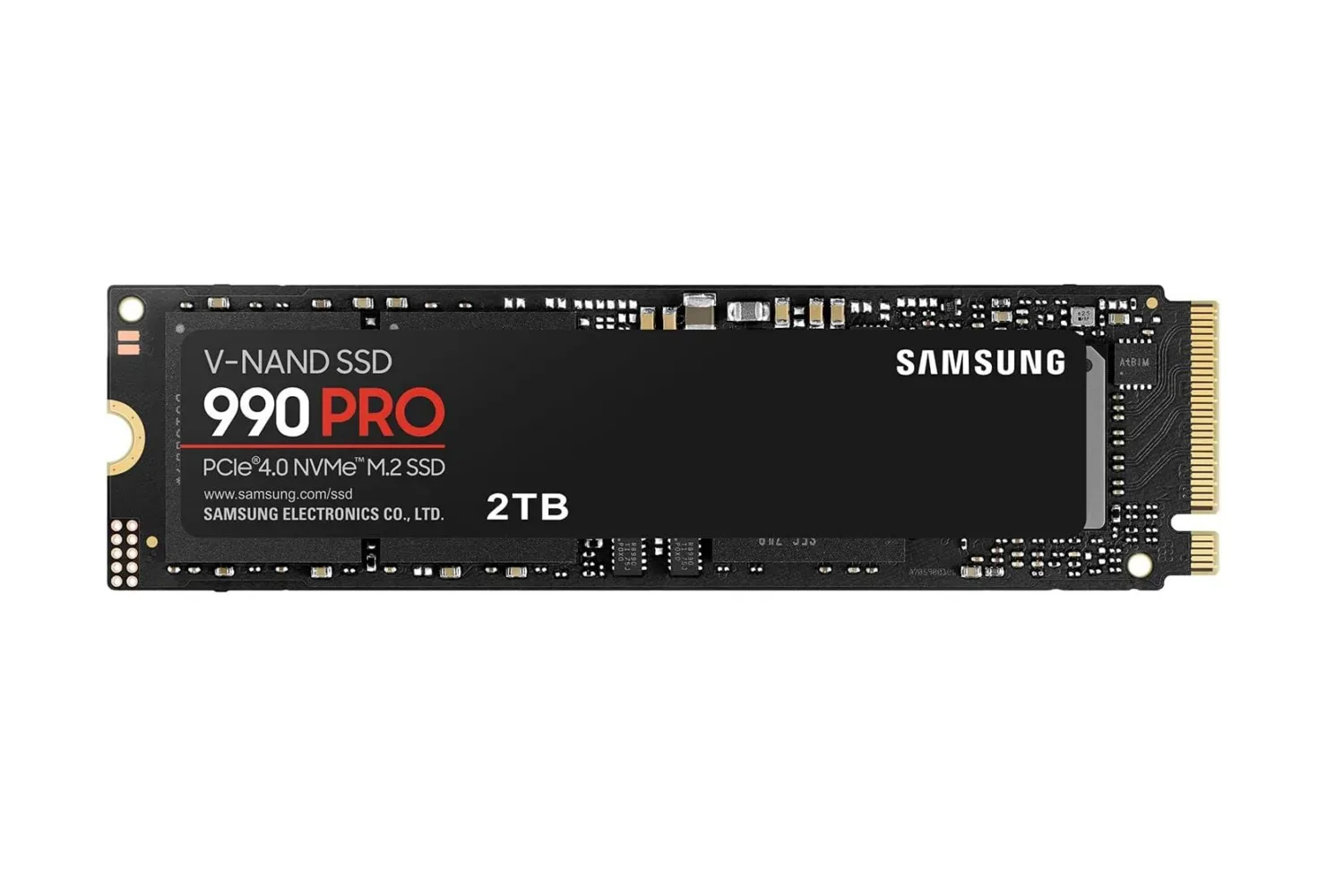
A high-capacity NVMe SSD is still not a casual impulse buy, particularly while NAND flash memory supply pressure is pushing storage prices upward. That context makes the current Amazon listing for Samsung’s 2TB 990 Pro Gen4 SSD notable: it is listed at $385, compared with a stated usual price of roughly $640. That is a $255 reduction, or about 40% off the referenced price.
The saving does not suddenly make a 2TB premium drive cheap. It does, however, change the conversation for people already considering a storage upgrade and finding recent SSD prices difficult to justify. The listing does not specify when the price will end, so it should be treated as a changeable retailer price rather than a fixed promotion.
What is being discounted
The product is Samsung’s 990 Pro Gen4 in a 2TB capacity. It is an NVMe SSD, meaning it is a solid-state drive designed around the NVMe protocol rather than a conventional spinning hard disk. In practical terms, SSDs are used to make file access, application launches and data transfers feel more responsive than storage that must physically move a disk head to find information.
“Gen4” refers to the drive’s PCIe generation. It is useful shorthand for the platform class Samsung is targeting, but it should not be treated as a promise that every system will see the same benefit. Storage performance depends on the whole setup and workload. The material available here does not establish device-by-device compatibility, installation requirements or measured transfer results, so buyers should verify those details for their own hardware before purchasing.
Samsung positions the 990 Pro around fast performance for larger applications, demanding software and heavier data work. Its cited comparison is a claimed 55% improvement in random performance over the earlier 980 Pro. That is a manufacturer claim, not an independently supplied benchmark result, but it identifies the type of work the upgrade is intended to address.
Why random performance is worth paying attention to
Storage specifications can become a wall of jargon quickly. Random performance is one of the more relevant concepts for everyday computing because it concerns lots of smaller data requests spread across a drive, rather than one uninterrupted copy of a huge file.
Opening a substantial application, loading its assorted assets, working through project files and letting the operating system handle background tasks can involve many requests that are not arranged neatly in a single sequence. A drive with stronger random performance is intended to handle that scattered activity more effectively. That is why Samsung’s comparison with the 980 Pro is framed around resource-intensive applications and larger workloads rather than just a single headline speed figure.
It is important not to overextend that claim. A stated gain in one performance category does not mean every task will finish 55% faster, nor does it tell us how a particular game, creative application or PC will behave. It does indicate that the 990 Pro’s upgrade case is not solely about copying one large file from point A to point B.
Related coverage includes Samsung 990 Pro 2TB SSD Drops to $385 in Limited Amazon Deal.
2TB is capacity as well as speed
The other meaningful part of this listing is the capacity. A 2TB drive offers room for a mixture of work files, media and personal projects without forcing everything into separate storage immediately. For a PC owner whose existing SSD is filling up, that can be as important as the performance tier.
Storage decisions are often presented as a simple race for faster hardware, but capacity affects day-to-day convenience too. More room can reduce the need to constantly choose what stays installed or where larger files live. That does not mean every shopper needs 2TB; it means this model is directed at people for whom multiple kinds of data need to coexist on a single drive.
The 990 Pro line is also offered in 1TB and 4TB versions, and both were discounted at the time this price was noted. No prices for those capacities are supplied here, so the 2TB model is the only version with a clear value comparison: about $640 regularly versus $385 at the listed deal price.
Drive health and updates: what Samsung Magician is for
Samsung includes support for its Magician software, which is described as a tool for checking a drive’s overall health, applying available updates and optimizing performance. Those functions are useful to separate from the SSD itself.
Drive health is the broad idea of monitoring the storage device’s condition. The software is intended to give the owner visibility into that status rather than leaving the drive as a completely opaque component. Firmware updates are updates for the drive’s internal software, potentially delivered after purchase when available. The supplied information does not say that an update is currently required, only that the software can install them.
The optimization option is similarly a management feature, not a guarantee of a universal speed boost. Its purpose is to let users tailor performance handling through Samsung’s software. For someone who values maintenance tools and status visibility, that ecosystem may be part of the appeal alongside the capacity and claimed performance uplift.
Thermals matter for consistency
Samsung also highlights thermal control intended to prevent overheating during use and support stable, consistent operation. Heat management is a practical consideration for performance storage because a component that gets too hot may not sustain its best behavior through prolonged demand. The key claim here is consistency, not a promise of unlimited performance under every possible condition.
That distinction matters when weighing an expensive drive. Peak figures are appealing, but people using heavier applications may care just as much about whether storage remains dependable while the workload continues. The supplied details support Samsung’s focus on efficient thermal control, though they do not provide operating temperatures or comparative thermal test results.
How to read the $385 price
The discount is substantial relative to the stated regular price, but it needs the right framing. First, the listing remains a $385 purchase. Buyers who only need a modest amount of extra space, or whose system does not make meaningful use of a Gen4 NVMe drive, should not assume a large percentage reduction automatically makes it the best fit.
Second, the broader NAND flash shortage is relevant. NAND flash is a core component of solid-state drives, and constrained supply has contributed to higher SSD pricing. Against that backdrop, a steep reduction on a higher-end 2TB drive may be especially appealing to someone who had already delayed an upgrade because storage had become more expensive.
Third, deals without a published end date can move quickly. There is no supplied indication of an expiration time, inventory level or guarantee that the $385 price will remain available. The sensible takeaway is not that everyone should rush to buy one; it is that shoppers who have already decided this capacity and class of drive suit their needs should recheck the live listing before making a decision.
For readers comparing broader PC purchases, our look at the Kamrui GK3PLUS Mini PC’s gaming limits and discount is a reminder that a lower price is only one part of evaluating hardware. The same principle applies here: the 990 Pro’s price cut is real, but capacity needs, system fit and the kind of work being done should determine whether it is worthwhile.
Who this offer appears to suit
- People already planning a 2TB SSD upgrade: The $255 reduction is most relevant when the capacity is genuinely needed.
- Users handling larger files or demanding applications: Samsung specifically positions the drive for heavier workloads and cites stronger random performance than the 980 Pro.
- Owners who want software management tools: Samsung Magician is described as providing health monitoring, updates and optimization options.
- Buyers mindful of sustained operation: Thermal control is presented as a feature for stable, consistent use.
Conversely, this offer is less obviously compelling for someone who simply wants the lowest-cost storage expansion, needs neither 2TB nor premium performance, or has not confirmed that the drive is appropriate for their machine. The source material establishes the deal, the product’s stated strengths and the wider pricing pressure; it does not establish that this SSD is the right upgrade for every PC.
At the listed $385 price, Samsung’s 2TB 990 Pro is a materially less expensive entry into this capacity and performance class than its roughly $640 usual price suggests. In a market affected by NAND flash constraints, that is the central reason to pay attention. Just treat the discount as time-sensitive, verify fit before checkout and evaluate the drive as a 2TB Gen4 NVMe purchase—not merely as a large percentage off a headline number.
Shop the products
Check current price, model and availability at the retailer.