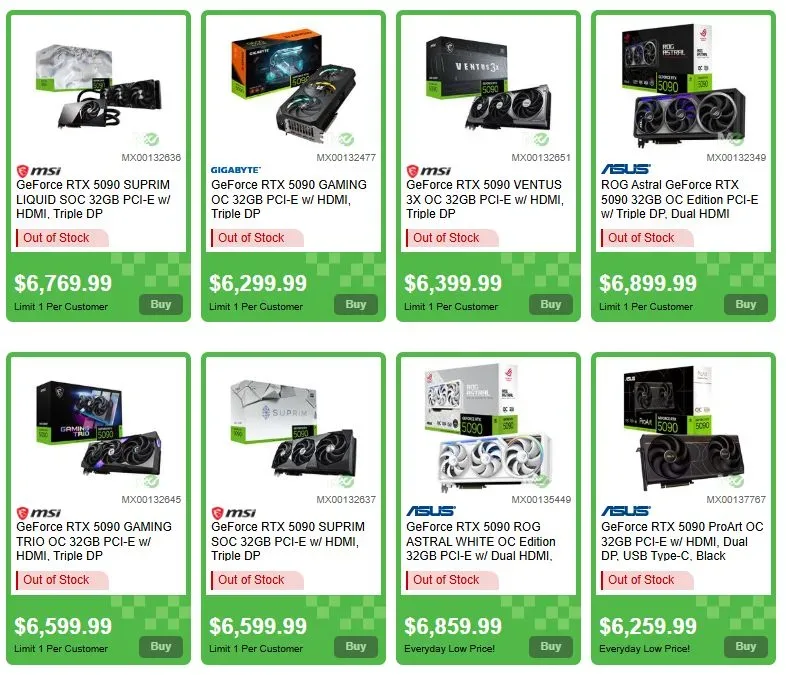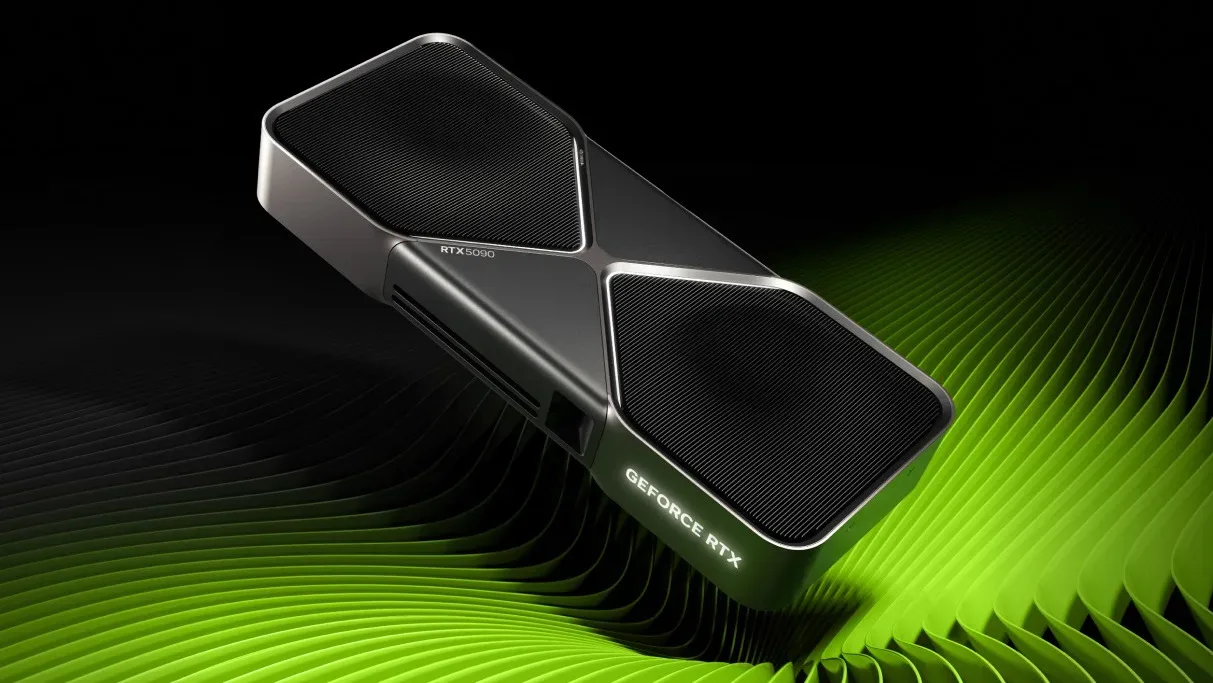
The Nvidia GeForce RTX 5090 is supposed to represent the sharpest end of consumer PC graphics, but current U.S. retail pricing has pushed it into a category that is difficult to describe as normal enthusiast hardware. Two 32GB RTX 5090 models—the Asus ROG Astral and TUF Gaming versions—are listed in stock at $7,494.99 apiece at Best Buy.
That figure matters not merely because it is big. It is the retailer’s listed base price for available cards, rather than the familiar case of an opportunistic marketplace seller attaching a startling markup to a scarce product. For people putting together a gaming PC, it turns a component that already launched at the extreme end of the market into a purchase approaching workstation territory.
Nvidia’s intended RTX 5090 MSRP was $1,999 when the card arrived in January 2025. The current $7,494.99 listings are therefore about 3.75 times that figure. Put another way, the difference alone is roughly $5,496—far more than the original suggested price of the GPU itself.
The price is not an isolated listing
Other recent RTX 5090 pricing points in the same direction. Gigabyte’s AORUS RTX 5090 was last listed at $6,899 on Amazon before going out of stock. Historical tracking for that listing shows a $4,888 price at launch and a low of $3,885. Even that lower tracked figure sat substantially above the $1,999 intended MSRP, illustrating the core problem: the nominal launch price and the price a buyer could realistically find have been separated for a long time.
The newest visible price is especially striking because flagship GPUs more commonly become easier to find, and often less expensive, as time passes. The RTX 5090 is now more than a year and a half beyond its January 2025 debut, yet supplies are still described as exceptionally thin across major U.S. retail options. Nvidia’s own store shows no available stock, while many other searches lead to out-of-stock pages rather than credible alternatives.
In a scarcity market, an in-stock listing gains leverage simply by existing. That does not make a $7,500 RTX 5090 a sensible value for most players; it explains why the ordinary habit of shopping around may not produce a meaningful lower price. A buyer can see a much smaller number attached to the launch MSRP, but MSRP is a manufacturer’s suggested reference point, not a guarantee that a given card can be bought at that amount.
Why the RTX 5090 is unusually exposed
The 5090 is Nvidia’s top general-market GPU and carries 32GB of video memory, usually abbreviated as VRAM. VRAM is the fast dedicated memory on a graphics card used to hold the visual data a game needs while rendering: textures, buffers, geometry-related data and other assets. Capacity by itself does not define gaming performance, but it is one of the specifications separating this flagship from lower-tier hardware.
Demand from AI-focused server operations is cited as the larger pressure behind today’s constrained GPU supply. That demand sits alongside the long-running pattern of non-gaming buyers competing for high-performance graphics hardware, previously including cryptocurrency mining. The practical result for gaming buyers is simple: consumer demand is no longer the only force determining whether premium GPUs reach shelves at approachable prices.
Related coverage includes RTX 5090 Prices Have Reached $7,500 as High-End GPU Stock Stays Scarce.
It is important not to overstate what the listed price proves. A $7,494.99 tag does not establish that every RTX 5090 transaction occurs at that amount, nor does it reveal precisely how supply is allocated throughout the chain. It does show that retail availability for certain in-stock cards has reached a level that makes the flagship difficult to treat as a normal upgrade option.
At roughly $7,500, the RTX 5090’s retail tag is not just a luxury premium. It is a signal that availability, rather than conventional generational price movement, is setting the terms of the purchase.
The RTX 5080 is available, but it is not a like-for-like substitute
For builders who still want a current Nvidia high-end option, the RTX 5080 is reported to be much more widely available, starting around $1,700. That is still a painful amount for a single PC component, particularly considering the RTX 5090’s $1,999 intended MSRP. Yet it is markedly closer to a feasible purchase than a flagship listing near $7,500.
Buyers should not mistake the 5080 for a small compromise, however. It is described as roughly 50% less powerful than the 5090, with half the cores, half the VRAM and half the memory bandwidth.
Memory bandwidth is the rate at which the GPU can move data to and from its memory. High bandwidth can be important when workloads need the graphics processor to move large amounts of visual data quickly. Cores, meanwhile, are the GPU’s parallel processing resources. These specifications do not automatically translate into a fixed frame-rate ratio in every game, but the stated hardware gap explains why the 5090 sits in a distinct class rather than simply serving as a lightly faster 5080.
The RTX 5080 also has a more manageable power proposition. The 5090 is associated with the need for a 1200W power supply unit, or PSU. A PSU converts wall power into the electricity required by the PC’s components, and its wattage rating describes the amount of power it can supply. A prospective 5090 purchase can therefore involve more than the card’s extraordinary sticker price; it may require checking whether the existing system’s power supply is appropriate. The 5080 can be run without stepping up to a 1200W PSU, though the source material cautions that it will not deliver top-specification 4K performance.
What PC builders can take from the numbers
The immediate lesson is to separate a product’s launch MSRP, a historical low, a current listing and actual availability. Each answers a different question:
- MSRP is a baseline suggested by the manufacturer. It is useful for judging the scale of a markup, but it may not be an obtainable checkout price during a shortage.
- A historical low shows that a lower price existed at some point. It does not mean stock will return there soon.
- A current in-stock listing shows what a buyer can potentially obtain immediately, but can be heavily shaped by scarcity.
- An out-of-stock listing is not a practical alternative, regardless of how attractive its last recorded price may look.
That distinction is especially valuable with the RTX 5090. A buyer seeing $1,999 in old launch materials and $3,885 as a prior tracked low could reasonably expect a current price somewhere in that neighborhood. The available evidence instead shows a market where the reachable price for certain cards has climbed to $7,494.99.
For many gaming-focused builds, that makes postponement or a lower tier the more rational decision than treating the flagship as mandatory. The RTX 5080’s availability does not erase its steep starting cost or its technical gap from the 5090. Still, it demonstrates that the supply crunch does not affect every model identically. A build plan should begin with the performance target and the total system budget, not with the assumption that the highest-numbered card is automatically viable.
Those holding on to an existing PC also have a reason to take its upkeep seriously while the upgrade market is distorted. Protecting files, saves, screenshots and other local data is a separate task from buying new hardware, but it becomes more relevant when replacing a machine or rebuilding a system is less attractive. Our guide on safer storage for old hard drives and digital collections outlines why physical storage conditions deserve attention.
A strange point in the GPU cycle
The prolonged status of the RTX 5090 is part of what makes the current moment unusual. The card remains Nvidia’s newest consumer flagship despite launching in January 2025. There is no stated timing for the next 6000-series, codenamed Rubin, to arrive in home desktops. Rubin workstation cards are available, but are said to cost around $15,000 or more—well beyond the needs and budgets of typical gaming-PC buyers.
That leaves the RTX 5090 in an awkward position. It is neither a newly launched product with a short-term availability scramble nor an older card steadily sliding toward better value. It is an established flagship whose supply remains scarce enough for major retail listings to soar far above its original intended price.
For now, the most meaningful RTX 5090 specification may be neither its 32GB of VRAM nor its performance lead. It is its availability. In a normal market, a gamer compares cards on price, power requirements and performance. In this one, the first question may be whether a card can be found at all—and the answer can carry a price tag closer to $7,500.
Shop the products
Check current price, model and availability at the retailer.