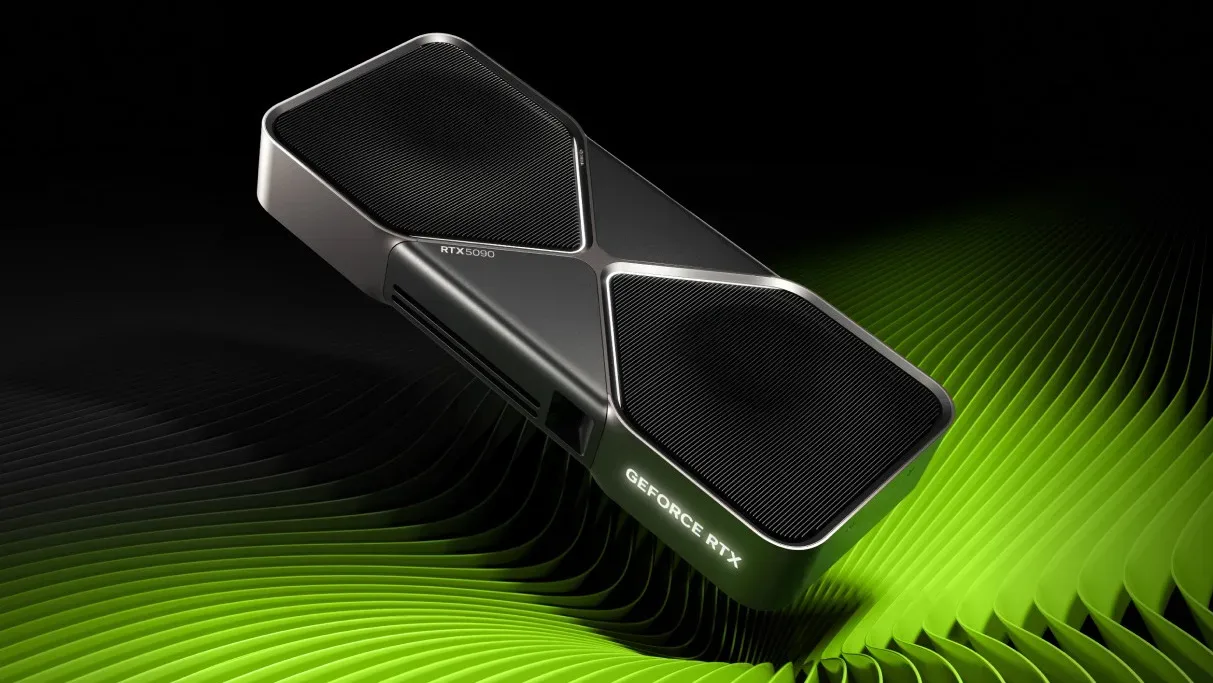
The GeForce RTX 5080 has disappeared from Nvidia’s GeForce Marketplace, adding another major warning sign for PC players trying to buy a high-end graphics card during the ongoing memory shortage. The card has not been formally declared discontinued, and Nvidia has not confirmed a replacement. Still, its absence from the company storefront, following apparent RTX 5090 availability issues, leaves the RTX 5070 Ti as the most powerful consumer GPU currently purchasable through Nvidia’s marketplace.
That shift matters because the RTX 5070 Ti is not behaving like a normal step-down option on price. It launched in 2025 at $749, but listed pricing on Nvidia’s storefront has climbed to at least $1,299. The RTX 5070, which launched at $549, is listed from at least $849. In a market this distorted, moving down a product tier does not necessarily mean paying less than the launch price of the tier above it.
For buyers specifically hunting an RTX 5080, cards can still be found at retailers, but the available prices illustrate how constrained the market has become. One MSI Call of Duty: Modern Warfare 4 edition RTX 5080 was listed for $1,899, compared with the GPU’s $999 launch price. At Micro Center, RTX 5080 listings were marked for store pickup only; the least expensive Gigabyte Windforce model was listed at $1,979, with that model unavailable at every New York location checked.
What has changed for the RTX 5080?
The clearest confirmed change is the listing status: Nvidia’s own marketplace no longer shows the RTX 5080. That does not, on its own, establish that production has ended. A product can disappear from a storefront for many reasons, including a lack of inventory or a revised sales plan. But the change has landed amid broader pressure on graphics-card supply, and it follows indications that the RTX 5090 has also become unavailable.
The practical result is straightforward: players should not treat an RTX 5080 purchase as routine at the moment. The remaining retail supply may vary sharply by model and location, and advertised prices are far above launch MSRP.
MSRP, or manufacturer’s suggested retail price, is the reference price established at launch. It is not a promise that every board-partner card will sell at that price, but it is useful for judging the scale of today’s increases. An RTX 5080 at $1,899 is $900 above its $999 launch price. The cited $1,979 store-pickup listing is $980 higher. Those are close to double the launch figure before buyers consider whether a specific retailer actually has a card available in their area.
The 24GB RTX 5080 rumor, explained
A supply-chain report has suggested Nvidia could discontinue the original 16GB RTX 5080 and replace it with a 24GB version as soon as December. This remains unconfirmed. Nvidia has not announced a 24GB RTX 5080, specifications, timing, pricing, or even that the 16GB model has reached the end of its run.
The numbers refer to the card’s onboard graphics memory, commonly called VRAM (video random-access memory). VRAM is memory located on the graphics card itself. It holds data the GPU needs to access quickly, such as game textures and other visual assets. It is distinct from a PC’s normal system RAM, though both are affected by wider memory-market conditions.
Related coverage includes RTX 5080 Vanishes From Nvidia Storefront as GPU Prices Spiral Toward $2,000.
Moving from 16GB to 24GB would mean 50% more VRAM capacity. Capacity alone, however, is not a complete measure of a graphics card’s performance. It does not tell buyers what GPU configuration, memory speed, power requirements, game performance, or final price a rumored model would have. More importantly in this case, the extra capacity would require more high-performance memory at a time when that component is under particular supply pressure.
That makes the rumor a double-edged possibility. A replacement could create a new route for RTX 5080-class availability. But it would not automatically make the card easier or cheaper to buy. With memory costs elevated, a 24GB model could arrive at an even steeper price than the original’s $999 launch MSRP.
Why memory availability is central to the problem
Modern graphics cards depend on dedicated, high-performance memory. The market’s RAM shortage has therefore affected GPUs especially hard. Each high-end card needs a significant amount of memory, and the pressure grows with higher-capacity configurations. Samsung, which manufactures much of Nvidia’s graphics memory, has said the RAM shortage is expected to worsen in 2027.
For shoppers, that wider context is more useful than assuming a disappearing listing means a straightforward generational transition. The reported plan for an RTX 50 Super series had previously been rumored, then reportedly halted in February because of the RAM shortage. That history does not confirm any current 24GB RTX 5080 plan, but it does show why a prospective mid-generation refresh may be unusually difficult to bring to market in a normal, affordable way.
GPU means graphics processing unit: the main processor on a graphics card responsible for rendering game visuals and handling other graphics workloads. A board partner model, such as the MSI and Gigabyte cards currently listed by retailers, combines Nvidia’s GPU with its own cooler, board design, and sometimes a game-themed finish or bundle. These variations can affect pricing even in a stable market. Under constrained supply, the difference between launch MSRP and actual shelf price can become vastly larger.
What PC gamers should take from the current listings
The evidence supports caution, not certainty. It is reasonable to say that the RTX 5080 is exceptionally scarce through Nvidia’s direct marketplace and costly where it remains available. It is not yet possible to state as fact that it has been discontinued, that a 24GB revision will launch, or that any particular December or CES 2027 timetable will happen.
- Do not mistake listing availability for broad supply. A card visible at a retailer may be pickup-only, unavailable in a nearby store, or priced far beyond its launch MSRP.
- Compare against launch price, not just adjacent cards. The RTX 5070 Ti’s current minimum listed price of $1,299 exceeds the RTX 5080’s $999 launch price, despite being the lower product tier.
- Treat a rumored 24GB model as unannounced. It may never arrive in the reported form, and more VRAM would not guarantee better value under the present memory conditions.
- Separate need from scarcity anxiety. A $1,899 to $1,979 RTX 5080 is a dramatically different proposition from the $999 product introduced at launch.
For players who do not need a high-end desktop card immediately, the present market makes patience a practical consideration. That does not mean prices will definitely improve; the available information points in the opposite direction for memory conditions in 2027. It does mean that paying an extreme premium now is a choice to buy immediate access, not evidence that the card’s underlying launch value has doubled.
Players considering a smaller or more portable alternative are seeing a different kind of inventory picture in the handheld space, where the Retroid Pocket Classic’s remaining vertical handheld stock is also reportedly running low. It is not a substitute for an RTX 5080-equipped gaming PC, but it is another reminder that availability and pricing can change quickly across gaming hardware categories.
An expensive gap at the top of the stack
Nvidia’s marketplace now presents an unusual gap: the RTX 5070 Ti is the highest-end consumer model available there, while the RTX 5080 and RTX 5090 appear to be out of reach through that channel. Retail listings show that the RTX 5080 is not wholly gone, but its remaining supply looks increasingly like a niche purchase for buyers willing to pay a substantial premium and navigate location-specific stock.
Whether Nvidia is preparing a 24GB replacement or simply dealing with a vanishingly tight supply of the existing model, the near-term message is the same. The RTX 5080 is no longer a readily available $999-class graphics card. Until Nvidia provides a formal update, buyers should view claims of discontinuation and replacement plans as reports rather than settled facts—and judge every listing by its actual price, availability, and local fulfillment terms.