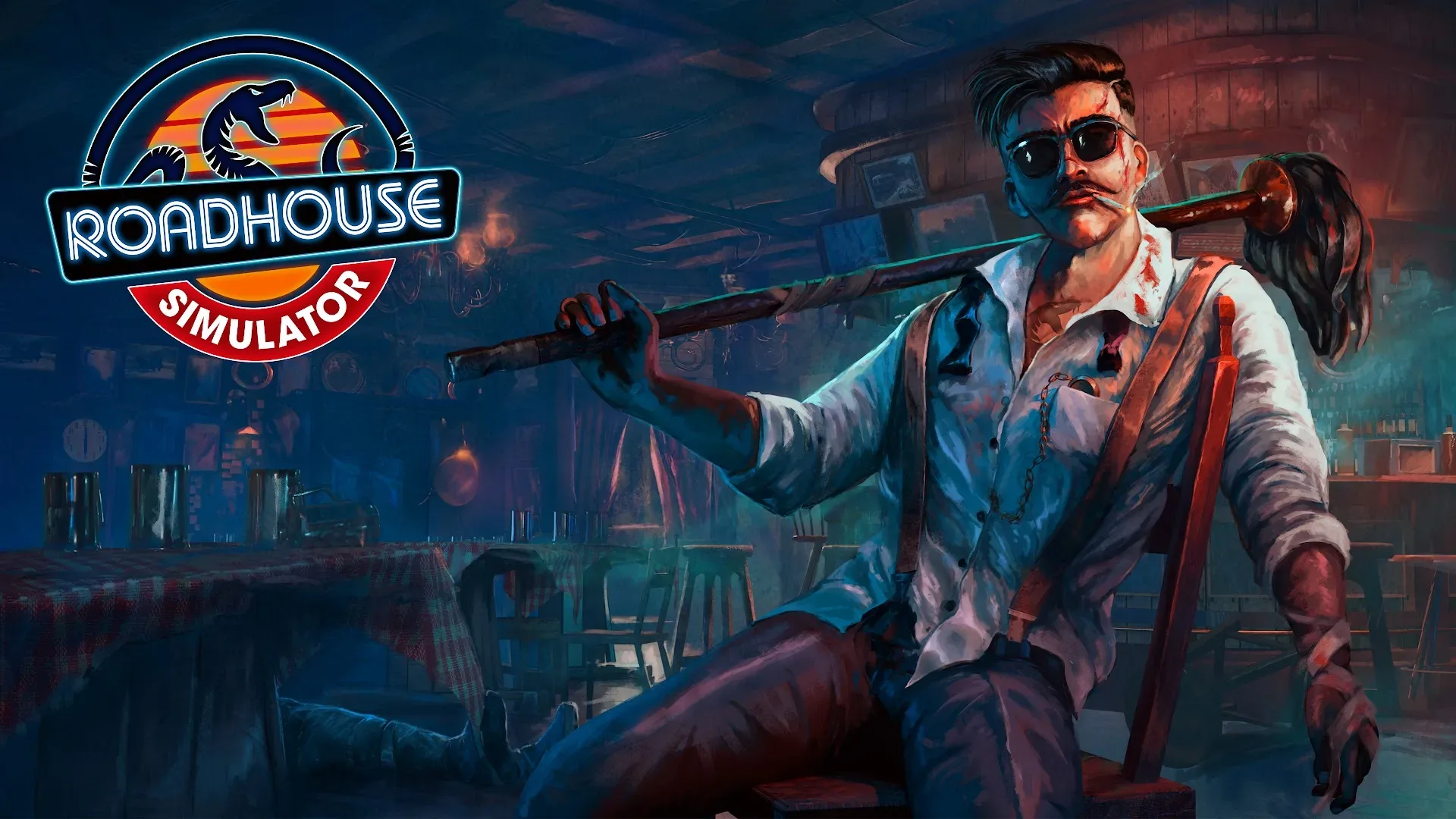
Roadhouse Simulator is now available on PC through Steam, giving the roadside-management formula of Gas Station Simulator a considerably rowdier new setting. Developed by DRAGO Entertainment, the game is priced at $19.99 and casts players as the Uncle, a familiar character whose past is explored in this prequel.
The broad premise is less “quietly balance the books” and more “keep the bar open while the books acquire a criminal record.” Players begin at the door as a bouncer before working toward ownership of a run-down Route 66 roadhouse. The intended climb extends beyond restoring a bar: the business can grow into a small biker empire, with management systems, customer behavior, reputation and territory all part of the equation.
A free Prologue arrived in May, followed by a Demo in August. Both remain available on Steam alongside the full release, offering a way to sample its particular blend of hospitality work, personal distilling, gang dealings and fisticuffs before committing to the complete game.
From the road to staying put
Roadhouse Simulator is a prequel to the 2-million-selling Gas Station Simulator, but its starting point signals a different kind of management fantasy. The previous game’s roadside setting emphasized keeping a business alive on the move. Here, the central idea is putting down roots in one location and making that location matter.
That distinction is important. A roadhouse is not presented simply as a shop counter with new wallpaper. It is described as a social hub and a contested piece of turf, where the player is responsible for serving people, feeding them, maintaining supplies and deciding how the establishment interacts with shadier opportunities around it. The game’s Route 66 backdrop and outlaw tone frame the business as a place that has to earn its standing.
“Gas Station Simulator was about survival on the road. Roadhouse Simulator is about everything that happens once you decide to stay,” said Lucjan Mikociak, Studio Head at DRAGO Entertainment.
For returning players, the Uncle’s presence provides the clearest link between the two games. Roadhouse Simulator explores his origin story, giving the character’s path from bouncer to proprietor a role beyond merely serving as a convenient player avatar. For newcomers, the setup is also straightforward: take over a dilapidated roadside joint, make it successful and deal with the colorful consequences.
A management game with a short fuse
Its feature list suggests that Roadhouse Simulator wants routine work and volatile complications to coexist. At the ordinary end, players tend bar, master the grill and stock supplies. Those are recognizable duties in a business-management game: there are customers to serve and an operation to keep running.
But the stated systems immediately add complications. Drinks affect customers differently, meaning beverage service is positioned as something more involved than selecting an item and collecting payment. The supplied details do not specify the exact outcomes of those reactions, so it is best not to presume how far those effects reach. Still, the mechanic implies that what is served can alter the mood or conduct of the people inside the roadhouse, potentially making service choices part of managing the room rather than a purely transactional task.
Players can also distill, improve and bottle their own liquor. In management-game terms, distilling means producing spirits rather than only reselling stock; improving and bottling indicate that the game has a production chain attached to the bar’s drink business. Exactly how recipes, upgrades or quality are measured has not been detailed, but the feature helps separate the roadhouse’s operations from a basic restaurant or retail loop.
The food side is similarly hands-on in concept. Mastering the grill sits alongside bartending and supply stocking, creating an operation where players are expected to handle several kinds of hospitality labor rather than delegate every job from a top-down menu. That mix could appeal to players who enjoy moving between direct tasks and larger business decisions, though the extent of automation or staff management has not been outlined.
Not every revenue stream passes inspection
The legal and illegal sides of the business are a major part of Roadhouse Simulator’s premise. Players can choose legitimate or shady business decisions while avoiding sheriff inspections. The game also includes stashing, packaging and delivering “questionable cargo,” a deliberately broad description that establishes risk without laying out precise mission structures.
That choice-driven framing is worth separating from a promise of a fully branching narrative. The available details confirm legitimate-versus-shady decisions and the need to evade inspections; they do not establish the number of endings, the permanence of consequences or the exact form those decisions take. What can be said is that the roadhouse’s business model is not restricted to conventional food-and-drink service, and players will face pressure from law enforcement when they take illicit routes.
The same applies to gangs, reputation and territory. These are management elements rather than incidental scenery: the game specifically lets players manage all three. Reputation, in this context, generally means the standing of a business or character in the surrounding world; territory means control or influence over an area. Roadhouse Simulator’s description links both systems to gangs, making the roadhouse’s success feel tied to the people and power structures around it, not only to how many drinks leave the bar.
That gives the title a potentially distinct tension. A clean, well-stocked operation may be one aspect of keeping the doors open, while relationships, turf and the sheriff form another. The game’s central fantasy is therefore not simply renovation. It is building enough authority to turn a neglected stop on the highway into a place with a local name and a local reach.
When diplomacy runs out, there are punches
Roadhouse Simulator does not present violence as the only answer to trouble, but it certainly presents it as an available answer. Players can de-escalate situations or throw punches, and an underground Fight Club is among the activities listed for the full game. The bouncer-to-owner arc makes that duality logical: protecting the door is part of the character’s starting identity, while operating the establishment is the longer-term goal.
The key word is de-escalate. It means reducing a conflict instead of escalating it into a confrontation. Its inclusion suggests that encounters may offer players a choice in approach, even in a game that openly advertises brawling. No further details have been provided about the combat system, encounter frequency or the ramifications of peaceful handling, so prospective players should not read more precision into that feature than has been announced.
Along with the Fight Club, the activity list includes pig races, gambling, slot machines and Hype Girls. These diversions reinforce the sense that the roadhouse is meant to be more than a counter, kitchen and storeroom. It is being built as a destination with entertainment, risk and a deliberately unruly atmosphere. Whether players view that as a welcome layer of character or as chaos in need of careful supervision will likely depend on how much they want their simulation games to mingle business work with disorder.
Who this Steam release may suit
The clearest audience is players interested in a management game that favors a rougher theme over a sterile storefront. Roadhouse Simulator combines familiar operational activities—stocking, cooking, serving and producing goods—with social pressure, illicit commerce and physical conflict. Its setting also offers a change of pace from business sims built around polished malls, cozy cafés or abstract spreadsheets.
Fans of Gas Station Simulator have the most obvious reason to look closely, since this is a prequel set in the same world and centered on the Uncle’s earlier story. But prior knowledge is not described as necessary. The upward progression from bouncer to owner supplies a self-contained objective, while the growth from a decrepit road stop to a biker empire gives the experience an intentionally larger destination.
It is also a PC-only release as currently stated, with Steam as the listed platform. Players considering where to run it may want to keep an eye on broader gaming-PC developments, including recent news around Acer’s Predator Atlas 8, though no hardware requirements for Roadhouse Simulator are included here.
What is available now
Roadhouse Simulator launched on Steam for PC on September 21, 2026, at $19.99. The full game includes its roadhouse ownership progression, drink effects, liquor production, food and supply duties, gang and territory management, sheriff-inspection pressure, questionable cargo, entertainment activities and the option to talk down or fight through confrontations.
The free Prologue and Demo remain available on Steam. That matters for a game with such a specific tonal mix: players can investigate its approach to bartending, business building and roadside mayhem directly, rather than trying to infer whether “pig races plus territory management” is their preferred form of entrepreneurial education.
For a closer look at its setup and tone, the official launch trailer is also available. Just remember: the bar may be on Route 66, but the route to ownership appears to involve enough inspections, illicit deliveries and fistfights to make a normal franchise application look positively relaxing.