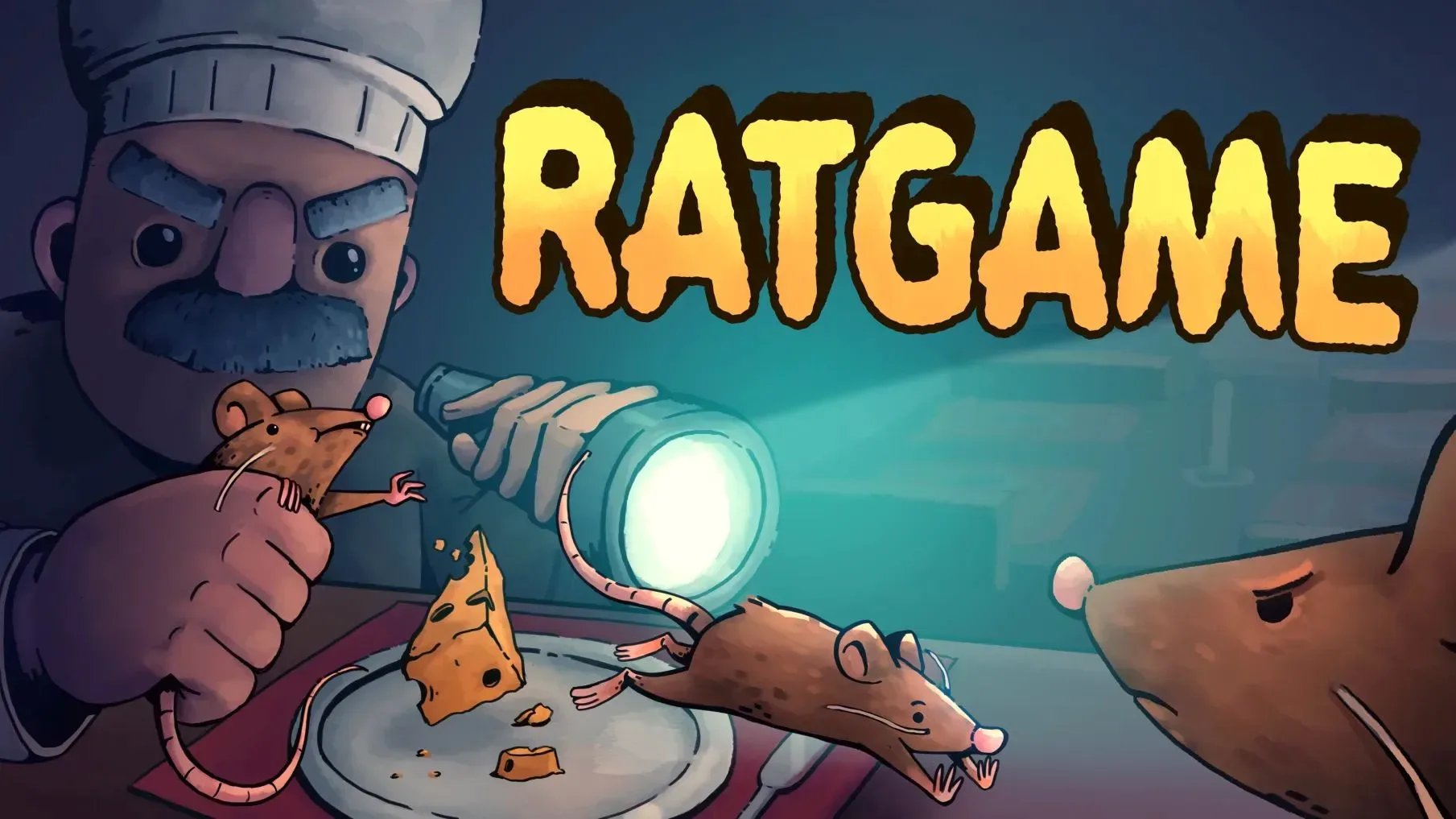
Rat Game has launched on PC, bringing a notably grubby spin to asymmetrical multiplayer: one player can become the restaurant’s Chef, while two to seven others play a pack of Rats determined to make the establishment spectacularly unfit for service. The premise sits between comedy and horror. The rodents are not merely escaping a kitchen; they are actively sabotaging it, while the Chef listens for them, catches them and cages them.
There is also a co-op-only alternative for groups that would rather unite against the restaurant than argue over who gets the intimidating apron. In that mode, players face ROBO CHEF, a robot-controlled Chef. That distinction matters because Rat Game is not confined to the standard human-versus-human format: a group of rat players can work together without needing another player to fill the opposing role.
The game was developed by Aran Koning, part of Sokpop. Its sound design and dynamic music come from Tumult Kollektiv: Alexander van der Kruijf, Jonathan Howe and Leonhard van Voorst.
A restaurant is the battlefield, not the backdrop
The Rats’ objectives are built around wrecking the restaurant’s operations. Their listed acts of sabotage include nibbling through wires, clogging toilets and hacking the staff computer. Rather than presenting the rats as fragile intruders with only a single escape goal, the game makes them a disruptive team with several ways to create trouble across the map.
The setting is described as an interconnected map containing shortcuts, hidden scurryways and many secrets. In practical terms, an interconnected map is a space whose rooms and routes join up in multiple ways rather than a simple chain of areas. That makes navigation knowledge valuable: a rat that knows a hidden scurryway may avoid a direct pursuit route, while a Chef who understands where paths reconnect can try to intercept rather than follow.
Those hidden routes are especially suited to the game’s uneven sides. Rats are a group with a numerical advantage, potentially seven players strong, while the Chef is alone. A conventional chase through obvious corridors would make the Chef’s job uncomplicated to describe, if not necessarily easy to perform. Shortcuts and concealed passages instead create opportunities for escape, regrouping and misdirection. They also give the Chef an incentive to learn the building rather than simply react to the latest visible rat.
That structure gives the sabotage list more significance than a collection of silly restaurant gags. Damaging wires, blocking facilities and accessing a computer suggest that rat players can spread their attention across the building. Coordination could mean splitting up to create simultaneous problems, or concentrating on one target while teammates watch routes and draw the Chef away. The exact systems surrounding each action have not been detailed, so it is too early to assume how long tasks take, what consequences each has or whether all sabotage is required in a given round. But the basic design direction is clear: chaos is intended to be cooperative.
What “asymmetrical co-op” means here
Asymmetrical multiplayer describes a mode in which competing sides do not have identical roles, numbers or tools. Rat Game’s stated format is one Chef versus two to seven Rats. One side is a solitary hunter and the other is a pack of smaller saboteurs. Their goals and moment-to-moment concerns naturally differ: the Rats move around the restaurant and work together to break things, whereas the Chef attempts to locate, capture and contain them.
Related coverage includes Rat Game Brings 1-vs-7 Restaurant Sabotage to PC.
The asymmetry is also tonal. The premise of rodents clogging a toilet is deliberately absurd, but being pursued through a restaurant by a Chef who can cage you adds pressure. That mix is why comedy-horror is an appropriate label. The game is built around a ludicrous situation, while its sound-focused pursuit and last-one-standing emphasis create the conditions for tense moments.
For the Chef, the crucial stated tool is listening. Scrabbling claws can give the rats away, transforming sound into information. The Chef is also said to have a gun available somewhere on the map, although the details are deliberately limited: its location, use and effect have not been specified. It should therefore be treated as a possible element of a match rather than a fully explained core mechanic.
For Rats, numbers do not automatically equal safety. A larger team can cover ground and make more noise, but that same activity may give a listening Chef more clues. The game’s focus on last-one-standing gameplay suggests that survival pressure can narrow the action as a round progresses. The supplied information does not establish the exact win conditions, respawn rules or what happens after a rat is caged, so players should not read more into that phrase than a stated emphasis on the tension of remaining alive when others are out.
Sound is part of the contest
Rat Game includes dynamic sound design, a dynamic soundtrack and squeaky proximity chat. These are related features, but they do different jobs.
- Dynamic sound design means the game’s sound effects can respond to what is happening rather than playing as a fixed, unchanging audio layer. Here, the central stated example is the Chef hearing rats’ scrabbling claws.
- A dynamic soundtrack is music designed to shift with play rather than simply loop in the same form. No specific triggers have been outlined, but the feature points to music that supports changing tension.
- Proximity chat is voice communication tied to players’ in-game distance. “Squeaky” proximity chat fits the rat premise while making communication potentially more exposed than a private team-wide voice channel.
That third point could be particularly important to the game’s social texture. In a proximity-chat setup, players may need to think about when and where they speak, because distance can shape who hears them. Rat Game’s announcement does not spell out the range, audibility rules or whether opposing roles can hear every conversation, so those technical specifics remain unknown. Still, the inclusion of proximity chat alongside sound-based hunting indicates that audible behavior is meant to be part of the drama, not just a convenience layer for coordinating a team.
The sound team’s role is consequently more central than a credits footnote. If the Chef is expected to listen for small movement sounds and the soundtrack changes with the action, audio helps establish both the mechanical readability and the comedy-horror mood. A restaurant full of tiny, destructive intruders needs noises that communicate danger to the Chef and excitement to the rats without losing the absurdity of the situation.
Human Chef or ROBO CHEF
Rat Game offers two distinct ways to encounter the Chef role. In the standard asymmetrical setup, a human player can take control of the Chef against the Rats. This is the competitive option, with one person trying to use sound, movement and capture to stop a coordinated group.
Alternatively, a pack can select the co-op-only mode and oppose ROBO CHEF. The information available identifies ROBO CHEF as robot-controlled, but does not describe its behaviors, difficulty settings or how its decision-making differs from a human opponent. What can be said is that the mode removes the need to recruit a Chef player, allowing the rat side to play as a unified group against an automated threat.
That option has a straightforward practical benefit for a game designed around an uneven player count. A party does not need to decide who must leave the rat team to become the lone opponent. Groups can either embrace the competitive 1-versus-many structure or remain on the same side. With support for two through seven Rats, the game can accommodate considerably different group sizes within its stated format.
Anyone looking for another recent PC release can also browse Neuron Activation’s PC launch, though its rapid-fire micro-challenge format is a very different proposition from Rat Game’s restaurant stalking and sabotage.
What is confirmed, and what remains open
The confirmed outline is unusually easy to grasp: a restaurant map, a Chef, a rat pack, sabotage targets, concealed routes and sound-led pursuit. Rat Game supports a 1 Chef versus 2–7 Rats format, or cooperative rat play against ROBO CHEF. It has proximity chat, dynamic music and sound design, and an emphasis on last-one-standing play.
Several important details have not been provided. There is no stated price, no platform information beyond PC, and no detailed explanation of progression, round structure, matchmaking, task requirements or the precise role of the gun. There is likewise no basis to claim how the robot Chef behaves or to rank the game’s modes by difficulty. Keeping those gaps in view is useful: the pitch establishes a strong concept, but its finer competitive rules will need to be learned from the game itself or future official detail.
For now, Rat Game’s identity rests on a pleasingly specific imbalance. The Chef is outnumbered but can hunt by ear. The Rats are vulnerable individually but can collaborate, vanish into scurryways and turn a restaurant’s ordinary infrastructure into a menu of problems. Whether players choose the human Chef conflict or the ROBO CHEF co-op route, the central joke remains wonderfully unappetizing: the restaurant’s smallest residents are finally taking customer complaints into their own paws.