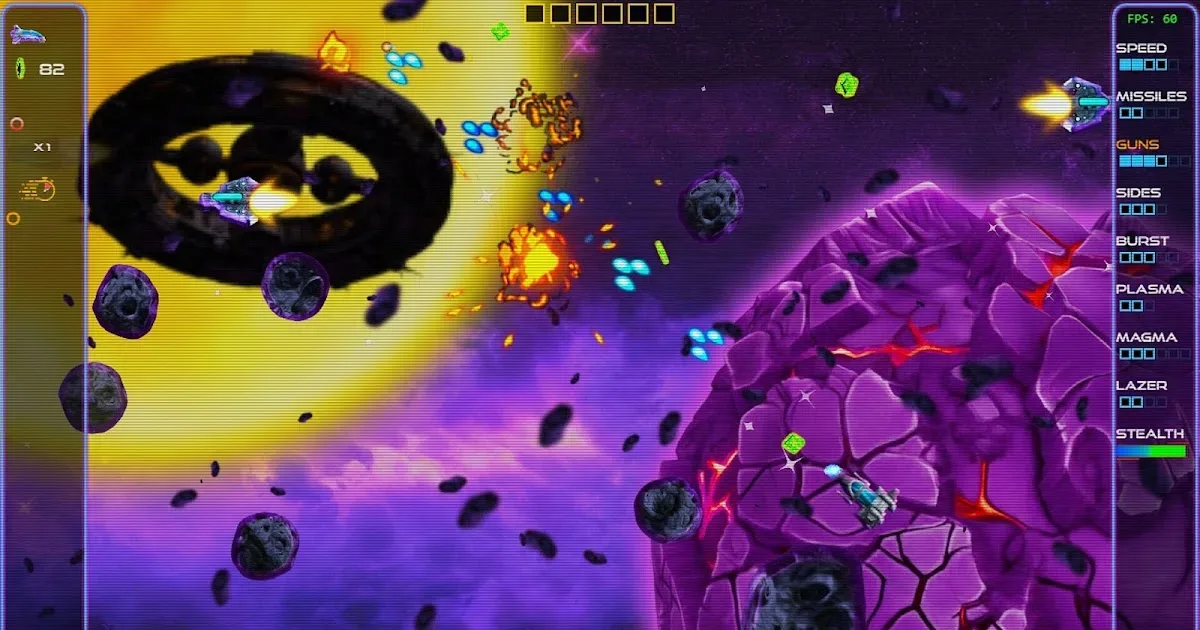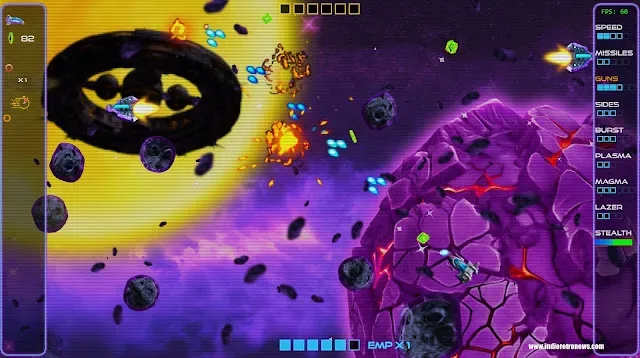
There is a particular kind of arcade game that does not ask for patience so much as it asks whether your thumbs have made peace with panic. Project Nebula, the upcoming PC shooter from MK_Games, is built for that tradition. Planned for Steam in December, it frames its action around 360-degree space combat: a pilot circles huge planetary arenas while alien swarms, asteroid hazards, bosses and a steadily escalating score chase compete for attention.
Its stated inspirations are unmistakably old-school heavyweights. Project Nebula draws from the all-angle survival pressure associated with Asteroids, while also looking toward the fast, orbit-focused destruction of 1990s favorite Super Stardust. That does not mean it is being positioned as a museum piece with a fresh coat of pixels. MK_Games describes hand-crafted HD visuals, a choice between retro-minded and modern modes, and multiple ways to control the action. The pitch is a modern presentation for a format that has always worked best when it stays legible at impossible speed.
A planet-sized arena and a very small margin for error
Project Nebula’s basic setup puts players in command of a starship orbiting a massive planet. The screen is expected to become crowded with alien threats and asteroid-field obstacles, turning movement into more than a way to get from one enemy to another. In this style of shooter, position is survival: drift too close to trouble, leave yourself no route through a swarm, or chase a target for one beat too long, and the whole run can unravel with cosmic efficiency.
The game is designed around high scores, so the objective is not merely to see the end of a level. It is also to improve, survive longer, manage the flow of threats, and turn a seemingly hopeless screen into a run worth putting on a leaderboard. That emphasis matters. A score-driven arcade shooter gives repeat attempts a purpose even when its broad rules are immediately understandable. Every loss can become a lesson in timing, movement, targeting priorities or risk management—usually followed by the solemn declaration that the next run will be the sensible one.
MK_Games says the release will include 100 handcrafted waves across 10 visually distinct planets. Each planet is set to have a boss, and those bosses are described as requiring different tactical approaches. The available details do not spell out each boss’s mechanics, nor do they explain how waves are divided between planets. Still, the structure suggests a campaign with clear milestones rather than an entirely random endurance format. Players should be able to encounter new settings and new major obstacles while continuing to work on the fundamentals of shooting, circling and staying out of the celestial blender.
Classic Mode and Modern Mode offer two routes into the chaos
One of Project Nebula’s more notable planned options is its split between Classic Mode and Modern Mode. Classic Mode is presented as the purer retro option. Modern Mode is described as the feature-rich alternative. Specific differences between the modes have not been detailed, so it would be premature to assume exactly which upgrades, systems or conveniences sit on either side of that divide. But the choice recognizes that arcade descendants can appeal to players with very different appetites.
Some people want the cleanest possible encounter with a score attack: learn the rules, chase the number, and accept that the game is under no obligation to offer a comforting handrail. Others enjoy that core pressure but also want progression, customization and extra systems to engage with. Letting both approaches exist in the same release could make Project Nebula more welcoming without abandoning its high-intensity identity. The real test will be clarity—whether the game communicates what each mode changes and lets players select their preferred flavor of space peril with confidence.
The game is also planned to include extensive ship upgrades. Again, the currently available information does not enumerate individual upgrade paths or explain their effects. Their presence does, however, point to an experience with room for experimentation beyond choosing a direction and holding fire. Whether players focus on one dependable setup or adjust to the demands of a planet and boss, upgrades could become part of the game’s tactical layer. In a genre defined by split-second decisions, even a modest preparation choice can feel enormous once asteroids begin arriving from every available angle.
Three ships, several control options
Project Nebula will offer three distinct starships. No names, loadouts or detailed differences have been confirmed in the available announcement information, but the selection makes sense for a game that leans into replayability. Distinct ships can give returning pilots a reason to reconsider how they approach a familiar sequence of waves, provided their roles are meaningfully differentiated. For now, the safest expectation is simply that three choices are planned; the finer points of how they play remain to be seen.
Control flexibility is another key part of the plan. MK_Games lists twin-stick and keyboard control schemes among the options. That is especially relevant to a 360-degree shooter, where the feel of aiming and movement can define a player’s relationship with the entire game. Twin-stick input is a natural fit for independent movement and firing, while keyboard support gives PC players another route into the action. More schemes are mentioned, although they have not been individually identified.
It is easy to treat control settings as a small menu detail, but in an arcade-focused game they are closer to the steering wheel. A good run depends on how quickly a player can translate intention into motion amid a crowded screen. Giving players alternatives is not a guarantee that every setup will suit every person, but it acknowledges an important truth: nobody wants to blame a promising score run on a control layout that felt like it was negotiating with them in real time.
Hot-seat rivalry and global score chasing
Alongside solo play, Project Nebula is planned to include local hot-seat co-op for friendly competition. The wording leaves room for questions about the exact format, so prospective players should not infer simultaneous co-op details that have not been specified. What is clear is that the game intends to support a local pass-the-controls social angle, one that fits a high-score shooter neatly. A short arcade run can make an excellent living-room challenge: one player posts a number, the next player immediately insists the asteroid pattern was suspiciously favorable, and the controller changes hands.
That local competitive streak pairs with planned global online leaderboards. Leaderboards are a natural home for a game that openly emphasizes score pursuit, because they turn private improvement into a larger contest. Project Nebula’s 100-wave structure, ship selection, upgrades and two-mode setup could give players several reasons to revisit its systems in pursuit of stronger results. Details such as leaderboard categories, reset schedules and anti-cheat measures have not been announced, so the broad promise is simply online ranking rather than a defined competitive ruleset.
For anyone who enjoys the strange, durable etiquette of playing together on one screen or one sofa, local score competition remains hard to beat. It creates a little event out of an otherwise solitary genre, especially when attempts are quick and the failure states are spectacular. Joking Joystick has previously considered the unwritten rules of couch multiplayer; a hot-seat arcade game is practically a laboratory for them. Celebrate a rival’s personal best, certainly. Just do not celebrate so loudly that they fly directly into a rock.
What is confirmed for the Steam release
Project Nebula is currently planned for PC on Steam in December. An exact release date has not been provided in the available information, and no additional platforms have been confirmed. The announced feature set includes:
- 100 handcrafted waves
- 10 visually distinct planets
- Bosses intended to call for unique tactics
- Three starships
- Multiple control schemes, including twin-stick and keyboard
- Classic Mode and Modern Mode
- Ship upgrades
- Local hot-seat co-op for competition
- Global online leaderboards
- A soundtrack described as pounding
That is a substantial checklist for a game whose central premise remains pleasingly direct: orbit a planet, shoot the threats, avoid becoming a new feature of the asteroid field, and do it well enough to want another run. Project Nebula’s ambitions will ultimately rest on the responsiveness of its controls, the readability of its handcrafted chaos and the variety supplied by its planets, ships and boss encounters. Those are questions for the finished release. For now, its December Steam target puts another retro-leaning arcade shooter on the PC calendar—one hoping that classic circular space combat still has enough gravitational pull to keep score chasers in orbit.