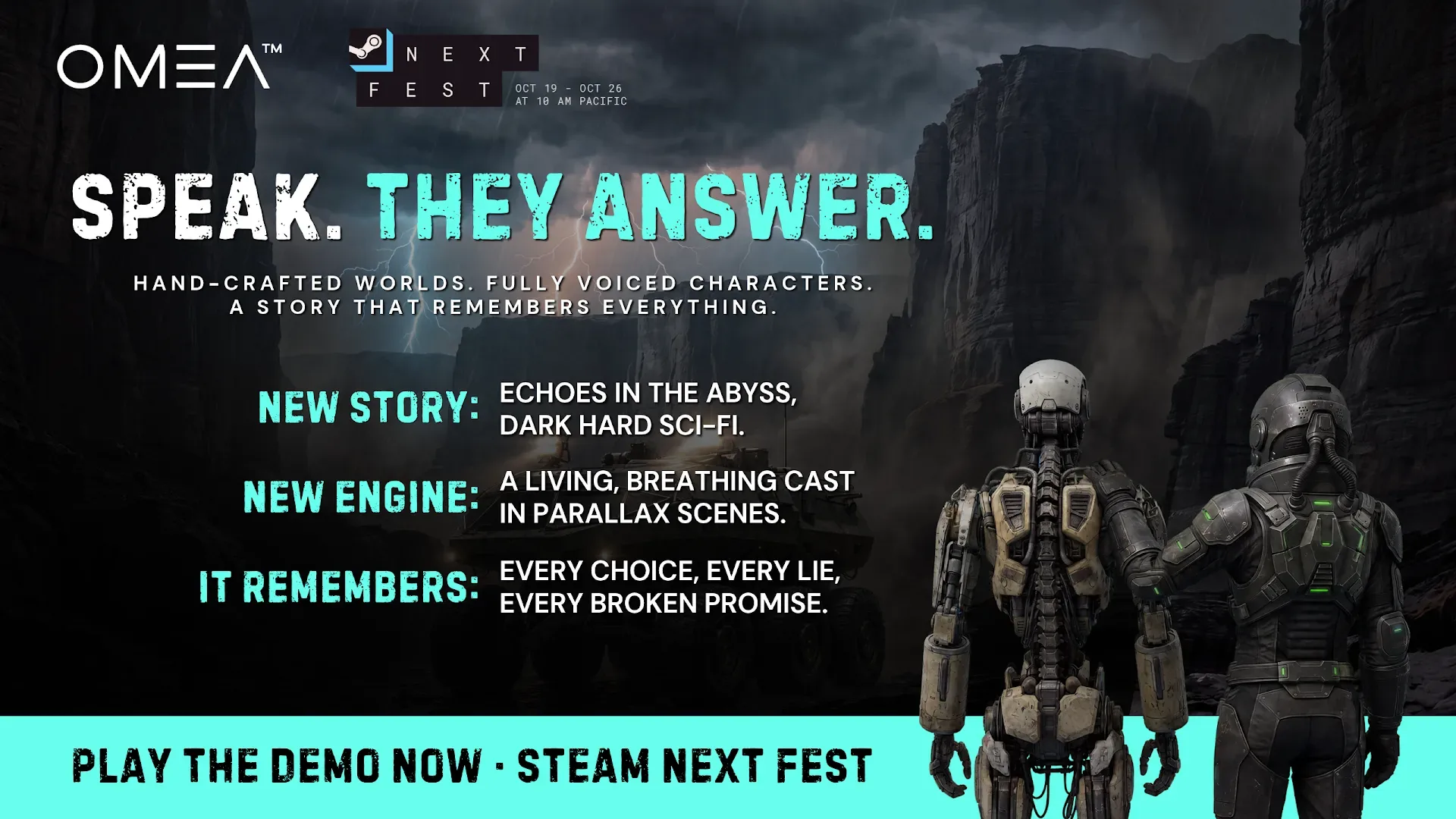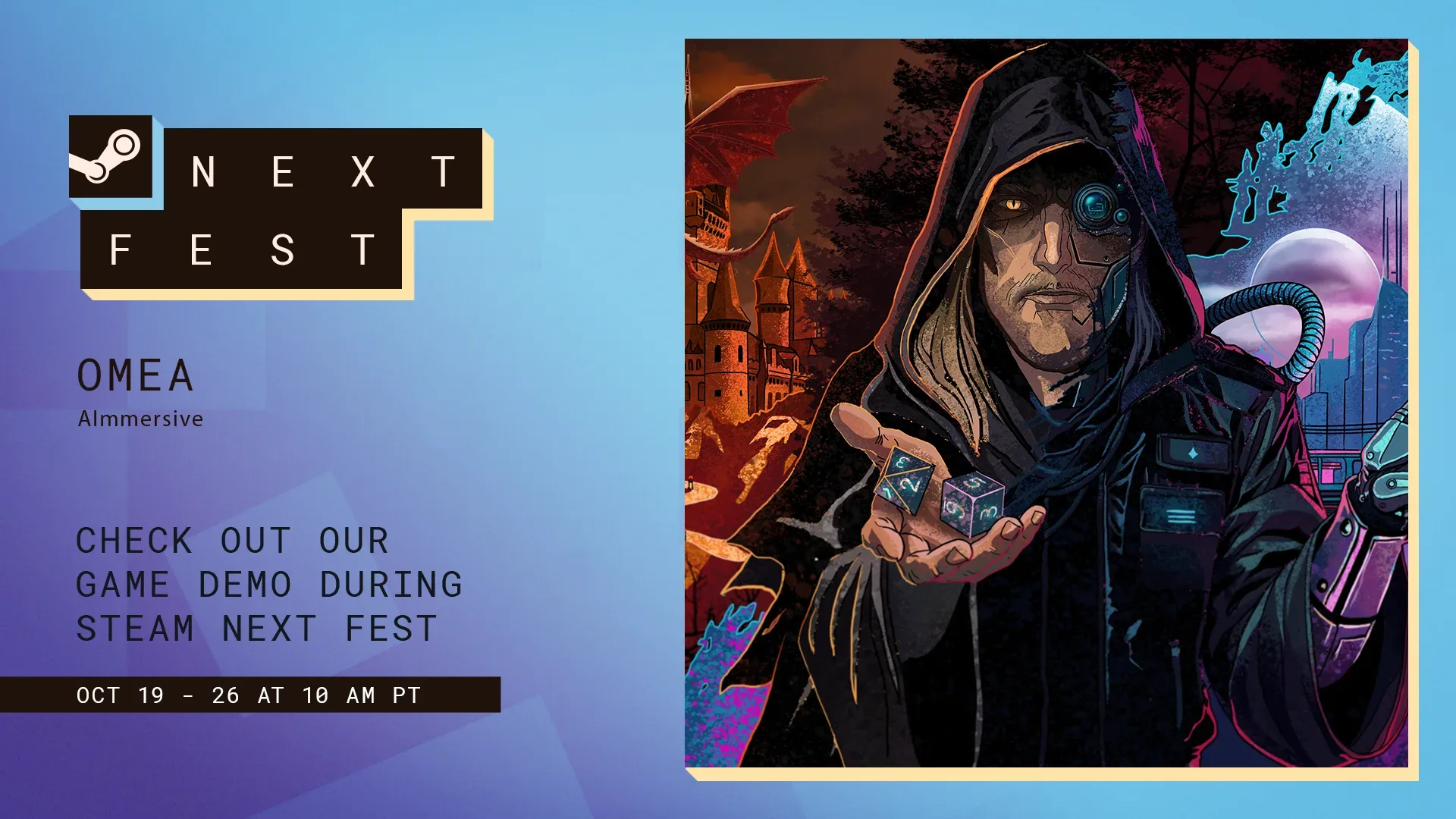
OMEA is expanding its free demo for Steam Next Fest with a second complete adventure, Echoes in the Abyss. The event demo is available from October 19 at 10:00 a.m. PT through October 26, 2026, and now lets players choose between the newly added science-fiction scenario and the existing Odin’s Trial.
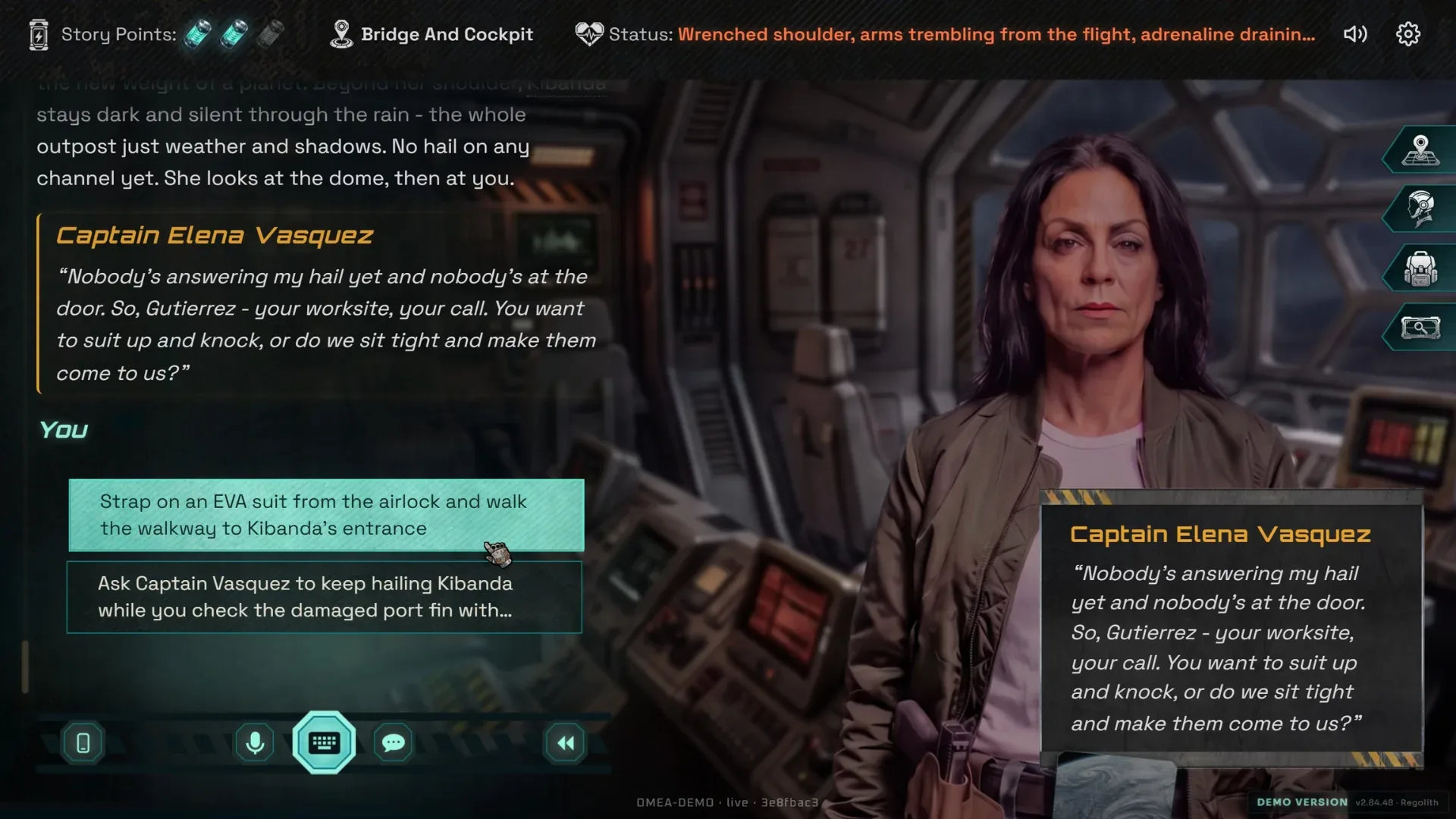
That is a substantial addition for a game built around an unusual promise: instead of selecting from a conventional, fixed list of dialogue choices or action prompts, players can say or type what their character attempts in their own words. OMEA then has its narrator and cast respond within an authored adventure, tracking the relationships, motivations, promises and grievances that build during play.
The resulting pitch is less about mastering a predefined command vocabulary and more about trying to communicate an intention naturally. Want to negotiate, investigate, bluff, issue a threat, reassure a suspicious ally, or ask a question the game has not displayed as a button? OMEA’s format is designed to make those approaches part of the interaction.
Echoes in the Abyss brings a more claustrophobic second scenario
Echoes in the Abyss begins with a corporate assignment: recover Dr. Marcus Finn and his work from a strangely silent research station on Saaremaa. The player arrives with a small crew whose motives are not entirely clear, then descends alongside robots that witnessed events before the expedition arrived.
The new adventure is described as darker, more dialogue-focused and more confined in atmosphere than Odin’s Trial. It contains nearly 100 locations, more than 100 glossary entries and a significantly larger cast. Crucially, this is not merely an opening chapter or a preview segment tucked into the demo. The full adventure is included.
That makes the Steam Next Fest build a stronger showcase for the range of OMEA’s premise. Odin’s Trial remains available, while Echoes in the Abyss provides a separate setting and a larger social web for players to navigate. A research station populated by a mixed crew, missing work, uncertain loyalties and eyewitness robots is particularly suited to a system where questions and accusations can be phrased freely.
The game’s storytelling model has an important stated boundary. Its worlds and characters are written by human authors. The reactive system’s role is to allow those authored characters to answer the player rather than to replace them with unstructured, generic improvisation. In practical terms, the game is positioning its technology as a way to make authored narrative material more responsive.
What “speak or type what you do” means
OMEA is a narrative RPG, but its interface concept differs from the familiar dialogue wheel. A traditional dialogue wheel offers a small number of authored sentences. A text adventure may accept typed commands, often in a more formal command structure. OMEA instead presents a character-driven role-playing setup where players can describe their actions or words in ordinary language, either aloud or through typing.
The crucial companion system is the narrator’s continuity tracking. OMEA says the narrator remembers who is present as well as what each character wants, has promised and holds against the player across the adventure. That is significant because reactive dialogue only feels meaningful if it carries consequences beyond a single exchange.
If a player makes a promise to one character, the game’s stated intent is that promise remains relevant later. If they offend, deceive, or otherwise anger somebody, that should continue to shape the relationship. Likewise, the narrator knowing who is physically present matters in a group scene: an admission delivered in front of one crew member should not be treated as though it happened privately.
These claims describe the kind of narrative continuity OMEA is aiming for, not a guarantee that every imaginable player instruction will work or lead to a desired outcome. Natural-language input is not the same thing as unlimited authorial control. A player may propose any approach, but the adventure’s characters, setting and circumstances still determine whether it makes sense and how it is received. That friction can be central to role-playing: a convincing lie can still be challenged, an unreasonable demand can fail, and a helpful promise can become a commitment with consequences.
Local speech recognition, and what RTX systems change
The demo supports speech recognition locally on Windows, macOS and Steam Deck. Local speech recognition means the game processes spoken input on the device rather than requiring that recognition task to be handled remotely. For players who prefer to speak their actions, that support extends across all three listed platforms.
Character voice generation has a more specific hardware condition. On Windows PCs equipped with a GeForce RTX GPU, OMEA can generate character voices on the player’s graphics card. The first audible word is expected roughly three seconds after a line begins. If the GPU is not fast enough, the game changes over to online voices.
A GPU, or graphics processing unit, is the specialized processor commonly used for graphical workloads. In this case, a compatible GeForce RTX GPU is also used for generating spoken character audio locally. The distinction is worth keeping clear: local voice generation is not listed for every platform, while local speech recognition is listed for Windows, macOS and Steam Deck.
For prospective demo players, the practical split is straightforward:
- Windows: local speech recognition is supported; local character voices are available on systems with a GeForce RTX GPU.
- macOS: local speech recognition is supported.
- Steam Deck: local speech recognition is supported, alongside controller support and gyro cursor control.
The game is currently English-only for text, character voices and speech recognition. Players who use spoken input should therefore expect English recognition rather than multilingual support in this demo.
More active scenes and clearer endings
The expanded demo also updates the presentation around the conversations. Characters now animate while speaking, including breathing, turning and shifting among poses. Environments are built with layered depth, while scene details such as active displays, clouds and a shaking ship can continue to move around the cast.
Those changes matter for a dialogue-heavy game because a static presentation can make long conversations feel detached from the setting. Layered rooms and persistent environmental effects are intended to give the exchange a physical place: the screen is not simply a text box with portraits, but a scene in which characters occupy space and react while the location carries its own mood.
OMEA’s adventures now also end with epilogues when players succeed and epitaphs when they die. An epilogue gives a completed storyline room to acknowledge the player’s outcome. An epitaph is the game’s death-ending counterpart: rather than treating failure as an abrupt mechanical reset alone, it frames the result within the adventure’s narrative.
That approach fits a game focused on authored characters remembering what happened. Success and failure are not presented only as abstract win states; they are given closing text that can place the player’s decisions in context.
A demo built around two distinct tests of the same idea
With two complete adventures now available, OMEA’s demo gives players a better opportunity to assess whether its spoken- or typed-response format suits them. Odin’s Trial and Echoes in the Abyss offer different narrative environments, while both use the same central model of freeform player input and character continuity.
Echoes in the Abyss appears positioned as the denser test: it has the larger cast, almost 100 locations, an extensive glossary and a mystery involving corporate recovery work, a quiet station and robots with firsthand knowledge of an earlier incident. It is also explicitly more dialogue-heavy, making it the natural place to explore the game’s promise of asking questions, probing motives and shaping relationships through the player’s own phrasing.
The demo is playable on Windows, macOS and Steam Deck. Steam Deck players also receive full controller support and gyro cursor control, the latter using motion to move the cursor. For more PC-focused news, see our PC coverage.
Steam Next Fest runs for a limited period, so players interested in the format have from October 19 through October 26, 2026 to try the enlarged free demo. OMEA’s central question is refreshingly direct: when an RPG allows players to explain what they mean rather than simply pick from a list, can its characters make that freedom feel remembered? With a second full adventure now included, the demo offers considerably more room to find out.