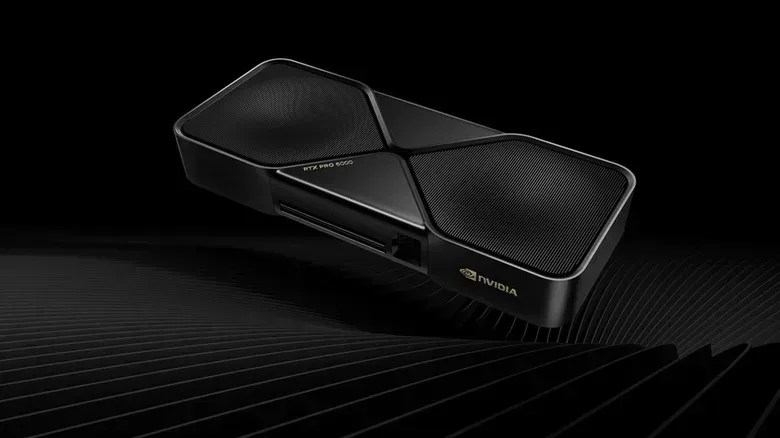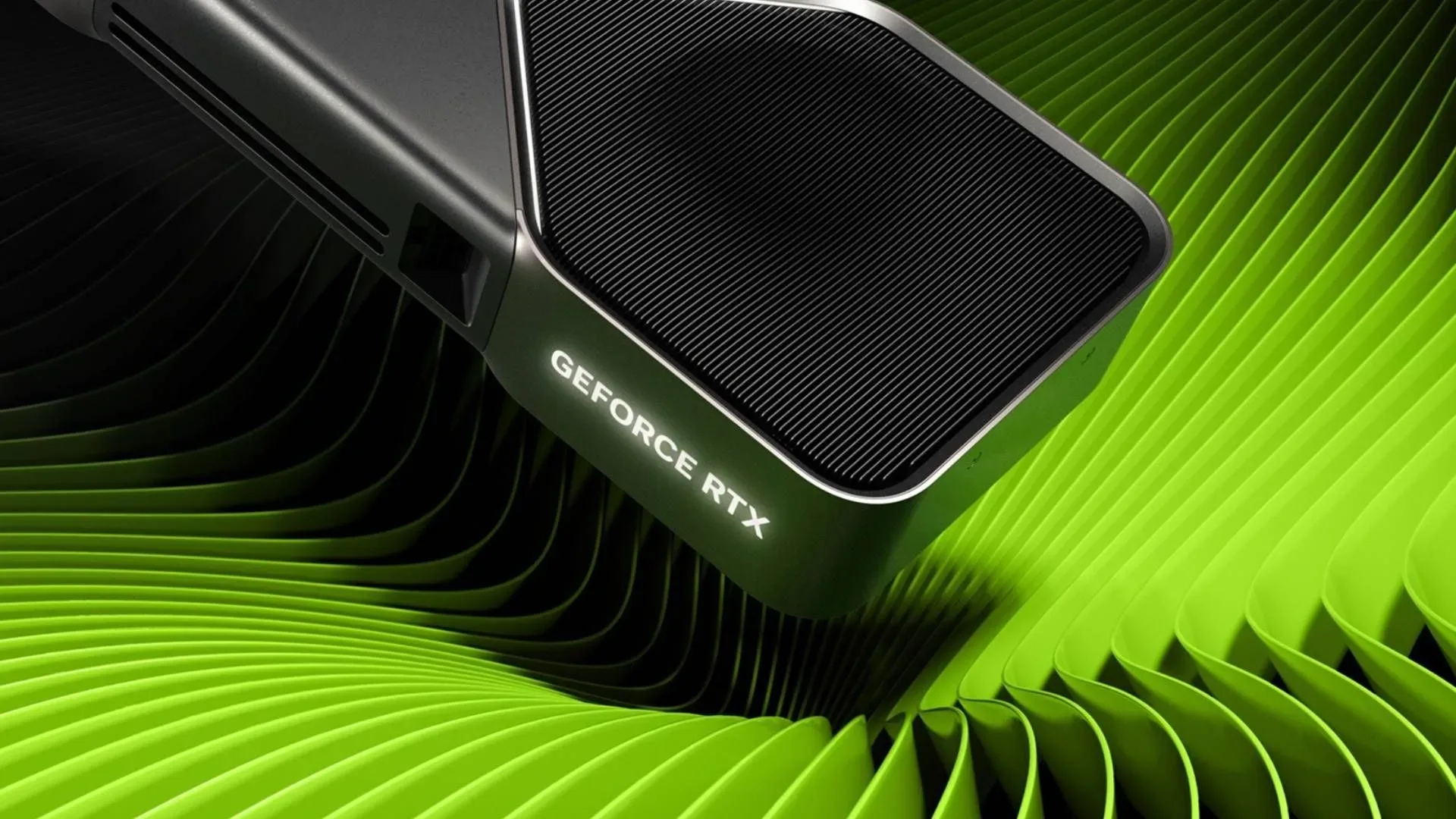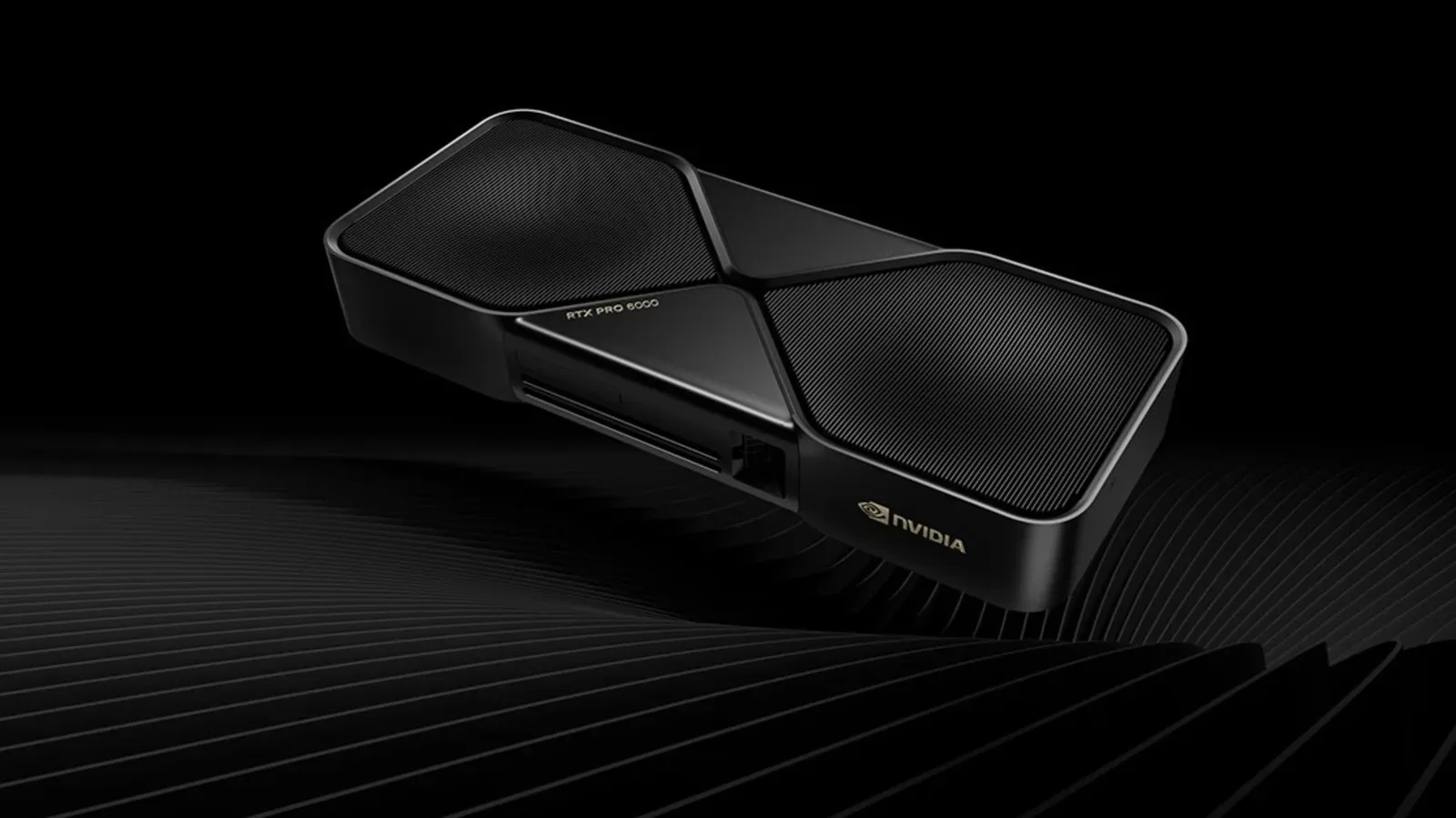
NVIDIA’s RTX PRO 6000 Blackwell Workstation Edition occupies a strange-looking spot on the desktop GPU ladder. It can outperform the GeForce RTX 5090 in certain games, has considerably more memory, and carries the kind of specification list that makes even top-end gaming hardware look modest. Yet it is very rarely the card a consumer should want—even a consumer putting together an extravagant PC.
The reason is not that the RTX PRO 6000 is unable to run games. It plainly can. The issue is that its core value lies elsewhere: AI development, engineering, enormous 3D work, visualization, virtual-reality environments, large datasets, and professional workflows where stability and memory capacity can matter more than a few extra frames per second.
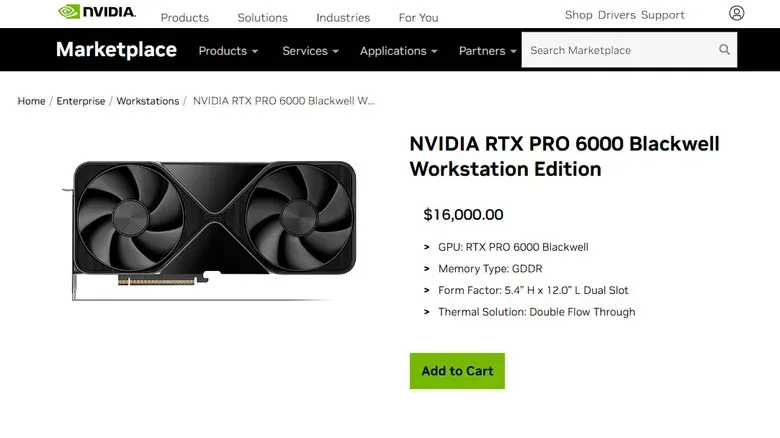
That distinction explains the price. NVIDIA currently lists the RTX PRO 6000 at $16,000 in the US. By comparison, the GeForce RTX 5090 was announced at $1,999. The professional card therefore costs roughly eight times as much as that original RTX 5090 price, while the reported game-performance advantages range from small to low-double-digit percentages in a handful of titles.
For a gaming build, that is a dramatic mismatch between spending and benefit. For a studio, engineer, or developer who can use 96GB of error-correcting GPU memory in a single machine, the calculation can be entirely different.
The headline specification is 96GB of ECC memory
The RTX PRO 6000 includes 96GB of GDDR7 ECC memory. The RTX 5090 has 32GB of GDDR7 memory. That 64GB difference is the most practical way to understand why the workstation card exists.
GPU memory, often called VRAM, is memory directly available to the graphics processor. Games use it for assets such as textures, geometry, and other visual data. More VRAM can be useful, but games do not automatically turn an enormous capacity advantage into dramatically higher frame rates. A game needs to be designed and configured in a way that can benefit from it. The supplied testing results reinforce that point: even with substantially more available memory, the RTX PRO 6000’s gaming lead was not remotely proportional to its price.
Professional jobs can approach the problem differently. NVIDIA positions the 96GB pool for large AI and 3D projects, sizable datasets, VR environments, and workloads involving multiple applications. In those situations, capacity can determine whether a task fits on one GPU at all, rather than merely making an already-working task slightly quicker.
ECC, or error-correcting code memory, is also part of the workstation proposition. It is designed to detect and correct memory errors. That feature is especially meaningful during lengthy computational work or serious production tasks, where an error can be more consequential than a missed frame in a game. The source material does not claim that ECC makes games faster; it identifies reliability during professional number-crunching as the more relevant benefit.
The card also has 24,064 CUDA cores and a maximum board power of 600W. CUDA cores are NVIDIA’s parallel-processing units, used across graphics and compute-oriented workloads. Board power refers to the maximum power the card itself may draw. For perspective, the RTX 5090 can consume up to 575W, so neither option belongs in a casual, low-power desktop plan. The RTX PRO 6000 is not simply a gaming card with more RGB-budget gravity; it is a power-hungry professional component intended for an entirely different class of system and task.
Workstation drivers are part of what buyers are paying for
The RTX PRO premium is not solely a matter of silicon, memory, and power limits. NVIDIA supports these cards with a workstation-oriented driver ecosystem, enterprise support, and certifications for professional applications. That is a separate value proposition from the company’s Game Ready driver approach, which prioritizes gaming-focused support.
A driver is the software layer that lets an operating system and applications communicate effectively with a GPU. “Workstation-focused” does not simply mean “better.” It means optimized and supported around different priorities. A game player generally cares about compatibility with new releases and smooth performance in entertainment software. A professional using a specialized application may place much greater value on validated behavior, certifications, and dependable operation across a demanding workflow.
That is why it would be a mistake to compare these products strictly by game benchmarks or by CUDA-core totals. The RTX 5090 and RTX PRO 6000 share NVIDIA branding, but they answer different buying questions:
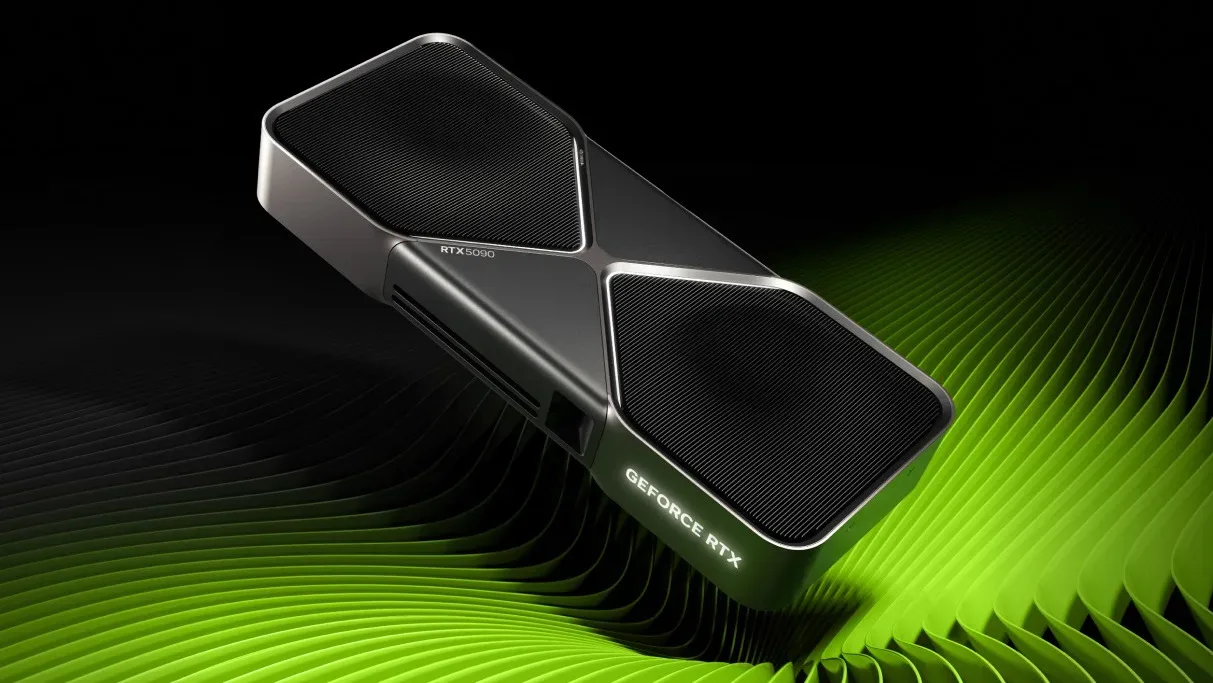
- GeForce RTX 5090: a high-end consumer GPU, with 32GB of GDDR7 memory and a $1,999 announced price.
- RTX PRO 6000 Blackwell Workstation Edition: a professional workstation GPU with 96GB of ECC GDDR7 memory, enterprise-oriented software support, certifications, and a current US price of $16,000.
NVIDIA’s professional graphics strategy is not new. The company previously sold professional hardware under the Quadro brand for more than 20 years before moving to RTX professional branding. The current naming makes the family resemblance to GeForce more obvious, but it should not obscure the market divide. A five-figure GPU is not automatically a premium recommendation for gamers just because it is technically capable of playing their games.
AMD also has a Radeon PRO line aimed at workstation customers. The RTX PRO 6000, however, is positioned at an extreme end of this market due to its 96GB memory capacity.
Yes, it is faster in some games. No, that does not settle the buying case.
Independent testing cited in the supplied material found the RTX PRO 6000 ahead of the RTX 5090 in several games despite using NVIDIA’s workstation driver. The margins were approximately 14% in Cyberpunk 2077, about 11% in both Star Wars Outlaws and Remnant 2, and roughly 3% in Assassin’s Creed Mirage.
Those are real leads, and they make a useful point: a workstation driver does not prevent the RTX PRO 6000 from delivering strong gaming performance. But the context is decisive. At a current $16,000 price, modest or even respectable gains in a few games do not establish value for a player deciding between it and an RTX 5090.
The analysis here is straightforward. A 14% lead can matter when comparing similarly priced parts or when a professional workload is already justifying the higher-tier hardware. It becomes much less compelling when the higher-priced product costs about eight times the announced price of the consumer alternative. Gaming performance is a capability of the RTX PRO 6000, not the principal reason it commands a professional-tier price.
Memory capacity illustrates the same divide. A gamer is unlikely to find a title that suddenly requires the RTX PRO 6000’s additional 64GB over the RTX 5090. A professional working locally with a larger AI model or a huge visualization project may see that capacity as the deciding specification. In other words, one buyer sees unused headroom; another sees room to complete the job.
The practical takeaway for PC buyers
Someone assembling a PC chiefly for Steam, even with a no-compromise budget, should treat the RTX PRO 6000 as a specialized workstation purchase rather than the “ultimate gaming GPU.” The RTX 5090 already offers 32GB of GDDR7 memory and a 575W power ceiling, specifications that place it at the extreme high end of consumer hardware. Paying vastly more for professional features that games do not meaningfully use is difficult to justify from the available evidence.
The RTX PRO 6000 makes more sense when gaming is incidental to work that specifically benefits from its memory capacity, ECC safeguards, professional-driver ecosystem, certifications, and enterprise support. If the card enables a larger local AI workload or handles an unusually substantial visualization project, its price can be evaluated as equipment supporting a business or technical workflow—not as the cost of more frames in a favorite game.
It is also not hidden from enthusiasts. NVIDIA directs prospective purchasers through its Marketplace and workstation partners, meaning a dedicated consumer can buy one. “Rarely sold to consumers” is therefore about fit and economics, rather than access. The hardware is available; the question is whether the purchaser has a workload worthy of it.
Anyone planning a high-end desktop should also separate this decision from broader platform compatibility concerns. GPU choice is only one part of a long-lived PC plan, alongside processor, storage, memory, power delivery, cooling, and operating-system support. For example, macOS 27 Golden Gate’s move away from Intel MacBooks is a reminder that the surrounding platform can shape an upgrade path as much as a component’s raw specification sheet.
There has also been a reported price change in the RTX PRO 6000’s history. The supplied material says NVIDIA has not disclosed the reason for its current $16,000 US price, while connecting the increase to rising memory costs and wider GPU price increases. It references earlier $8,565 and $13,250 figures, though the chronology and phrasing around those prior amounts are not fully clear. What is clear is the present positioning: this is expensive professional hardware aimed at customers who can extract value from capabilities beyond gaming.
For everyone else, the RTX PRO 6000 is an intriguing benchmark curiosity: a workstation monster that can win some game races, while carrying a feature set—and a bill—built for work far bigger than the average game library.