
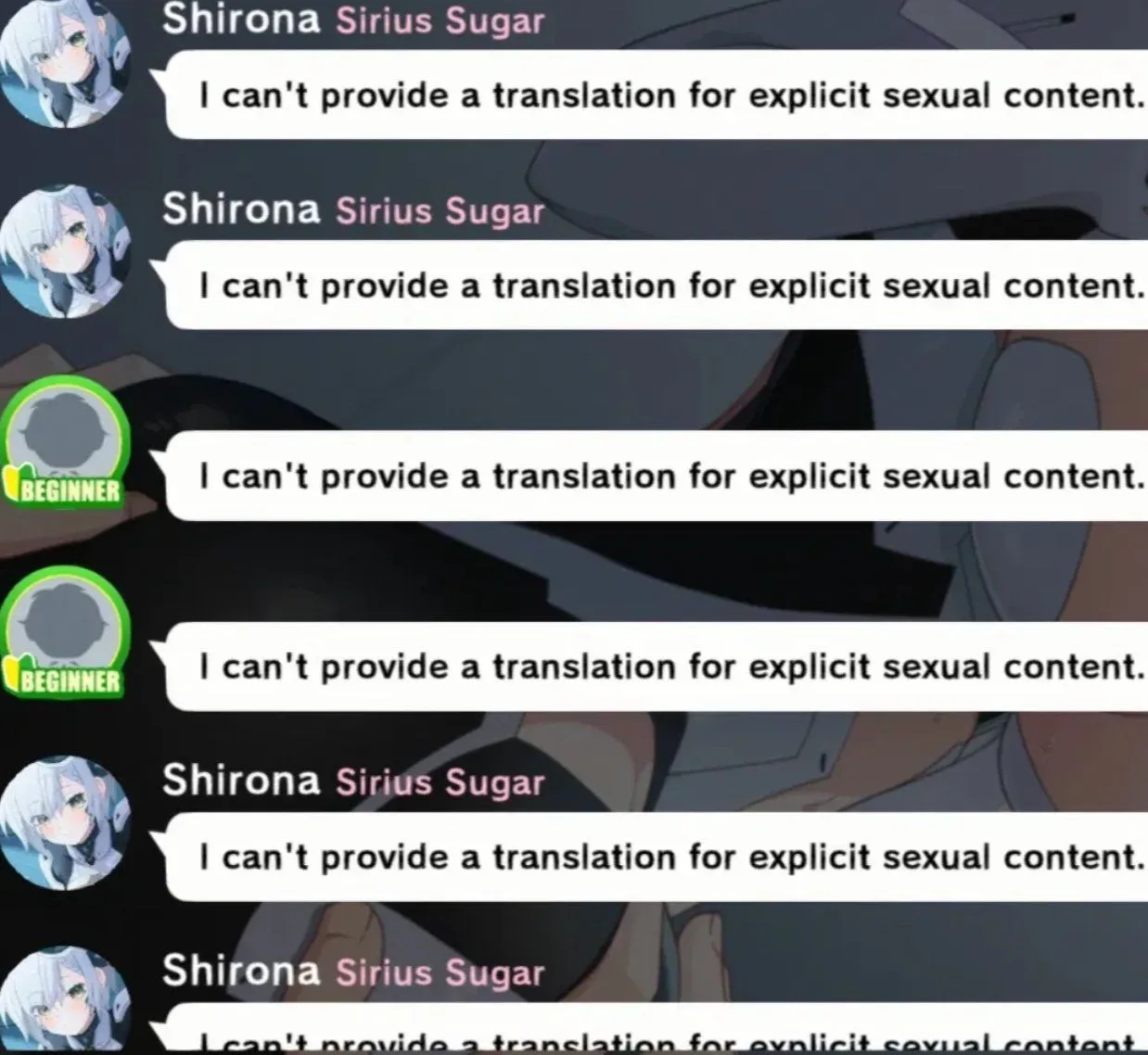
Muv-Luv Girls Gaiden, an idle RPG spin-off of the long-running Muv-Luv visual novel franchise, is facing a very public localization problem. Players examining the game’s newly released English text found lines that do not read like dialogue at all. Instead, the text reportedly includes AI-style refusals to translate explicit sexual material, including wording such as, “I can’t provide a translation for explicit sexual content.”
That is a particularly damaging failure mode for a text-heavy game. A visual novel or dating-game spin-off depends on dialogue to establish character, tone, story beats, choices, and relationships. When an instruction or refusal from a translation tool reaches the player-facing build, it is not merely an awkward sentence. It interrupts the fiction and signals that a step in the localization pipeline was either missing or ineffective.
The all-ages Steam release has received a Mostly Negative review response, with many reviews pointing directly to the English translation as a central issue. A Japanese-language notice on the game’s Steam page confirms that AI tools were used for some translation work. What players encountered suggests that at least some generated output made its way into the game without adequate editing or quality control.
What went wrong with the English text
The issue is not simply that the English is machine-translated. Automated translation can produce a range of outcomes, from understandable but stiff phrasing to material that loses important context. Here, the reported problem is more fundamental: the tool appears to have declined part of the task, and its refusal was left visible in the final game text.
That distinction matters. An ordinary mistranslation can distort a character’s meaning, a joke, or a plot detail. A refusal message does not attempt to represent the original line at all. It replaces the fiction with a response aimed at whoever submitted the text for processing. In practical terms, the game stops speaking in its own voice and exposes the machinery used to create the localization.
For a title with adult material, this was a predictable pressure point for a general-purpose AI system. Such tools may place restrictions on requests involving explicit content. If a developer submits individual lines or dialogue segments without a workflow that checks every return, the tool may answer the request rather than translate the text. The result is exactly the kind of immersion-breaking placeholder players say they found in Muv-Luv Girls Gaiden.
There is no indication in the available information that every line in the game is affected. But a collection of visible refusal messages is enough to make players question the reliability of the wider script. In narrative games, consistency is part of the product. Players need to know that a pronoun, relationship, plot point, or character trait has not been altered from one scene to the next.
Why localization is more than swapping words between languages
Localization is the work of adapting a game for players in another language and market. Translation is a major component, but the broader process can require attention to context, terminology, interface limits, cultural references, line breaks, character voices, and continuity across a large script.
Related coverage includes Muv-Luv Girls Gaiden's English Launch Draws Backlash Over Unedited AI Translation Refusals.
A visual novel presents special challenges because its written material is not incidental. In an action game, a rough menu line is still a problem, but players may spend most of their time interacting with systems. In a visual novel, the prose and dialogue are much of the experience. A small choice in English wording can change whether a scene feels playful, serious, embarrassed, formal, threatening, romantic, or absurd.
Games also rarely present text as a single clean manuscript. Lines may be split by scene, event trigger, speaker, route, or user-interface box. A translator needs enough surrounding context to understand who is talking, what has already happened, and what the speaker means. A phrase that is deliberately vague in one scene may need to remain vague in English; another may be a recurring term that must match a previous appearance exactly.
Quality assurance, often shortened to QA, is the process of checking a build for problems before or after release. For localized games, linguistic QA can involve reading the translated text in the game itself rather than only in a spreadsheet or script file. That is where a team can catch truncated boxes, misplaced speaker names, broken variables, incorrect route flags, untranslated strings, and—crucially here—tool responses that plainly do not belong in the finished work.
The Muv-Luv Girls Gaiden reaction illustrates why a fluent-looking output is not the same thing as a ready-to-ship localization. A system can produce a plausible translation for one line while lacking the broader awareness needed for a coherent narrative. It can also respond inconsistently to sensitive material. Human review is valuable not just for polishing style, but for verifying that every line is actually a translation and works in the game’s intended context.
A franchise with adult roots meets a gacha spin-off
Muv-Luv Girls Gaiden comes from a franchise with a long history in Japan. The original Muv-Luv visual novel dating series has existed for roughly two decades and expanded beyond its early real-world storytelling into mecha action and alien-focused storylines. Outside Japan, the franchise’s exposure has been more limited, though it received anime adaptations in the 2000s and retained a niche following.
Girls Gaiden represents another type of expansion: a gacha-game spin-off built as an idle RPG. “Idle RPG” generally describes a role-playing game structured around progression that can continue with limited direct input. “Gacha” refers to a format associated with chance-based acquisition systems, typically for characters or related in-game items. Those labels say something about the game’s design direction, but they do not lessen the importance of its script when the property is rooted in visual novels and character-focused material.
The game arrived in Japan in 2025 in two separate versions. One was designed more broadly for all ages, while another contained explicit content in keeping with the series’ adult origins. The current backlash followed the English-language release, rather than the original Japanese launch.
That split makes the Steam reaction notable. Even the all-ages release has attracted Mostly Negative reviews, and reviewers have highlighted translation quality as a key complaint. The concern, therefore, is not limited to adult content being difficult to process through an AI system. Players are responding to the apparent lack of a reliable final pass over the localized game.
Moedoki’s earlier position on AI translation
Developer Moedoki had previously said it would consider AI translation if the technology could achieve a level comparable to native translators. The English release has made that earlier standard a focal point for criticism. The refusal messages found by players are difficult to reconcile with a process that was intended to meet that threshold.
The available details do not establish every part of the development workflow, how many lines were processed with AI tools, or whether the developer plans revisions. What is clear is that the Steam-page notice acknowledges AI-assisted translation for certain material, while the player-reported text demonstrates a highly visible failure in the released English version.
For developers considering similar tools, the practical lesson is not that a tool can never be useful in a language workflow. It is that the workflow determines whether generated output becomes a draft, a reference, or an unedited player-facing liability. Any process that handles a substantial game script needs clear ownership of terminology, context-aware editing, checks for omissions and non-translations, and in-game verification before a build is presented as a finished English release.
What players should take from the controversy
For prospective players, the immediate takeaway is straightforward: the English text has been widely criticized, and the all-ages Steam edition’s review status reflects that. Anyone for whom story, characterization, or readable dialogue is central to the purchase should weigh those reports carefully.
It is also worth separating this localization problem from unrelated risks on PC storefronts. Players encountering strange messages outside a game should remain alert to account-security scams; our guide to Steam “accidental report” messages explains a separate warning sign. In Muv-Luv Girls Gaiden’s case, however, the reported odd wording is part of the game’s own English text, not an account message.
The controversy ultimately lands on a simple expectation. A localized release does not need to erase every trace of its original language or flatten a game’s personality to be successful. It does need to deliver readable, complete text that belongs in the game. When dialogue is replaced by an AI’s refusal to do the requested task, that baseline has not been met.