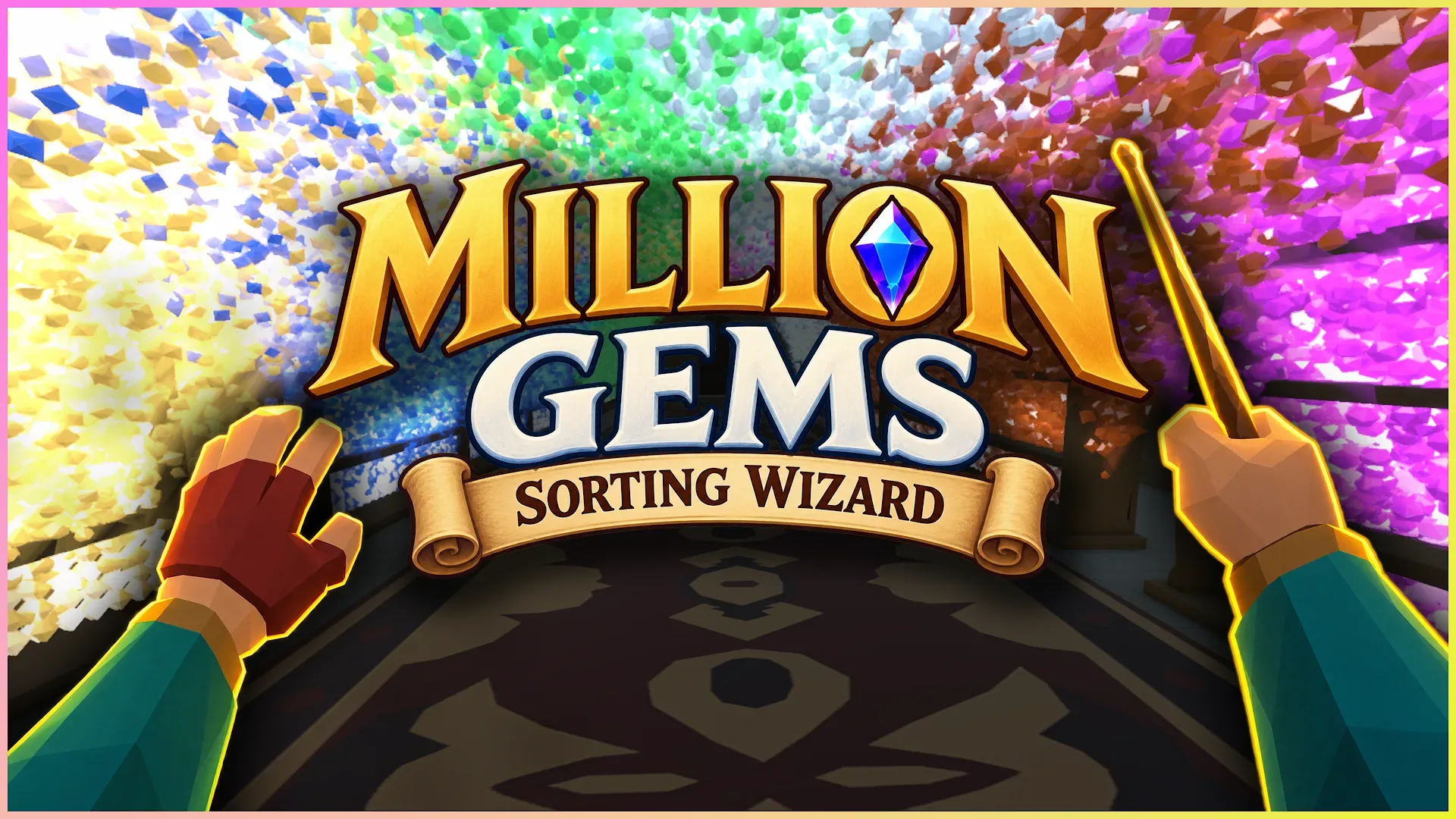
There are many ways to escape a magical castle: find a key, defeat a monster, solve an ancient riddle. Million Gems: Sorting Wizard chooses a more orderly solution. Its trapped wizard must deal with one million scattered gems, turning magical housekeeping into the path toward freedom.
The newly announced PC game comes from solo indie developer Liviu Globa and is currently targeting a Q1 2027 release. Its central task is deliberately simple: gather, clear and organize ever-larger gem piles. The larger idea is to make that repetitive, tactile job feel like a calming magical ritual rather than a punishment handed down by a particularly fussy archmage.
A million gems, one clear objective
Million Gems: Sorting Wizard gives its premise a concrete end point. The wizard is confined in a magical castle and needs to sort one million gems to escape. That is a substantial number, but it is also a very legible goal. Players are not merely tidying indefinitely; each cleared and organized batch contributes to a larger escape plan.
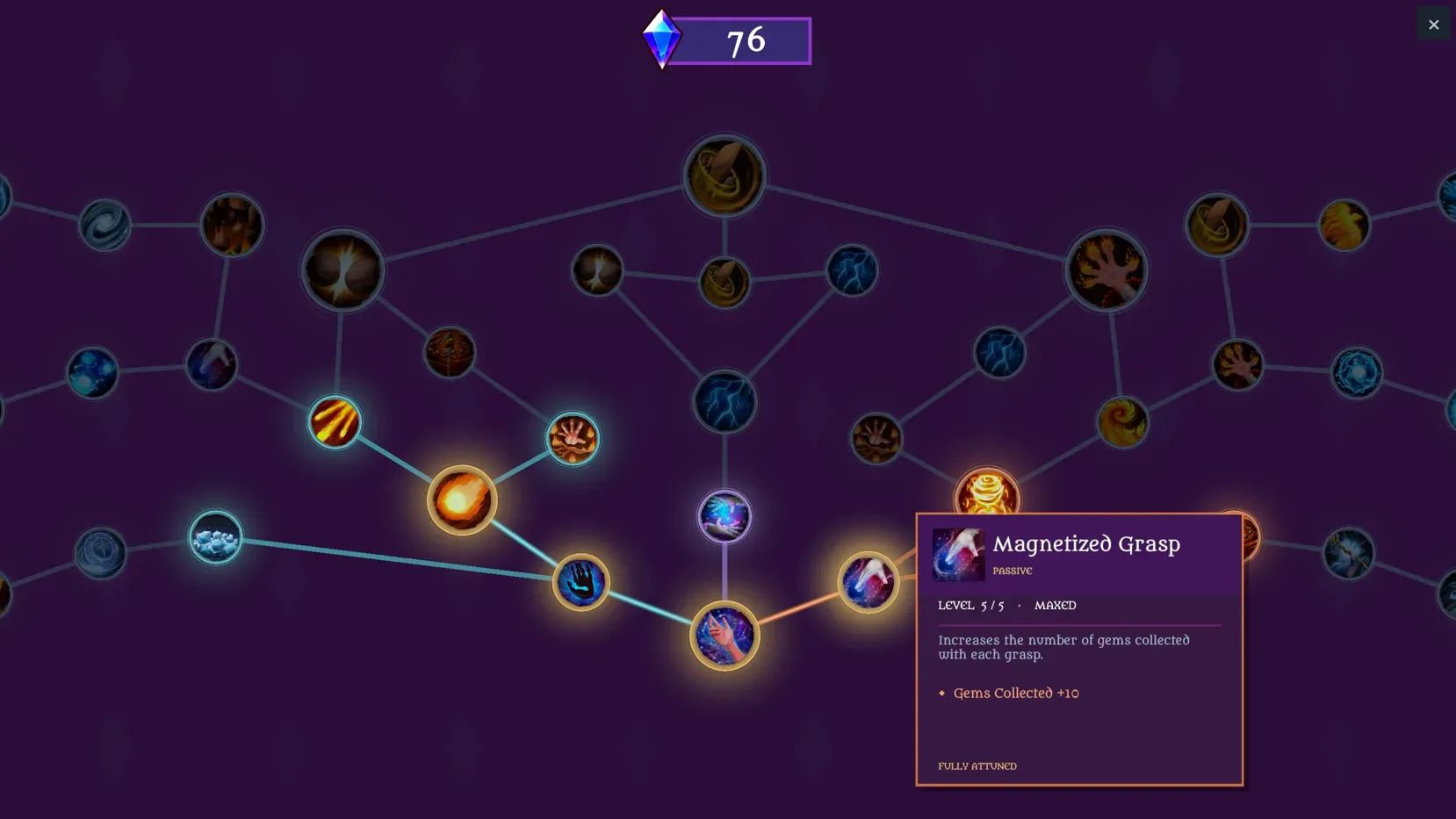
The game’s structure pairs that goal with new spaces to access. As players progress, they will unlock additional rooms within the castle. That means the setting is not just a backdrop for a single pile of gemstones: it is intended to open up as the player’s work continues. The announced design also includes a skill tree for improving magical abilities.
A skill tree is an upgrade structure in which players choose improvements from connected options. In this case, it is described as a way to upgrade the wizard’s magic. Specific upgrade paths and their exact effects have not been detailed, so it is too early to assume precisely how spell behavior, speed or efficiency will change. What is clear is that progression is meant to give the sorting loop new momentum over time.
Spells turn sorting into the main interaction
Rather than relying on ordinary hands alone, the wizard uses named spells to manage the gem chaos. The announced lineup includes Arcane Palm, Fireball and Vortex. They are intended for gathering, clearing and organizing the growing piles.
Those names point to different magical approaches without the announcement defining a full control scheme or individual spell rules. Arcane Palm suggests a direct magical means of moving objects; Fireball carries obvious potential as a clearing tool; and Vortex evokes pulling loose gems together. The important practical point is that the act of sorting is not being framed as static inventory administration. It is the game’s active, spell-driven verb.
That distinction matters for a game built on repetition. A repeated action can become engaging when it has satisfying feedback, understandable goals and visible change. Million Gems is aiming for that combination: a pile that becomes organized, abilities that can be improved, and rooms that can be unlocked. The castle escape gives all of that activity a clear purpose.
Related coverage includes Million Gems: Sorting Wizard Turns a Mountain of Gems Into a Cozy Escape Plan.
“Million Gems began with a very simple question: could sorting an absurd number of gems become a relaxing magical ritual?” Globa said. “The original prototype attracted nearly one million views across social media, and I wanted to develop that simple idea into a complete game with progression, magical abilities, and a clear goal - escaping the castle one gem at a time.”
What “light incremental progression” means here
The game is described as using light incremental progression. Incremental progression generally refers to a design in which players make steady gains through repeated actions, upgrades and gradually increasing capabilities. “Light” is an important qualifier: the announced pitch places the emphasis on cozy accessibility and gradual organization, rather than presenting the game as an especially complex optimization exercise.
Based on the details currently available, the progression loop can be understood in broad terms:
- Use magic to gather, remove and arrange scattered gems.
- Work through increasingly large piles.
- Improve magical abilities through the skill tree.
- Unlock more rooms in the castle.
- Continue advancing toward the million-gem target and escape.
That is a concise loop, but it has several layers of visible advancement. There is local progress in clearing a pile, character progress through upgraded magic, environmental progress through new rooms, and the overarching count toward escape. Keeping those milestones distinct can be especially useful in a cozy game, where the appeal often comes from a sequence of achievable tasks rather than pressure, failure or competition.
At the same time, the announcement does not spell out whether the million-gem total is tracked in a particular way, how rooms are gated, whether players can revisit spaces freely, or how the three named spells differ in practice. Those remain open questions for development updates rather than confirmed features.
Cozy design with an unusually large number attached
“Cozy” can cover a broad range of games, but the stated priorities here are accessible gameplay, gradual progress, organization and a whimsical magical setting. Million Gems is not selling its premise on a villain to conquer or a score to chase. It is presenting a big cleanup job as a structured, magical activity.
The one-million figure gives that quiet premise a playful sense of scale. It makes a familiar satisfying action—putting scattered things in order—feel absurdly large while avoiding the need to make the player’s goal abstract. Gems are visible, countable objects, and the escape condition is easy to understand. The premise knows exactly what it is asking: please deal with this impossible-looking floor situation.
The original prototype’s nearly one million social-media views also suggests that the core visual idea connected before it became a full project. That attention does not establish how the finished game will feel or how its progression will be balanced, but it helps explain why the prototype is expanding into a PC release with spells, upgrades and a castle to open up.
What players can expect—and what remains unknown
For now, the confirmed picture is focused. Million Gems: Sorting Wizard is in development for PC; its wizard is trapped in a magical castle; sorting one million gems is the route out; Arcane Palm, Fireball and Vortex are among the spells; a skill tree and room unlocks support progression; and the release target is Q1 2027.
There is no confirmed price, exact release date, platform plan beyond PC, or detailed breakdown of the upgrade system in the available announcement. Players interested in following its development can wishlist it on Steam. For another PC game built around uncovering an unusual place, see Radiotext’s lost radio network.
The basic challenge for Million Gems will be maintaining the soothing quality promised by its premise while steadily adding fresh reasons to keep sorting. Its announced structure has the right kind of scaffolding for that: different spells, improving powers, new rooms and an unapologetically specific finish line. If the magical tools make organization feel expressive and the castle reveals its spaces at a satisfying pace, one million gems may be less a daunting chore than a very large invitation to put everything in its proper place.