Hack 42 is a compact Steam game built around an unusually direct idea: type well enough to commit fictional infrastructure hacks, take the money, and reinvest it until the whole operation spirals into something vastly larger. It joins two familiar PC-game formats—typing challenges and incremental progression—but gives each one a meaningful job. Typing is not merely a theme pasted onto a clicker; accuracy governs whether a run pays out at all.
The premise is knowingly over-the-top. Players work through hacks aimed at nations’ infrastructure, stealing funds to buy new capabilities and ultimately pursuing world domination. Yet the game’s systems sound more concerned with the micro-drama of a keyboard than with cyber realism. A mistyped technical term can matter. A successfully completed word can recover the resources needed to keep going. The result is a game about a recognizable human experience: knowing how to type until a strange acronym, an unfamiliar Linux-adjacent word, or the suddenly alarming location of the X key makes the fingers hesitate.
A typing game where every letter has a cost
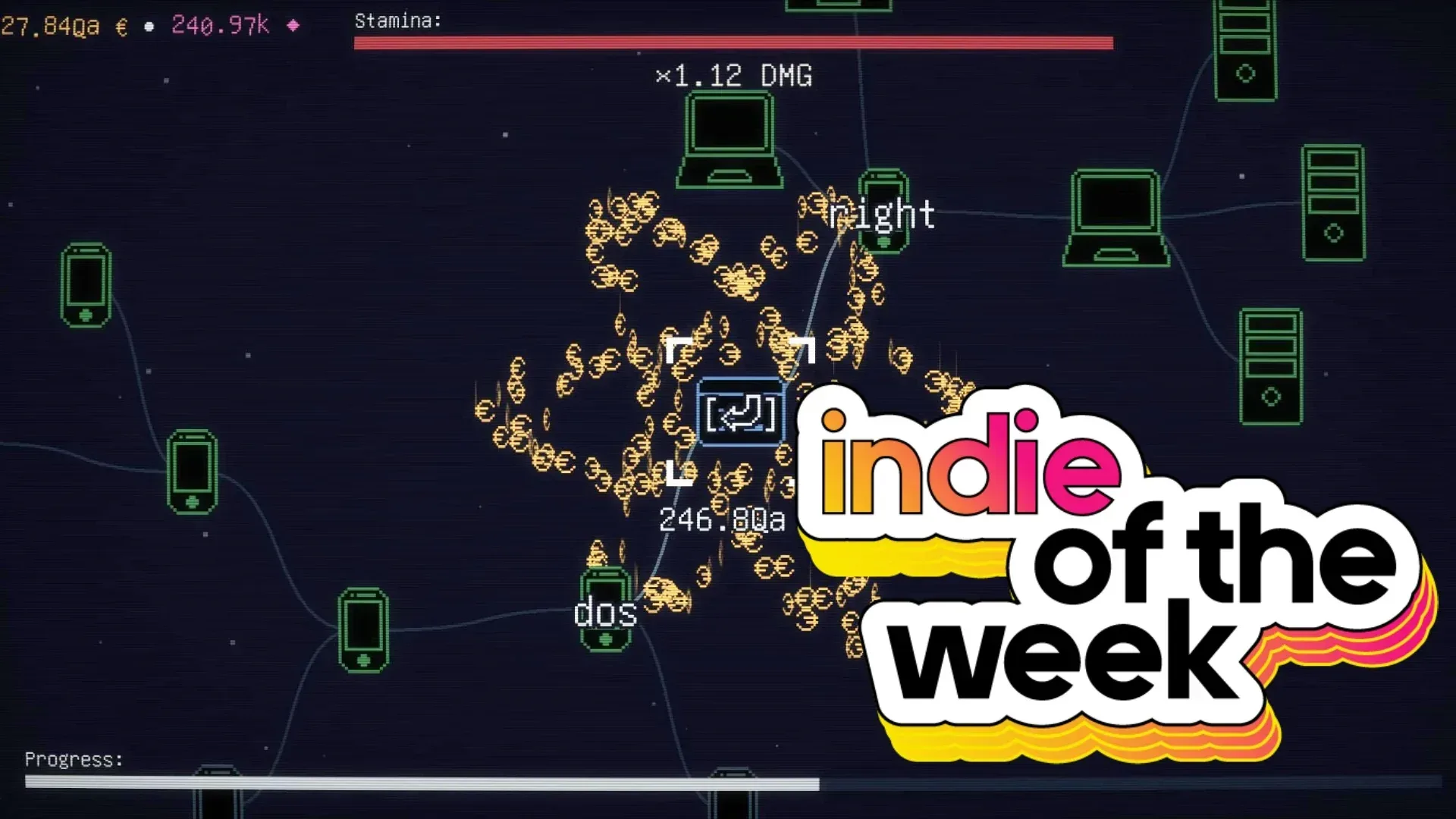
Each hack is represented as a network of nodes. Nodes carry one or more words, and accurately entering those words unlocks them while exposing additional paths through the network. Unlocking nodes earns cash, establishing the basic incremental loop: perform an action, collect a reward, purchase improvements, then perform the same action more effectively.
Hack 42 complicates that loop with stamina. Typing letters consumes stamina, while completing nodes restores some of it. That creates a tension absent from the most hands-off incremental games. Players are incentivized to keep typing, but cannot simply mash through text without consequence. Errors are expensive because the player is spending stamina without reaching the node-completion reward that could replenish it.
The risk becomes sharper because a failed server run has real stakes: cash earned during that attempt is lost if stamina reaches zero before the player exits the server. In practical terms, this turns accuracy into more than a high-score concern. A player deciding whether to push deeper into a node network is also judging whether their remaining stamina can survive the next difficult-looking sequence.
That is an effective fit for the format. Traditional typing games often score speed and precision, while incremental games are usually about improving output over time. Hack 42 appears to join them by making precision part of the economy itself. Better performance produces more money; more money buys tools that improve the ability to clear future nodes; the player’s typing still matters because the stamina meter keeps each run from becoming entirely automatic.
What “incremental” means here
An incremental game is generally structured around escalating production and upgrades. Early actions yield modest returns, which are invested into systems that generate resources faster or reduce the work needed to produce them. Eventually, numbers that began in ones and tens can reach deliberately absurd scales. Hack 42 follows that curve, moving from small sums of money toward quintillions.
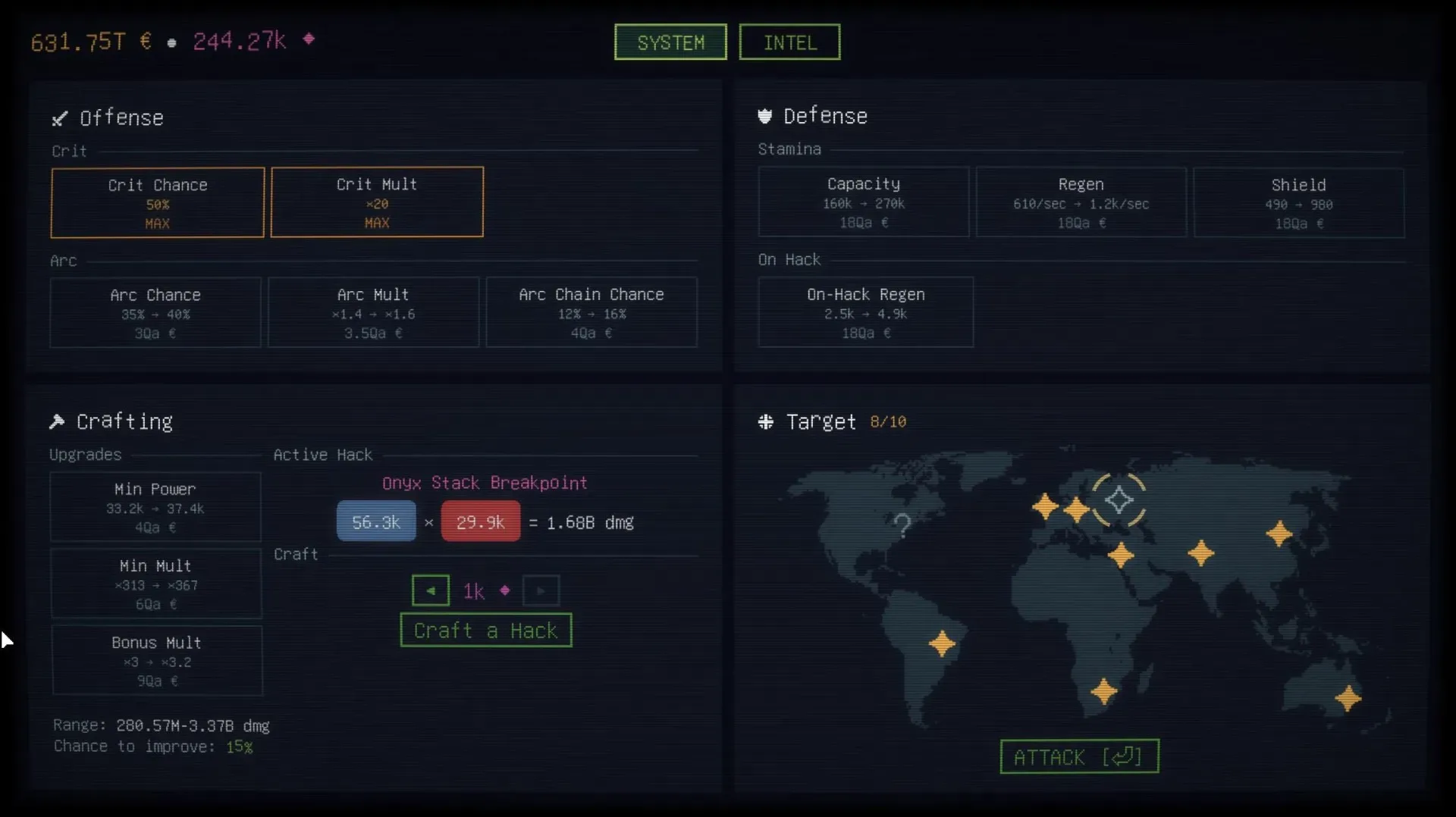
Its upgrades are presented through a large skill tree. Cash taken from successful hacks can unlock and enhance abilities, with key improvements increasing the effective power of the player’s typing and making nodes easier to crack. The phrase “typing power” is intentionally game-like rather than a claim about real-world keyboard skill: it describes the growing mechanical advantage supplied by upgrades.
Related coverage includes Hack 42 Turns Typing Into a Fast, Clever Incremental Hacking Game.
That structure makes the game less about reaching a single perfect typing result and more about compounding capability. A rough early run can still contribute toward improvements that make later runs easier. At the same time, the loss condition prevents progression from becoming consequence-free. The system asks players to earn their automation rather than simply wait for it.
There is a useful contrast with the biggest-budget end of the games business. While open-world spectacle can find drama in massive simulated spaces, Hack 42’s apparent hook is considerably more intimate: a blinking cursor, a demanding word, and the knowledge that one sloppy input can wreck the run’s economics.
A second progression system: fragments and cells
Hack 42 does not put all of its advancement behind server-node typing. A separate screen has players type pairs of letters to release fragments. Those fragments are decoded into cells, represented visually as pink diamonds. Cells feed another upgrade path and can themselves be improved through incremental systems.
This second loop matters because it broadens the game’s definition of typing. Node hacking is a run-based challenge tied to stamina and banking cash. Fragment work is a parallel route to long-term growth, eventually becoming automated and optimized enough to produce hundreds of cells per second without direct input.
Automation is a foundational incremental-game concept: an action that initially requires repeated player input is gradually handled by upgrades or systems. In Hack 42, that process appears to be part of the joke as well as the design. Players begin by actively entering letter pairs, then eventually build a machine that manufactures cells without them. The labor of typing is not discarded immediately; it is converted into the means to reduce future labor.
That makes the two-layer structure more interesting than a simple typing test. One set of tasks tests accuracy under resource pressure. The other supplies a route toward compounding, increasingly passive output. Money from hacks, upgrades to typing effectiveness, fragments, cells, and automation all reinforce the sense of moving from an improvised operation to an absurdly efficient one.
Technical language is part of the obstacle
The word selection is a central part of the game’s personality. The vocabulary is described as consistently nerdy, full of acronyms and awkwardly spelled Linux-adjacent terms. That distinction is important. Familiar everyday words can often be typed through muscle memory: readers recognize the pattern and their hands follow. Unusual abbreviations and technical-looking strings interrupt that process, forcing more deliberate attention to individual letters.
In a game where each keystroke draws on stamina, that interruption is not cosmetic. An unfamiliar term becomes a mechanical hurdle. Players may know where every key is, but recognizing and executing a strange sequence quickly are separate skills. The language therefore helps the hacking fiction and supplies resistance to an otherwise straightforward input method.
The interface also appears designed to make the act of typing feel physical. Its reactive, jiggling presentation gives feedback as words are entered, reinforcing the sense that the player is working through a live system rather than filling in a static text field. For a game centered on an activity as ordinary as keyboard input, that kinetic response may be especially important: it gives success—and presumably error—a visible presence.
Short, focused, and priced like an experiment
Hack 42 is said to last roughly three hours. For an incremental game, that compact length is significant. The genre is often associated with prolonged loops and long-term background progress, but this seems to aim for a concentrated climb through its systems instead. Each completed nation hack opens the next, harder challenge, giving the brief structure a clear escalation.
The listed price is $4, positioning the game as a low-cost, short-form experiment rather than a sprawling forever-game. That price and length are practical considerations for players: the appeal is not an endlessly expanding service but a few hours with a specific mechanical novelty. Its reported combination of typing under pressure, node-network runs, a large upgrade tree, and eventually self-running cell production provides a defined arc without requiring a huge time commitment.
Hack 42’s strongest idea is that it does not treat incremental progression and typing as separate attractions. The game links its economy to a player’s ability to stay accurate when the vocabulary gets weird and stamina gets thin. The payoff is the classic incremental pleasure of watching output rise dramatically, but the route to that payoff remains rooted in individual keystrokes—at least until the upgrades begin doing some of the work.