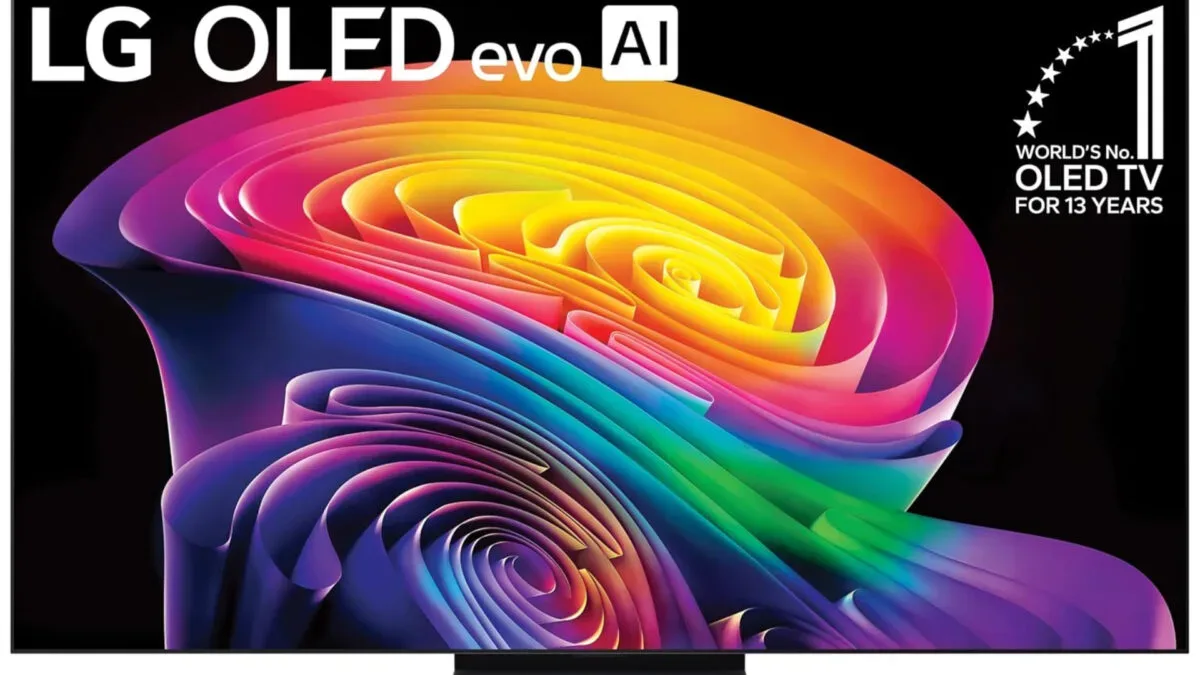
Big-screen gaming is often discussed as a question of image quality, refresh rate, and whether a display can keep up with a powerful PC. The 83-inch LG C6 OLED makes another issue impossible to ignore: physical space. The 2026-model television is 72.5 inches wide—more than six feet—so this is a purchase that begins with a tape measure, not a benchmark chart.
Amazon currently lists the 83-inch C6 OLED at $3,499.99, down from $5,299.99. That is a reduction of roughly 34%, and the listing labels it a limited-time deal. A Prime membership is not required for the listed price. It remains an expensive display, but the discount substantially changes the proposition for somebody already planning an 83-inch OLED for a living-room PC, console, or shared entertainment setup.
An 83-inch OLED designed with gaming in mind
LG’s C6 uses an OLED evo panel. OLED, short for organic light-emitting diode, differs from conventional backlit display designs because each pixel supplies its own light. An individual pixel can turn off completely, producing black rather than relying on a dimmed light behind the screen. In practical game terms, that matters in dark scenes: a moonlit skyline, a shadow-filled room, or a horror-game corridor can retain deep blacks while retaining bright details elsewhere on screen.
The panel contains 8.3 million pixels, and its self-emissive nature is central to the appeal of OLED for games and films. It can give bright interface elements, muzzle flashes, subtitles, and highlights a strong contrast against darkness without the grayish glow that can surround bright objects on some backlit screens.
Brightness remains one of the more complicated parts of any OLED comparison. LG markets Brightness Booster Pro with a claim of pixels up to 3.2 times brighter, but the figure has a footnote and does not provide a clear baseline in the listing. It is best treated as a manufacturer positioning claim rather than a directly comparable brightness measurement. Buyers who are deciding between displays should avoid treating that number alone as a guarantee of a specific real-world result in a bright room.
The C6 supports Dolby Vision, HDR10, and Filmmaker Mode. HDR, or high dynamic range, is intended to expand the visible range between dark and bright portions of an image when the content and display support it. Dolby Vision and HDR10 are HDR formats, while Filmmaker Mode is intended to present material with fewer picture-processing changes; here, it also adjusts to the lighting in the room. Those movie-oriented features do not replace gaming features, but they help explain why a screen this large is positioned as a multipurpose living-room display rather than simply an oversized monitor.
What 165Hz, VRR, and low response time actually mean
The gaming headline is a maximum 165Hz refresh rate, plus a listed 0.1ms response time. Refresh rate refers to how many times the display can update the picture in one second. A 165Hz ceiling can be relevant to a PC capable of delivering very high frame rates. It also gives the television more headroom than a typical 60Hz screen when a compatible game and connected hardware can take advantage of it.
Response time is a separate measurement. It describes how quickly pixels can transition between states. The listed 0.1ms figure points toward reduced motion blur and ghosting, though shoppers should remember that a response-time number and a game’s frame rate do not describe the same thing. One is about pixel transitions; the other is about how many complete frames the system renders per second.
Related coverage includes LG's 83-Inch C6 OLED Drops to $3,499 for Big-Screen Gaming Setups.
The set also supports Nvidia G-Sync, AMD FreeSync Premium, and variable refresh rate, commonly shortened to VRR. VRR lets a display match its refresh cycle more closely to the frames being produced by the connected machine. The practical goal is smoother motion and fewer visual interruptions when frame output is not perfectly fixed. G-Sync and FreeSync are Nvidia and AMD’s respective ecosystems for that kind of synchronization, while VRR is the broader feature category.
For a gaming PC connected to the television, those specifications put the C6 in monitor-like territory on paper: high refresh capability, low stated response time, and support for the major adaptive-sync approaches. Console players may not use every part of the 165Hz ceiling, but the low-latency and VRR-oriented design still targets responsive play rather than treating games as an afterthought.
That combination is particularly interesting for the kinds of games where a large screen changes how a room uses it. Racing games, sports games, fighters, and cooperative action titles all benefit from a shared view without forcing everyone to gather around a much smaller panel. For players following the growing technical demands of modern releases, including the storage and memory conversations around Gears of War: E-Day’s SSD overflow strategy on Xbox Series S, the C6 represents the opposite end of the setup: the display is built to make a large-format, high-spec output visible to a whole room.
Split-screen may be the strongest reason to go this big
An 83-inch screen is not merely a larger version of a 55- or 65-inch television. Its most distinctive gaming use may be local multiplayer. In a two-player split-screen game, each person gets a section of the image that is still large enough to feel substantial. With four players, each quadrant is also far more workable than the tiny boxes created by dividing a conventional living-room television.
That does not mean every game will suddenly work better with four people on one couch. Interface scale, viewing distance, and the game’s own split-screen implementation still matter. But the physical premise is compelling: maps, inventories, scoreboards, and other on-screen information have room to breathe. A display this size is less about a single player sitting inches from an enormous image and more about making a communal screen genuinely usable.
The source dimensions also put that idea in perspective. From roughly three meters away, an 83-inch display can fill a meaningful portion of the viewer’s field of vision. That helps a movie night feel more cinema-like, but it is equally relevant to games with sweeping environments or detailed HUDs. The tradeoff is that the room needs enough distance to make that scale comfortable.
Software, sound, and panel care
The C6 runs LG’s webOS interface and includes Google’s Gemini assistant. LG also lists processor-driven upscaling and picture optimization, along with Dolby Atmos support. Upscaling is the process of adapting lower-resolution material to the panel’s native resolution. It can be useful for older video sources and content that does not arrive at the screen in its highest available resolution, although the final result depends on both the source material and the television’s processing.
Dolby Atmos support concerns sound presentation. It is worth separating that support from a promise about any one room’s audio result: the television can support the format, but speaker placement and the rest of a setup remain important factors in how sound is experienced.
LG also includes OLED Care, described as protection for the panel over time. That is a relevant inclusion for gaming because games often display persistent elements such as health bars, compasses, ammo counters, ability icons, and minimaps. These are commonly called static interface elements: graphics that stay in the same part of the screen for long periods. Panel-care features are intended to address the long-session concern that comes with using an OLED for UI-heavy material.
One specification deserves caution. The listing identifies the television’s processor inconsistently in different places. As a result, any processor-specific performance percentage attached to the listing should not be relied upon until the product information is clarified. The broader listed features—webOS, Gemini, upscaling, picture optimization, Atmos support, and OLED Care—are the more useful points for prospective buyers here.
Measure the room and plan the delivery before ordering
For a television at this scale, logistics are not a footnote. On its stand, the 83-inch C6 measures 72.5 inches wide by 43.1 inches high, with a depth of 11.7 inches. Wall mounting reduces the panel’s depth to 2.1 inches, but a slim panel does not eliminate the need to plan the mount, wall space, cabling, and viewing position.
The first check is straightforward: confirm the width of the intended wall or furniture, then account for any nearby shelves, speakers, doors, or artwork. The second is viewing distance. A large OLED can be the point of a living-room setup, but it needs a seating layout that makes its size enjoyable rather than overwhelming. Finally, buyers should think through the path from the entrance to the room. An 83-inch screen demands considerably more planning than a display that can be carried and positioned by one person.
Amazon currently includes delivery to a room of the buyer’s choice and unpacking at no additional charge. Professional wall mounting is offered for $239.99, not including mounting hardware, and old-set haul-away is available for a fee. The current return window is 30 days. Those terms can make an intimidating delivery more manageable, but they do not remove the value of measuring before purchase.
At $3,499.99, the LG C6 is still a specialized purchase, not a casual upgrade. Its appeal is clearest for someone who wants OLED contrast, high-refresh PC compatibility, modern VRR support, and a living-room screen large enough to make couch co-op and split-screen feel less compromised. The price drop is substantial; the screen’s 72.5-inch width is the equally important specification.
Shop the products
Check current price, model and availability at the retailer.