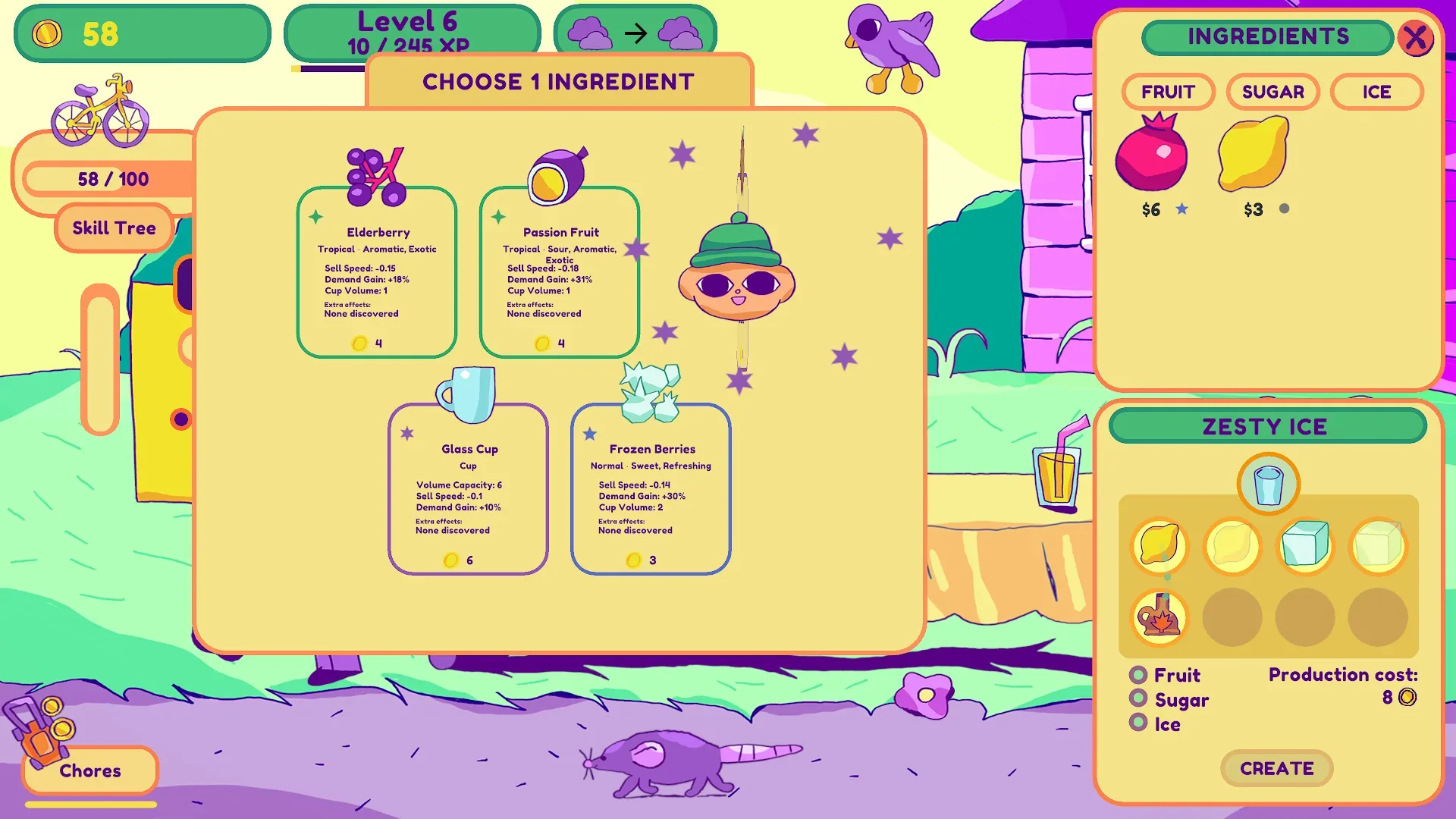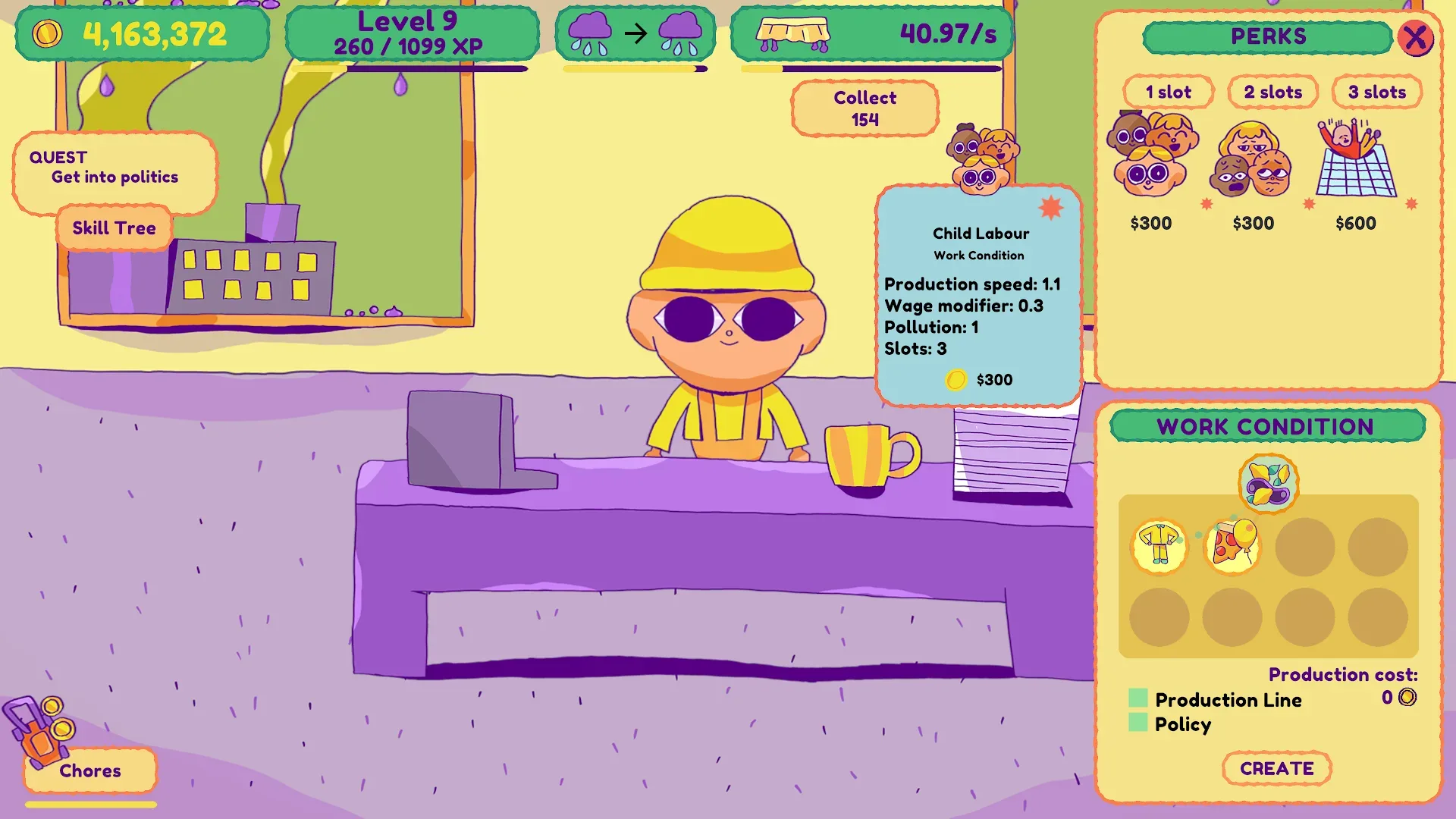
Pantaloon and Adventales have announced Lemonade Apocalypse, a business simulation that takes the humble lemonade stand in a distinctly un-humble direction. Revealed during PC Gaming Show: Tokyo Direct, the game asks players to build and expand a lemonade empire, balancing the immediate appeal of better recipes and bigger profits against longer-term consequences.
A playable demo is planned for October. The reveal arrived with an announcement trailer featuring voice work from Chanisha Somatilaka and Greg Miller, while a Steam page, press materials and more information have also been made available.
From mixing lemonade to running an empire
The central premise is not simply selling drinks. Lemonade Apocalypse is built around scaling a business: making lemonade, adjusting recipes, responding to supply and demand, controlling the climate, seeking political influence and, eventually, pursuing the presidency. That is a deliberately enormous escalation for a game that begins with citrus, sugar and a glass.
Business simulation is a broad term, but it generally describes games where a player makes operational and strategic decisions rather than directly controlling moment-to-moment action. In this case, the announced systems point toward a loop of identifying an opportunity, changing the business to exploit it, watching the effects on profit and then deciding what to do next.
Recipe tweaking provides one understandable layer of that loop. A player may be considering the product itself: what goes into it, how it is positioned and how changes could affect demand. Supply and demand adds the market side. Supply refers to the availability of materials or products; demand is how much consumers want them. When either changes, a business may need to alter what it makes, how it operates or how aggressively it chases profit.
The announcement does not yet set out the exact mechanics behind those choices, so it would be premature to assume a particular pricing model, production chain or customer simulation. But the stated ingredients make the intended fantasy clear: the lemonade operation is meant to grow past a small enterprise and into a powerful institution.
Climate control is part of the pitch
One of the more unusual elements is climate control. Weather and climate can be obvious variables for a lemonade business—hot conditions can make a cold drink more appealing—but Lemonade Apocalypse frames the idea as something the player can control rather than merely endure.
That distinction matters. A game where weather is random asks players to adapt. A game that lets players influence climate potentially turns environmental conditions into another business lever. It could mean players are not only reacting to the market but also changing conditions around the market to suit their goals. The announcement has not explained the scope, cost or limits of this system, so the trailer and October demo will be the clearest next opportunities to see how literal that control is.
Related coverage includes Lemonade Apocalypse Mixes Business Sim Ambition With Climate Control and Political Power.
It also fits the game’s escalating tone. Lemonade Apocalypse is presenting profit-making as an activity that can expand into influence over forces far larger than a shop counter. The name itself suggests that the game is not aiming for a purely cozy small-business story.
Legal decisions, delayed consequences
The most interesting qualification in the announcement is that many business decisions may be technically legal while still creating consequences later. That phrasing suggests the game wants players to think beyond whether an action is allowed in the moment.
In practical terms, delayed consequences are a way for a strategy game to make a profitable short-term decision feel less automatic. If a choice delivers revenue now but creates a future drawback, the player has to judge timing, risk and whether the immediate gain is worth the eventual cost. The announcement does not identify particular penalties or moral systems, so there is no reason to presume how those consequences will be represented. They could affect business outcomes, political ambitions, public standing or another part of the simulation.
Still, the stated idea gives Lemonade Apocalypse a sharper angle than a straightforward expansion game. Maximising profit is explicitly part of the goal, yet the game appears interested in asking what happens when that goal is pursued without regard for everything around it. The tension is not necessarily between legal and illegal conduct; it is between what a player can get away with today and what that decision may set in motion tomorrow.
Lemonade Apocalypse is framing a lemonade empire as a machine with commercial, environmental and political reach—not just a larger version of a roadside stand.
Politics enters the management game
Political power is another announced pillar, including the possibility of running for president. That places Lemonade Apocalypse’s business ambitions well beyond stock management and sales figures. The details of campaigning, elections and governing have not been announced, and it is not yet clear whether a presidential run is a late-game objective, one route among several or a more direct extension of the core business systems.
Even so, the presence of politics helps explain why the game emphasizes consequences. A company may have different priorities from a candidate or officeholder, and a game about moving between those roles can make the player’s earlier decisions more meaningful. A reputation created while building the lemonade business may matter once influence becomes an explicit goal—though that connection remains an inference from the announced premise rather than a confirmed feature.
This kind of cross-system setup can give a management game more than one definition of success. Money may remain important, but influence and the ability to reshape the world around the business can become valuable in their own right. The important unanswered question is how freely the systems interact. The October demo may show whether players encounter climate, markets and politics as separate activities or as parts of one interconnected economy.
What the October demo can establish
A demo is especially useful for a game whose pitch covers several large systems. It can clarify the basic rhythm of play: whether a session starts with hands-on recipe decisions, broader economic planning or both; how quickly a modest lemonade operation grows; and how clearly the game communicates the consequences of a decision.
Players curious about Lemonade Apocalypse should watch for a few practical details:
- Decision feedback: whether the game makes the relationship between a business choice and its result understandable.
- System connections: how recipe changes, supply and demand, climate control and political activity affect one another.
- Consequences: whether delayed repercussions are signposted, surprising or both.
- Scope: which portions of the announced empire-building fantasy appear in the demo and which are being held back for the full game.
None of those points are confirmed by the announcement, but they are the key questions raised by its feature list. A strong business sim does not need to make every outcome predictable; it does need to give players enough information to form a strategy and learn when it fails.
A growing taste for unusual simulations
Lemonade Apocalypse joins a broad PC simulation space where ordinary work is often used as the doorway to stranger and more elaborate ambitions. The distinguishing feature here is the scale of the stated progression: drinks become an empire, the empire reaches into climate, and commercial success can become a bid for political office.
For another recent example of a PC game using an everyday craft as the basis for a more focused simulation, see Dressmaker’s tactile tailoring premise. Lemonade Apocalypse appears to be pursuing a far more satirical and system-heavy direction, but both illustrate how a familiar activity can support a game built around process and player choice.
For now, Pantaloon and Adventales have established the core promise without spelling out every system underneath it. Lemonade Apocalypse has a trailer, an October demo on the way and an intentionally outsized vision of what can happen when a lemonade business stops being content with lemonade.