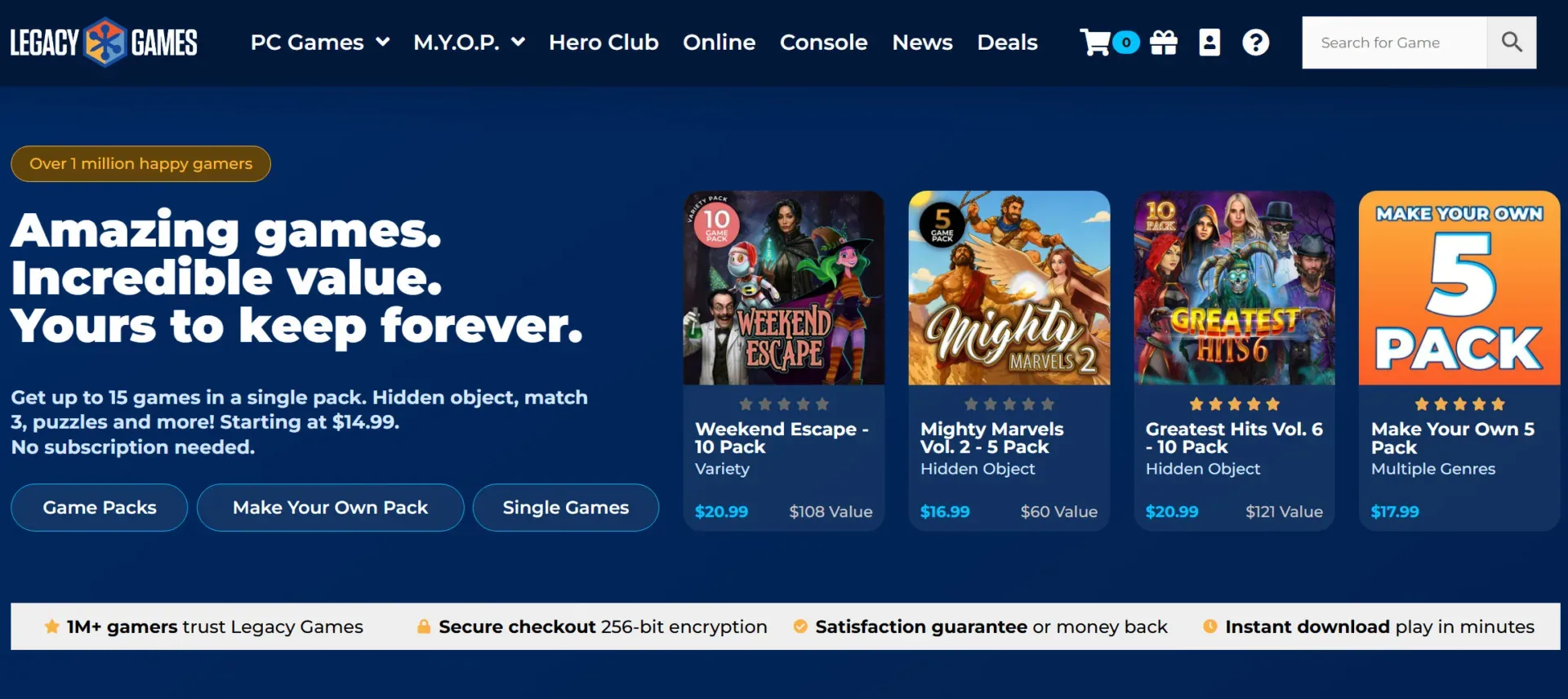
Legacy Games, a PC storefront and launcher known for inexpensive bundles of lesser-known indie and casual games, is preparing to shut down. Its most prominent sales promise has been that its games are “yours to keep forever,” but the company’s closure timetable puts a very clear condition on that claim: customers need to download and install the games they want to retain before February 28, 2027.
That date is the final cutoff for the Legacy Games storefront and its broader online services. For people with claimed purchases sitting uninstalled in their account libraries, the important task is not simply to remember that the games were bought. It is to retrieve and install them through the Legacy Games Launcher while that remains possible.
What is ending, and when?
Legacy Games has offered packs that can include up to 15 games, with an emphasis on genres such as hidden-object games, match-three games and puzzle games. Its packages started at $14.99, did not require a subscription, and the company says it has served more than one million customers. The closure affects the storefront and launcher infrastructure that customers use to access those purchases.
The deadlines do not all land on the same day:
- December 1, 2026: Game-of-the-month deals will end.
- December 31, 2026: Disc download codes will stop working. Existing points, rewards and membership perks will also expire at year’s end.
- February 28, 2027: The Legacy Games online storefront and remaining services will go offline. This is the last stated day to download and install purchased games through the launcher.
Legacy Games instructs customers to install their purchased titles as soon as possible and no later than the February deadline. Its stated position is that games already installed can still be played through the launcher afterward. That distinction is central: the stated preservation path is installation before the shutdown, not an expectation that the library can be re-downloaded later.
What customers should do now
Anyone with a Legacy Games account should treat this as a library-retrieval job rather than a last-weekend chore. A purchased game that has been uninstalled, ignored in a backlog, or claimed as part of a bundle may require attention before it can remain accessible under the company’s guidance.
- Sign in to the Legacy Games Launcher. Confirm that the account still shows the games you expect to have claimed or purchased.
- Review the full library, not only favorites. Bundle storefronts can make it easy to overlook games obtained alongside the title that motivated the purchase.
- Install the games you want to preserve before February 28, 2027. The company specifically directs users to download and install them through its launcher before the cutoff.
- Handle disc codes before the earlier December 31, 2026 deadline. A code that has not been redeemed by then will no longer work.
- Do not depend on points, rewards or membership benefits after the end of 2026. Those balances and perks are scheduled to expire.
This is also a useful reminder that a digital library is not one uniform thing. The words “purchased,” “claimed,” “downloaded” and “installed” can have different practical consequences. In Legacy Games’ case, the stated cutoff makes installation the decisive step for customers who want to continue using a title after the storefront closes.
Amazon Luna-related claims have their own condition
Legacy Games also had a partnership involving Amazon’s Luna streaming service. The company says games connected to that arrangement will continue to be supported, but only where they were claimed before the end date. That is a separate eligibility condition from a game merely being visible on a storefront page.
Related coverage includes Legacy Games Storefront and Launcher Will Shut Down in February 2027.
Customers with games tied to that partnership should therefore check whether they have already claimed the relevant titles rather than assuming the connection will remain available once Legacy Games’ services have ended. The supplied closure details do not establish any broader outcome for unclaimed items, so it is sensible to avoid reading more into the support statement than it says.
Why “ownership” is more complicated in a launcher era
The immediate news is a closure, but the bigger issue is digital preservation. Storefront marketing often frames a purchase as permanent ownership. In practice, access can depend on services that are not permanent: a store, a launcher, an account system, a download server, or an authentication process.
A launcher is software used to obtain, manage and start games. It can be convenient because it centralizes updates and libraries. It can also become an access bottleneck when a company discontinues the service behind it. Legacy Games’ instructions indicate that installing a title before shutdown is what enables continued play through the launcher, while leaving it in an account for a future re-download is no longer a dependable option after February 28, 2027.
That does not mean every PC game store works in exactly the same way. The relevant technical term is DRM, short for digital rights management. DRM is a set of access controls that can require software to verify a purchase, account or license. Games offered without DRM can generally be moved between a player’s own storage devices without relying on a launcher or a later store download. That does not eliminate every preservation concern, but it reduces the risk that a shuttered storefront becomes the sole route back to a game.
The Legacy Games situation is a practical illustration of the difference. The company is not describing an endless cloud library that will always be waiting for users. It is advising customers to create a usable installed copy before its infrastructure disappears.
The storage problem is real, but so is the deadline
One obvious frustration is storage. A large bundle library can take significant room, and customers may not have enough free capacity to install every title at once. That concern has appeared in community discussion around the closure, alongside criticism of a “forever” promise that now comes with a firm download deadline.
Still, the deadline gives users time to prioritize. Start with games that are hardest to replace, titles that have personal value, and any purchases whose installation status is uncertain. Then work through the rest of the library as device capacity permits. The key point is that waiting until the service is nearly gone creates unnecessary risk, especially when the company is explicitly urging users to install games as soon as they can.
This does not require pretending that every game in a bundle will be played immediately. Preservation and play are different goals. A player can decide which games matter enough to install now while recognizing that the chance to obtain them later through Legacy Games will end with the service.
A broader warning for PC libraries
It may feel difficult to imagine the largest PC storefronts disappearing, but scale is not the same as permanence. Legacy Games’ closure is a concrete reminder that digital-game buyers should understand how their libraries are delivered and what happens if the delivery platform changes or ends.
For shoppers, that means paying attention to the terms behind reassuring phrases such as “keep forever.” For existing customers, it means periodically checking whether important games are installed and whether their access depends on an active service. It also means recognizing the advantage of DRM-free copies where they are available: they can be transferred among a player’s own storage devices without requiring a future launcher download.
The conversation is especially relevant to PC players because libraries often accumulate quietly through packs, promotions and monthly offers. An account can hold dozens of titles that were never installed, and a closure only becomes urgent when the access window starts to narrow. Readers following other PC-platform changes can find related coverage in this look at Ace Combat Zero’s planned PC app.
For Legacy Games customers, however, the action is straightforward and time-sensitive. Game-of-the-month offers end first, disc codes and account benefits expire at the close of 2026, and the store and launcher go offline on February 28, 2027. If an installed game is the company’s route to continued access, installation should happen well before that final day—not after the meaning of “forever” has already run out.