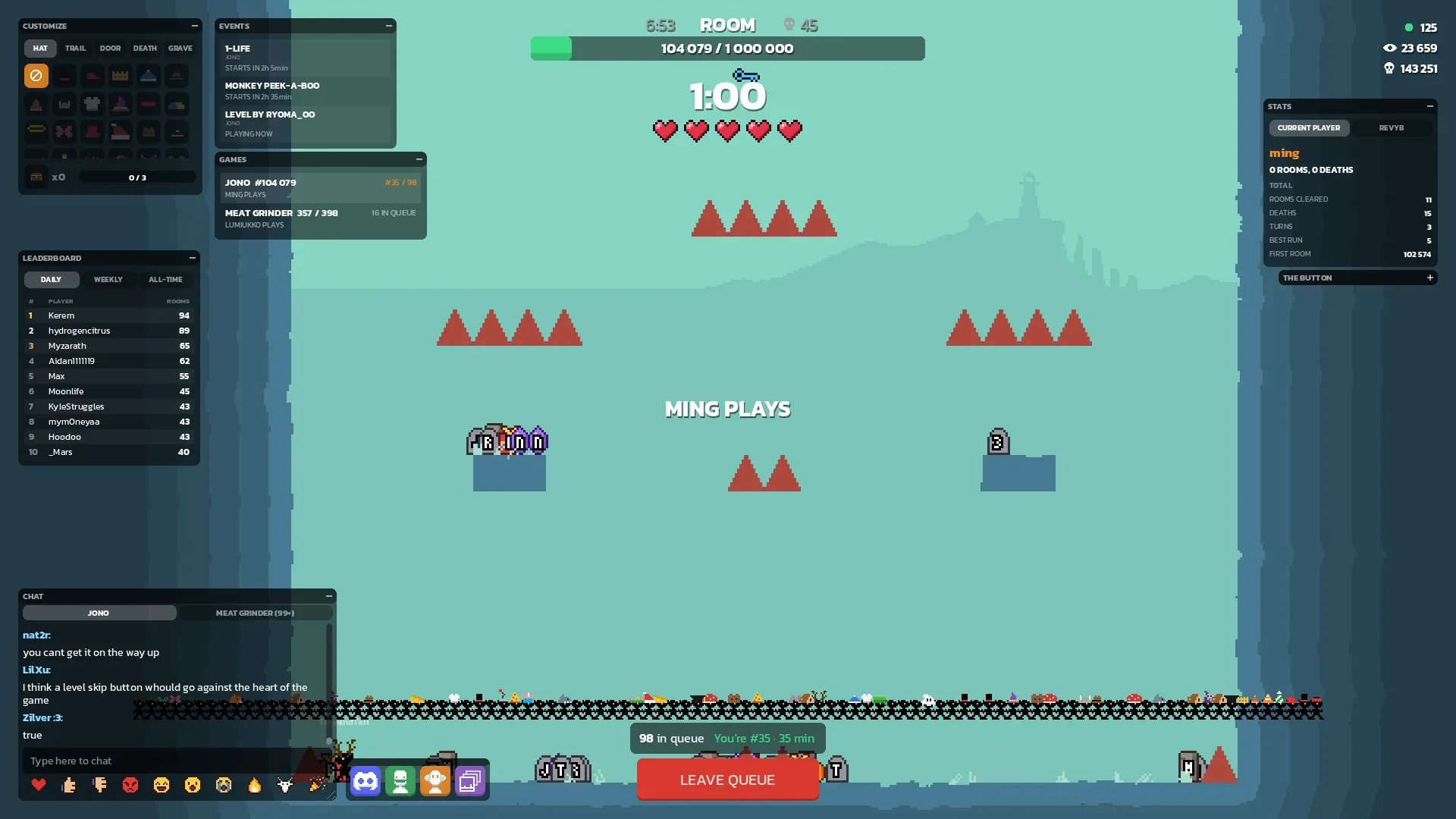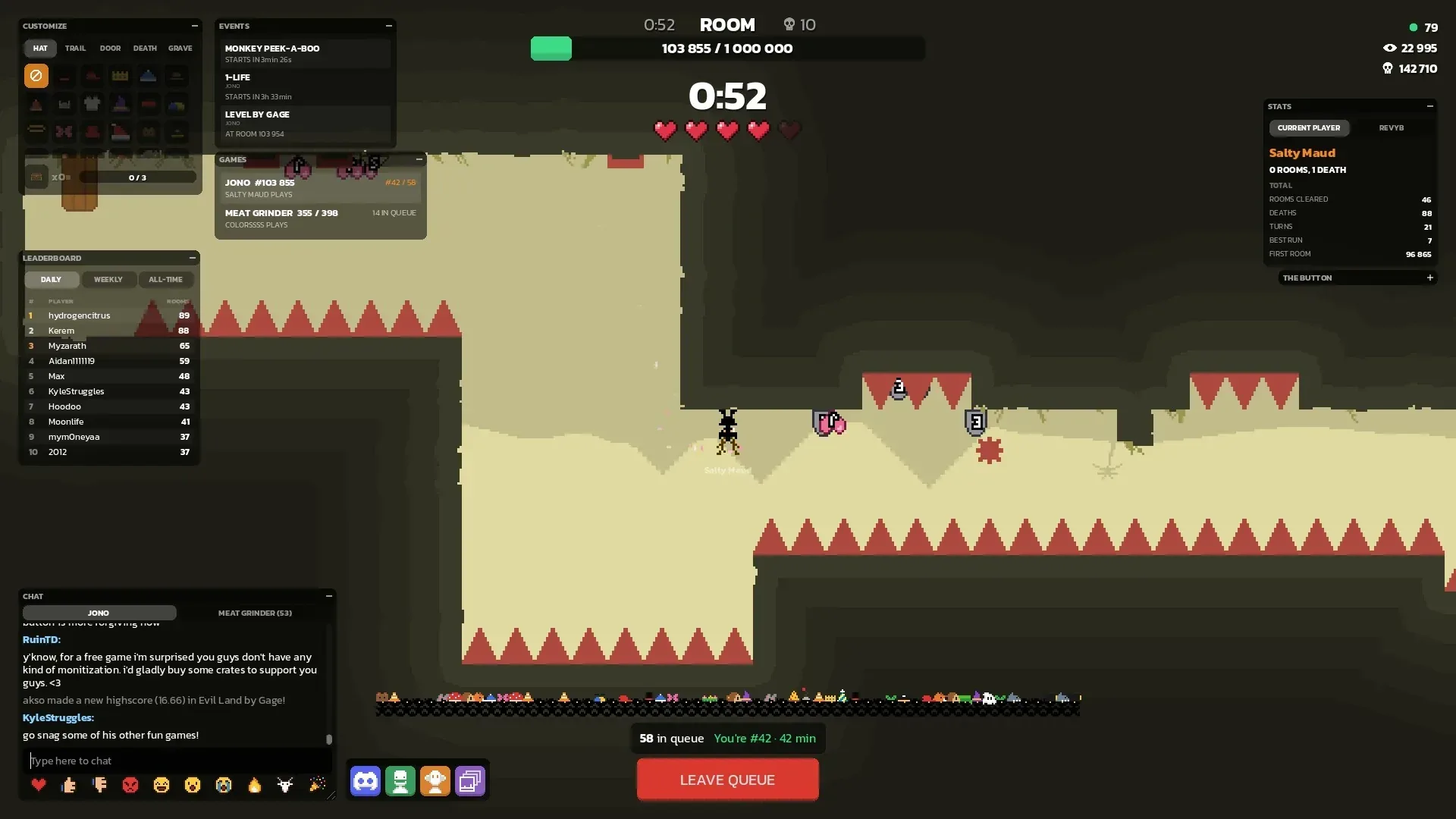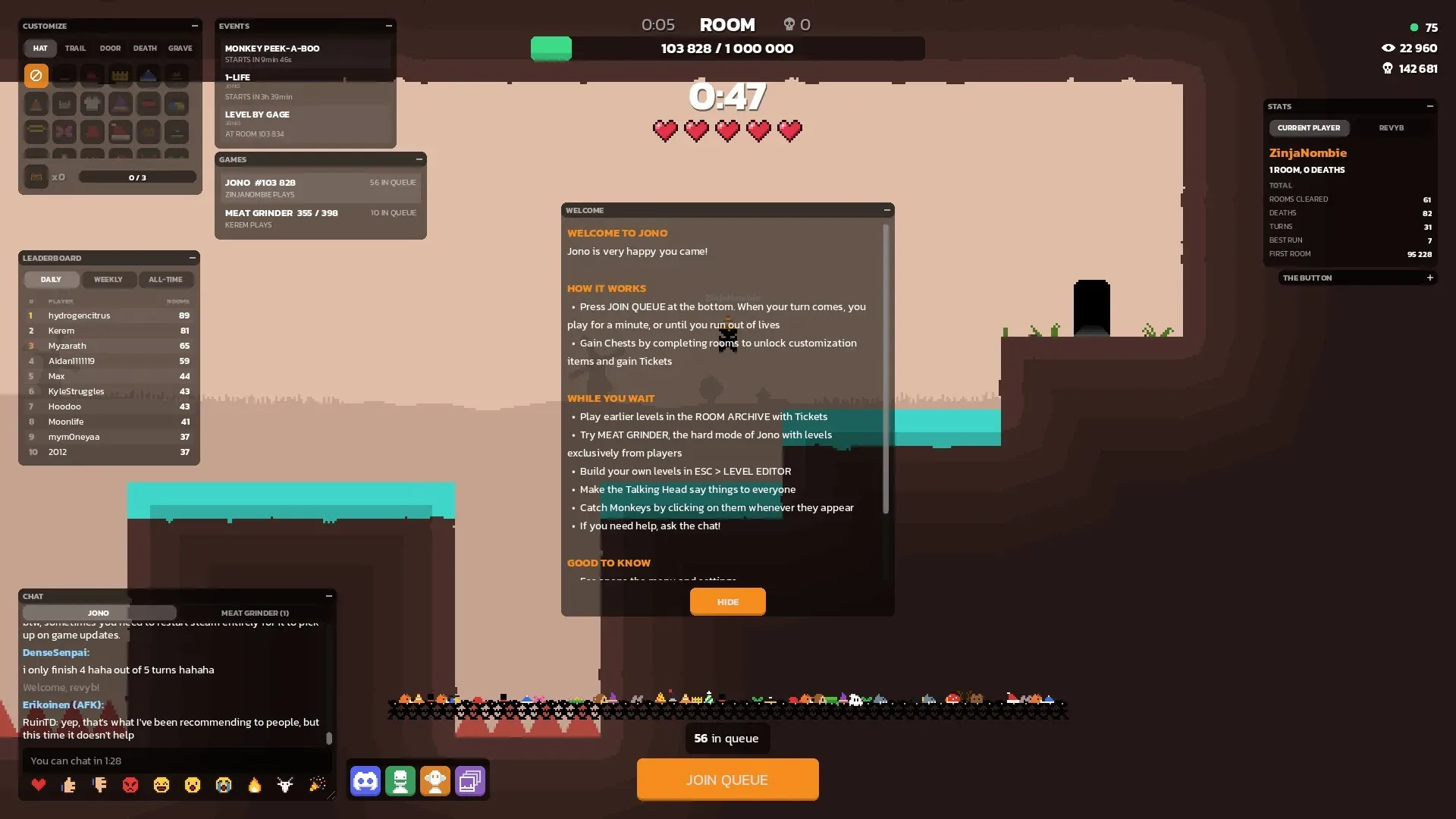
Most platformers make a simple promise: pick up the controller, jump over the spikes, reach the exit, repeat. Jono makes a much stranger offer. Open the game, and someone else is already playing. You can watch their run, follow the chat, join a global queue, and wait for the one-minute window when control finally passes to you.
That constraint is the whole joke, and seemingly the point. Only one player anywhere can actively control Jono at once. A turn ends after one minute or five deaths, whichever happens first, and the next person in line takes over. Rather than treating the wait as dead time, the game wraps it in spectatorship, low-stakes interaction and a persistent community effort to clear an enormous sequence of rooms.
Jono is free to play on Steam and is described as having no monetization. It reportedly contains one million rooms, though that scale should be treated as the game’s stated total rather than a completed journey waiting for any individual player. At the reported point in progress, the shared community had reached room 104,680. Every completed room stays completed, meaning the project moves forward even when most participants are watching rather than jumping.
How Jono’s global queue works
Jono’s basic loop is unusually easy to explain:
- One player has control worldwide.
- Everyone else sees that player’s current attempt and can enter the queue.
- The active player gets up to one minute, unless they die five times first.
- Control moves to the next queued player.
- Finishing a room advances the shared run permanently.
The result is a platformer built around scarcity of input rather than scarcity of lives or continues. A player may spend far longer watching than playing. During busier periods, the queue has reportedly sat in the low hundreds. Because players can leave before their turn and difficult rooms may burn through five deaths quickly, position in line is not a precise timer. Still, an hour between brief attempts is a plausible rhythm.
That sounds actively hostile to the usual expectation of a videogame—immediate agency—but it creates a different kind of tension. The level is already familiar by the time a player reaches the front. Everyone has seen others miss the same jump, trigger the same surprise hazard or discover a safer route. Then the handoff arrives and the observer becomes the person who has to execute.
It is less a conventional single-player platformer with a chat box than a tiny relay event. One person’s failure can reveal a trap for the next person; one person’s success can remove an entire room from the collective path. The active player owns the controls for a minute, but the crowd owns the context.
A simple moveset carrying a long communal climb
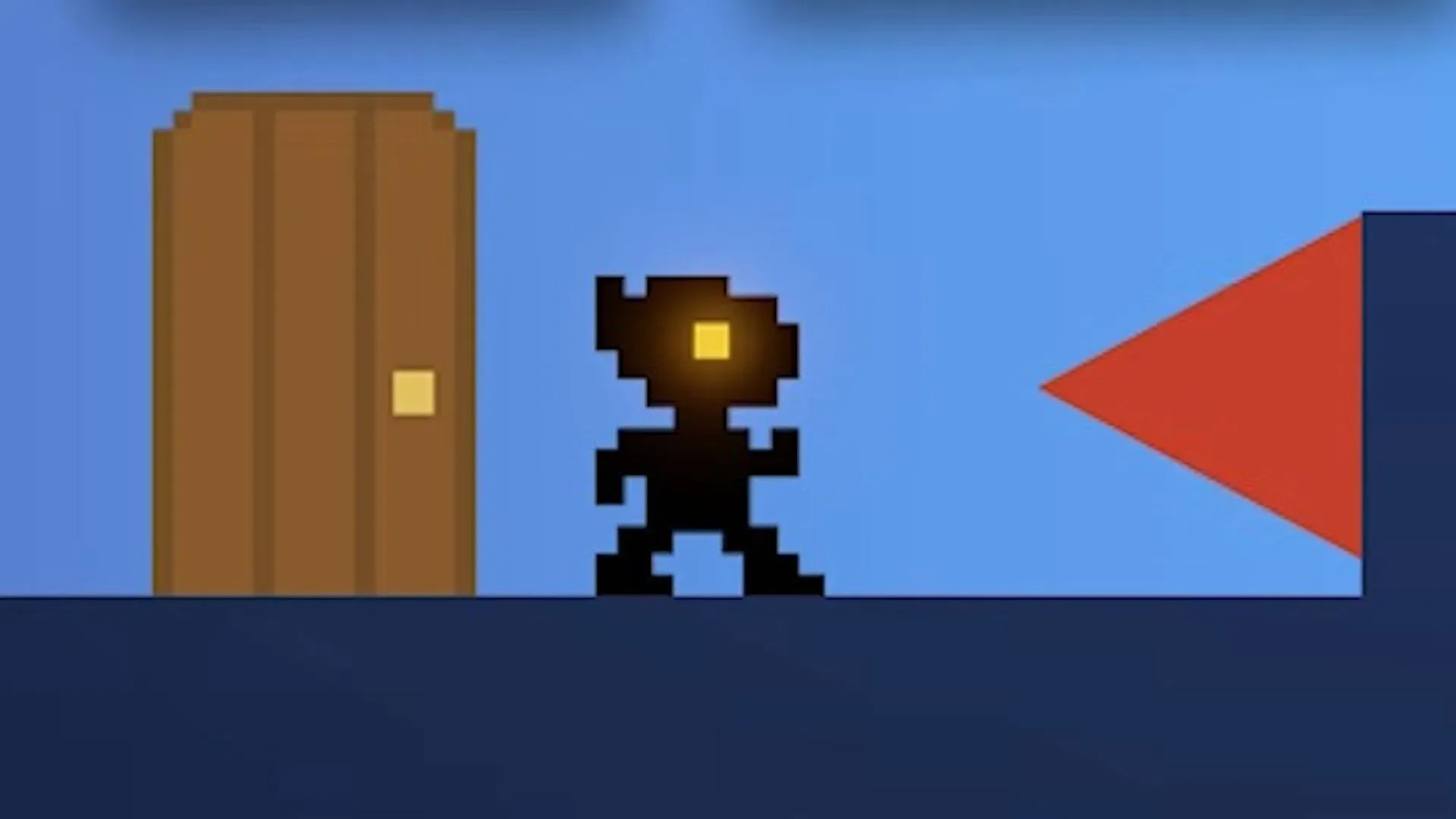
The character is a small stick figure whose core abilities are straightforward: jump and double jump. The typical objective is to reach a door elsewhere in the room. That economy matters. With only a few inputs to understand, viewers can read a room quickly and immediately recognize what went wrong when a run ends on red spikes or a fall.
Related coverage includes Jono Turns a Million-Level Platformer Into a Global Queue.
The rooms are not limited to ordinary gaps and spike pits. Reported variations include portals that reposition the character, icy floors, upside-down layouts, keys needed to open doors, and spikes that can appear unexpectedly. Those elements are enough to make each short attempt feel like a puzzle of movement, timing and memory rather than merely a test of reflexes.
The mention of “Kaizo” helps describe the game’s trickier instincts. In platform-game language, Kaizo generally refers to deliberately demanding design that expects exact timing, close knowledge of hazards and repeated failure while learning a route. Jono appears to borrow some of that spirit in its surprise traps and punishing setups, but its turn limit means a player often cannot simply grind a room privately until it becomes automatic. Their learning is public, and their mistakes become information for the line behind them.
Respawning also keeps the focus narrow. Players always return to the start of the room they are currently on, rather than being sent backward through previously solved stages. The larger run is persistent; the immediate challenge is contained. That structure avoids turning a missed jump into the loss of a long personal session, which would be a particularly rough fit for a game that may only grant a minute of direct play at a time.
The million-room question: generated, curated and player-made levels
A claim of one million rooms naturally raises questions about how those rooms are built. The available information points to a mixed approach. The creator has said the game combines procedurally generated rooms that follow preset patterns with player-created rooms that are reviewed and scheduled by the developer.
Procedural generation means game content is assembled through rules or systems rather than each instance necessarily being built entirely by hand. “Preset patterns” is an important qualifier here: it suggests the generated content is not simply unconstrained randomness. The exact composition and selection process have not been detailed in the available information, so it would be a mistake to assume every room is wholly random or wholly handcrafted.
There is also no AI disclosure on Jono’s Steam listing. That absence does not, by itself, establish how every asset or level was made. What is established by the creator’s explanation is the stated use of procedural patterns and reviewed player submissions. Those are distinct from a claim that generative AI created the game’s rooms.
Especially difficult community submissions have a separate destination: the Meat Grinder. To place a level there, its creator only needs to beat it once, a validation rule familiar from creator-driven platform games. The division is practical. It keeps the main shared progression from being overwhelmed by the harshest challenge levels while giving players a place to submit and face fiercer designs.
That moderation and scheduling layer may be one of the most important pieces of the million-room premise. A community-made level pipeline can generate variety, but it can also produce abrupt difficulty spikes. Separating the most punishing creations into another mode gives the main queue a better chance of remaining a long-running public climb rather than a permanent traffic jam at one brutal room.
Why the waiting may actually work
Jono’s platforming alone is intentionally spare. Its social layer gives the downtime a purpose. Players can chat while a run is underway, inspect statistics such as rooms completed and total deaths, and use emoji reactions to encourage—or gently heckle—the person currently holding the controls.
There are also small diversions designed specifically for queue time. A continuing “Don’t press the button” activity runs alongside the platforming, while a monkey can occasionally appear at the edge of the screen for viewers to click first. Neither replaces the main game. They acknowledge that Jono’s unusual structure has created an audience with gaps to fill.
Cosmetic rewards extend that sense of presence. Completing three rooms grants a chest that can contain items such as hats for the stick figure and distinctive tombstones for deaths. These do not appear to alter movement or confer an advantage. Their value is social: a hat makes a player recognizable for their fleeting turn, while a custom grave marker gives failure a little personality in a game where failure is extremely visible.
This is a useful distinction. Jono is not asking every person in the queue to become equally skilled or equally important. It gives spectators ways to participate without pretending that watching is identical to playing. Chat, reactions, mini-games, stats and cosmetics create a surrounding space for the central relay, while the scarce control window remains the prize.
A game designed for the second monitor
The most natural way to approach Jono may be as a background social space rather than a game demanding uninterrupted focus. Keep it visible while doing something else, check in when a room looks especially difficult, and pay closer attention as the queue gets shorter. In that use case, the wait is not necessarily an obstacle. It is the format.
That does come with a straightforward practical tradeoff: players who want to practice one sequence repeatedly and improve through constant, private repetition may find the global handoff frustrating. The same room might be solved before their turn arrives; their turn might begin on a particularly awkward room; and a bad stretch can end in five rapid deaths. Jono is not built around dependable solo progression.
For players comfortable with that loss of control, however, the format creates a rare shared stake. Watching someone else finally solve a troublesome room is good news even if it means you will never get to play it yourself. Your own brief turn can help the people behind you, whether it ends in a clear, a useful discovery or five gravestones in quick succession.
Steam has recently also been home to projects that preserve unusual or inaccessible pieces of game history, including a free playable archive for a canceled Paranormal Activity project. Jono is a very different proposition, but both show how the platform can accommodate experiences that sit outside the usual big-release model.
What Jono is really testing
Jono’s million-room figure makes for the headline, but the queue is the actual experiment. The game turns platforming into a public resource: one controller, one current room, one uninterrupted chain of players. Its rules limit individual ownership while making every successful door part of a persistent group accomplishment.
That is why a bare-bones stick figure, red spikes and a one-minute timer can sustain more interest than their individual pieces suggest. The game is not only about whether you can double jump cleanly. It is about whether the stranger ahead of you can, whether chat spots the route, and whether the collective is one room nearer to a stated million-room finish.
For now, Jono’s appeal is likely strongest for people who enjoy the peculiar mixture of passive viewing and sudden pressure. It asks for patience, tolerates failure and makes a virtue out of the fact that someone else is always playing. In most platformers, waiting in line would be a bug. Here, it is the level before the level.