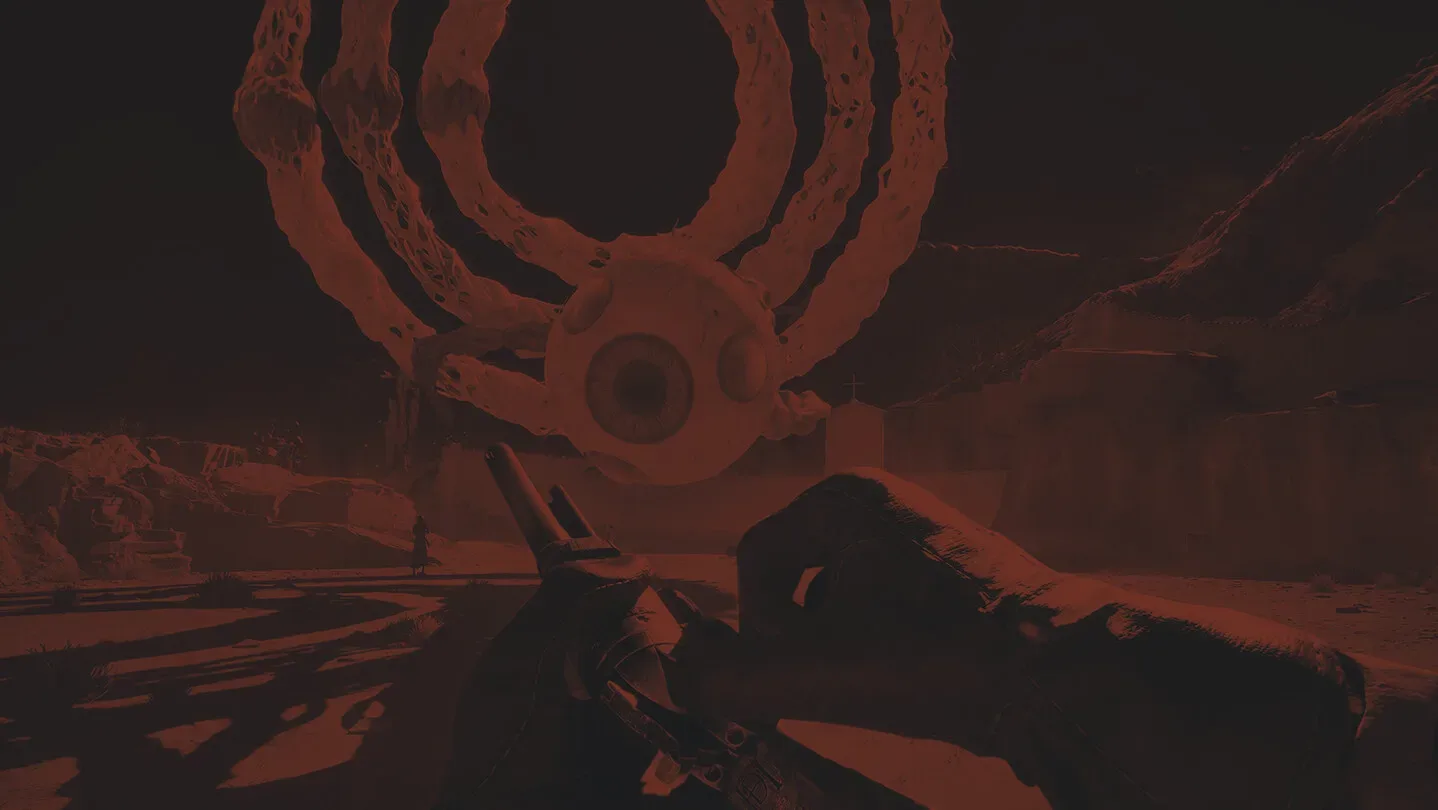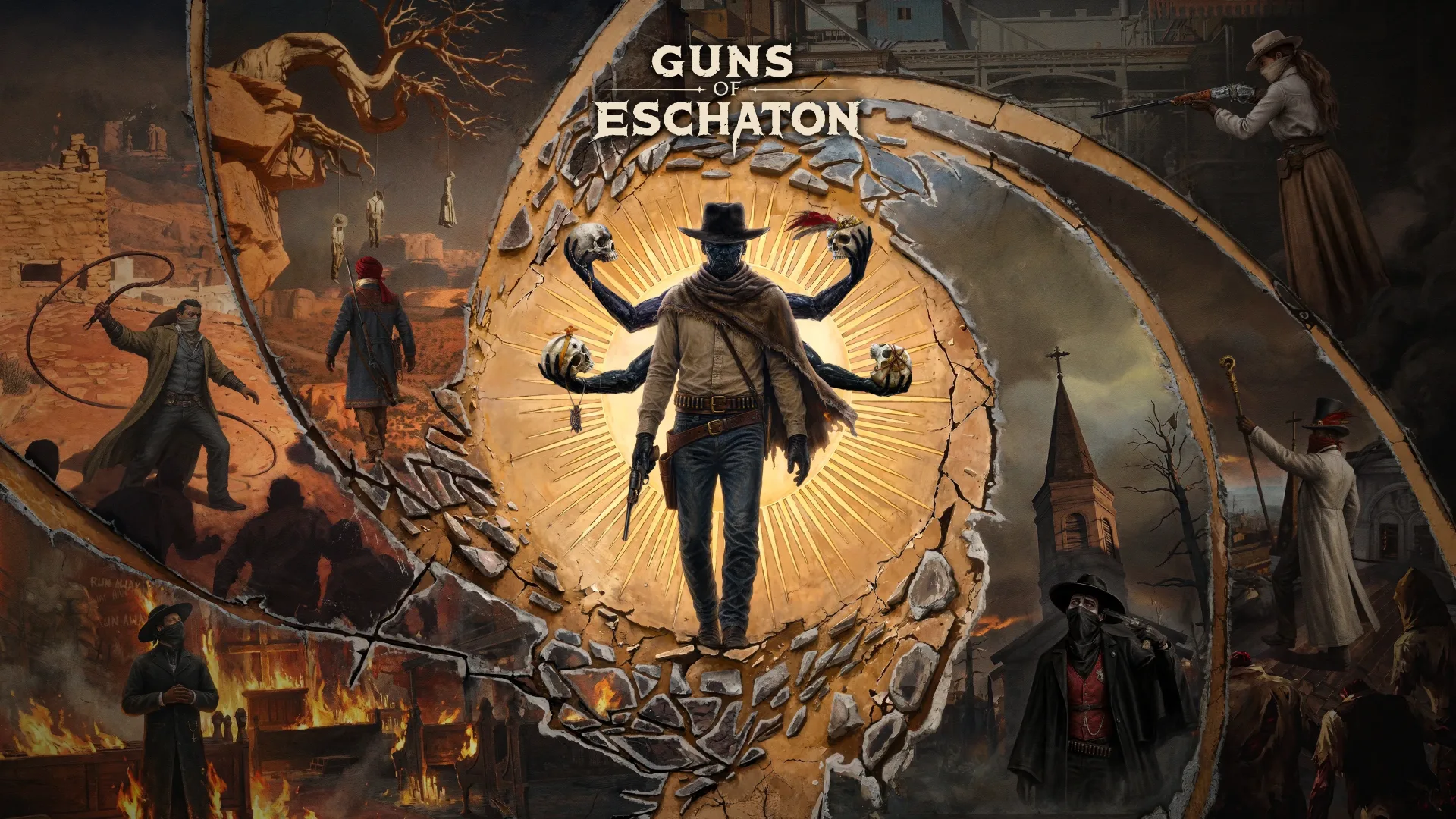
Guns of Eschaton now has a demo on Steam, giving PC players an early look at its severe blend of first-person shooting, Western imagery and Soulslike pressure. Developed by Eschatology Entertainment and published by 4Divinity, the game casts players as a mysterious gunslinger moving through an apocalyptic version of 19th-century Americana—an environment where a missed shot apparently carries more emotional weight than an unpaid bar tab.
The demo arrived on October 5, 2026, and is scheduled to remain available through Steam Next Fest, running October 19 through October 26, 2026. It is positioned as a chance to sample the game’s combat systems before the event rather than merely admire a dusty hat from a safe distance.
Its core pitch is deliberately harsh: ammunition is limited, mistakes can be fatal, and death is framed as part of the learning process. Guns of Eschaton calls itself a Western FPS Soulslike, a description that suggests the game is interested in more than fast aim and an itchy trigger finger. Players will need to study the threats in front of them, consider which equipment is appropriate and make each round count.
A first-person shooter where ammunition is a decision
Scarce bullets are one of the clearest signals of what Guns of Eschaton wants from its combat. In many shooters, ammunition functions as a renewable buffer: shoot first, sweep through rooms later, and collect whatever a fallen crate has decided to produce. Here, the stated scarcity changes the role of every shot. Ammunition is not just a way to deal damage; it is a limited tactical resource.
That can alter the player’s priorities in several ways. A firearm may still be the most direct answer to danger, but the best answer is not necessarily to fire immediately. The game’s demo also includes timed parries, occult powers, talismans and consumables, each of which suggests a potential alternative or complement to conventional shooting. The exact balance between these tools is not detailed, but their inclusion points toward combat encounters that reward adaptation rather than a single reliable weapon routine.
Timed parry is a useful term to unpack in this context. A parry typically asks the player to respond at a narrow, precise moment to an incoming attack, potentially negating it or creating an opening. Its presence in a first-person Western shooter is notable because it makes timing and enemy recognition part of survival alongside aiming. Players who conserve ammunition through well-timed defensive play may be better placed for the dangers that follow—assuming, naturally, their reflexes are prepared to cooperate.
The demo’s focus on specialized ammunition further reinforces that combat is intended to be situational. Specialized ammo means shots can have a purpose beyond simply being “the bullet currently in the gun.” The available information does not specify individual ammunition types or effects, so it would be premature to assign them particular roles. Still, the design language is clear: loadouts and choices appear meant to matter, especially when supplies are constrained.
Occult powers meet historically inspired firearms
Guns of Eschaton brings together historically inspired firearms and occult abilities. That contrast sits at the center of its identity. The setting draws from 19th-century Americana, but it is not presented as a straightforward historical Western. This is an apocalyptic world, and the gunslinger’s toolkit includes supernatural powers alongside talismans and consumable items.
Related coverage includes Guns of Eschaton Demo Hits Steam Before October Next Fest.
The phrase historically inspired deserves a little restraint. It signals that the weapons take cues from firearms associated with the era rather than promising exact museum-grade simulation. The game’s combat framework is clearly fantastical, after all, and the occult layer is not attempting to hide behind the saloon piano. Players looking at the demo should therefore expect Western flavor integrated into a supernatural action game, rather than a purely historical firearms exercise.
Talismans and consumables broaden the player’s available options. A talisman is generally an item associated with a magical or protective effect, while consumables are items used up when activated. Guns of Eschaton identifies both as tools available in the demo, though it does not yet explain their individual abilities, duration or limits. What can be said is that their presence supports a broader combat loop in which preparation and resource usage may carry real weight.
That blend is particularly important because the game describes a single mistake as potentially fatal. In a punishing action game, systems only become meaningful when the player must decide when to deploy them. An occult power saved too long may go unused; an item spent too early may be absent when the situation worsens; a valuable round put into the wrong target may leave the revolver unhelpfully philosophical at the next confrontation. Guns of Eschaton’s stated design makes these kinds of trade-offs central to its appeal.
The Codex is designed to turn information into an advantage
Another major tool in the demo is the in-game Codex. It can reveal enemy weaknesses and help players plan their tactical approach. A codex, in game terms, is a reference collection that records information about the world—often enemies, items, characters or lore. In Guns of Eschaton, it has a direct practical purpose: it is meant to help players identify how to approach hostile encounters.
That matters in a game built around scarce ammunition and high consequences. If every encounter can punish a mistake, understanding an enemy’s weakness could be more valuable than simply trying to overpower it. The Codex may encourage players to pause, inspect what they have learned and adjust their tactics before charging back in. It is a modest but meaningful counterweight to the genre’s usual “learn through failure” reputation: death is still a lesson, but the game also offers a notebook for the part of class where the lesson is supposed to stick.
There is no detailed breakdown of how entries are obtained, how many weaknesses exist, or whether Codex information changes over time. Those are questions the demo may help answer, but they should remain questions for now. The confirmed point is narrower: enemy research is an explicit part of the game’s intended tactical toolset.
What “Soulslike” signals here
Soulslike is a broad label, but Guns of Eschaton pairs it with several concrete ideas: demanding combat, lethal errors, repeated learning, deliberate resource management and timing-based defense. The game is also an FPS, meaning its action is played from a first-person perspective, which gives shooting and immediate spatial awareness a more prominent role than in many third-person action games.
The combination may appeal to players who want tension in their shooters without reducing that tension to enemy damage values alone. Limited bullets create pressure; parries introduce timing; specialized ammunition and supernatural tools create loadout considerations; the Codex supports knowledge-based planning. These elements form a picture of an FPS where survival is meant to come from combining information, execution and conservation.
Of course, a demo is especially useful for a premise like this because game labels can only do so much heavy lifting. “Western FPS Soulslike” is a compact description, but the feel of weapon handling, the timing window of a parry, the severity of ammunition limits and the usefulness of the Codex are the details that determine whether the pieces make a convincing whole. The Steam demo offers an opportunity to assess those fundamentals directly.
Steam Next Fest timing and what is confirmed
The demo is live before Steam Next Fest begins, giving interested players time to approach it at their own pace before the October 19–26 event window. Its availability through the festival means it should also remain accessible during Next Fest itself. A trailer is available as well, offering a visual introduction to the game’s atmosphere and action.
No full release date, price, console version, system requirements or final game scope has been specified in the available details. Likewise, the announcement does not enumerate the demo’s content, its length, the number of weapons, the types of enemies, or the precise effects of its occult equipment. Keeping those boundaries clear is worthwhile: the confirmed features establish a promising direction, while many of the particulars remain for the developers to outline later.
For players browsing a busy Steam calendar, the timing is notable. October’s festival will offer many demos competing for attention, and Guns of Eschaton arrives with a distinct proposition: an end-times Western in which a gun is powerful but not carefree, knowledge is treated as equipment, and the supernatural is apparently welcome at the range. Those interested in other PC demo releases can also see how Teamcrafter’s Steam demo approaches roguelite strategy from a very different angle.
For Guns of Eschaton, the immediate takeaway is straightforward. The Steam demo is available now, it will stay up through Steam Next Fest from October 19 to 26, and it presents a demanding first-person combat system built around historically inspired guns, specialized ammo, precise parries, mystical abilities and careful enemy study. In other words: bring composure, read the Codex, and try not to spend the last bullet on a dramatically unimportant barrel.