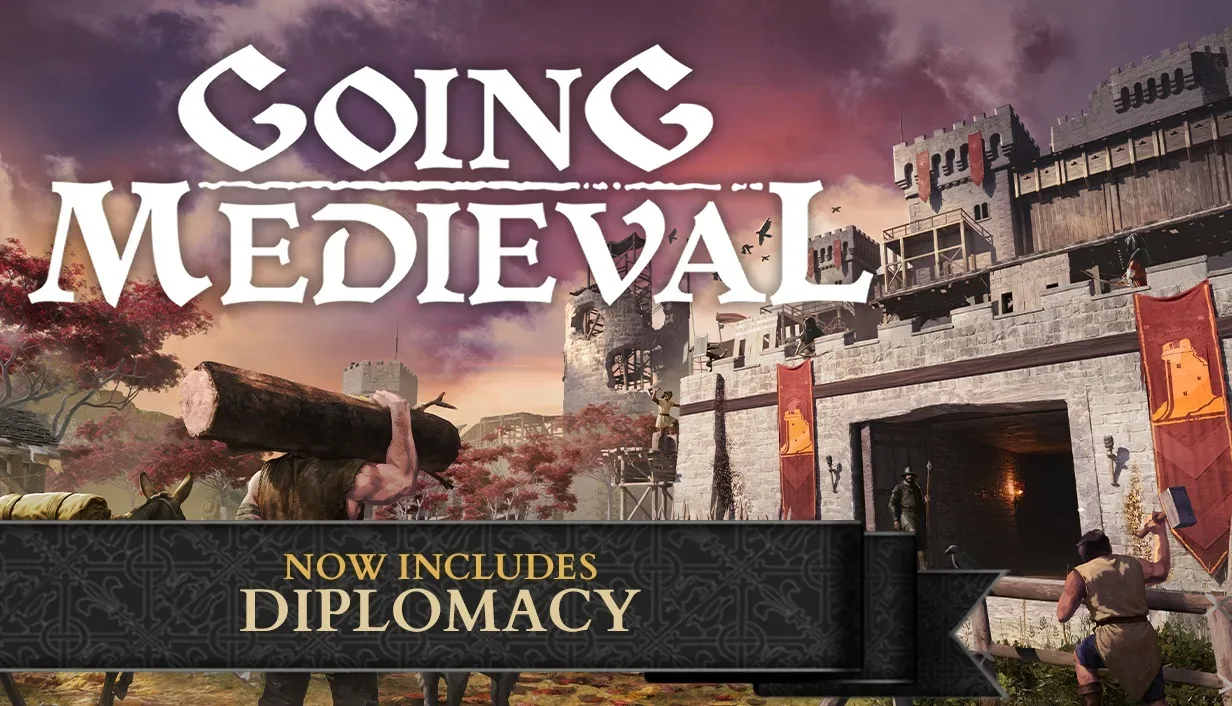
Going Medieval has expanded the concerns of its castle builders beyond their own walls. The game’s Diplomacy Update is available now on Steam, the Epic Games Store and GOG, introducing a diplomacy system built around caravans, relationships with 12 NPC factions, revised trade, recruitable workers and mercenary support.
For a settlement-management game about rebuilding after calamity while enduring raids, the new systems broaden the choices available between isolation and direct conflict. Players can now contact nearby settlements rather than treating the wider world solely as a source of danger or commerce. That does not mean every interaction will lead to friendship: factions can be difficult to deal with, and some will be openly hostile.
The update is a substantial fit for Going Medieval’s established loop of building a fortified settlement, managing its inhabitants and preparing defences. The important change is that growth can now involve political and economic decisions as well as construction and survival. A stronghold may still need stout walls, but it can also benefit from carefully chosen pacts, a timely caravan and specialist labour acquired from outside its own population.
Caravans turn diplomacy into an active settlement decision
The centrepiece is the new Diplomacy System. Players can dispatch caravans to neighbouring settlements and use those visits to form alliances, make demands or offer peaceful favours. In practical terms, caravans are the means by which a player engages with the region’s politics; diplomacy is not described as a passive background value that changes without player involvement.
An alliance is a cooperative relationship between settlements. A demand is a more forceful diplomatic action, while a favour is an explicitly peaceful offer. Those three options establish a useful spectrum in the update’s design: players are not restricted to buying goods or fighting over resources, but can choose a stance ranging from conciliatory to confrontational.
Going Medieval now includes 12 NPC factions with which players can work or clash. NPC means non-player character; here, it refers to groups controlled by the game rather than another human player. Each faction contributes a different relationship to manage, and a settlement’s dealings can involve trades, pacts and changing relationships. The system therefore gives a larger settlement a new set of priorities beyond immediate stockpiles and incoming raids.
There is no guarantee that a caravan trip results in a useful agreement. The update specifically frames some factions as uncooperative or hostile. That uncertainty matters. It suggests players should not assume diplomacy simply removes risk from settlement expansion. Instead, it gives them another way to respond to risk, one that may require weighing a peaceful gesture against a demand, or deciding which relationship is worth pursuing.
Trade is being reshaped around faction identities
The update also makes major changes to trading. Factions receive their own specific resources, intended to give each group a distinct economic identity and to encourage a broader approach to production and exchange.
Faction-specific resources means that resources are tied to particular factions rather than functioning as a completely interchangeable pool of trade goods. The stated goal is diversified production and trade: a settlement is encouraged to make and exchange a wider mix of goods instead of relying on a single economic path.
That can change how players assess their own workshops and stockpiles. Rather than asking only whether a resource is useful within the settlement, a player can consider whether it helps establish or sustain a particular trading relationship. Similarly, the value of a caravan is not only in what it carries on one trip. It is also tied to which faction receives the goods and what that faction’s place is in the wider network of pacts and trade.
The available details do not specify the individual resources assigned to each faction, the exact terms of any agreement or how relationship values are calculated. Those are useful distinctions to keep in mind. What is confirmed is the high-level direction: trade has been designed to make faction differences matter and to reward production variety.
For players who enjoy the logistical side of Going Medieval, that could make economic planning more closely connected to diplomacy. A decision about what the settlement produces may now influence which outside relationships are easiest or most worthwhile to maintain. For players more focused on defence, diversified trading may offer another route to preparing for difficult encounters—though it does not replace the need to protect the stronghold.
Job postings bring miners, scholars and smiths into the recruitment pool
The Diplomacy Update adds new hiring options at neighbouring locations. Players can hire miners, scholars and smiths from job postings, providing a direct way to seek out specific kinds of help for a growing settlement.
These roles point to distinct needs within a medieval rebuilding project. Miners are naturally relevant to obtaining materials; smiths suit a settlement concerned with making and maintaining the tools of survival; scholars add another specialist role to the available workforce. The update does not lay out their exact tasks, bonuses or hiring requirements, so it would be premature to treat them as guaranteed solutions to any one problem. Still, the system clearly expands recruitment beyond simply managing the settlers already under a player’s control.
Job postings in this context are opportunities at neighbouring locations through which these specialists can be hired. Their inclusion is significant because it connects staffing to the game’s expanded world map relationships. Nearby settlements are not just diplomatic targets or trade destinations; they can also become sources of talent.
There is a practical strategic tension in targeted hiring. A player may know that a mining, scholarly or smithing role would help the settlement’s present plan, but gaining access to that person is part of the larger diplomacy-and-trade structure. The update’s various additions appear designed to overlap in this way: economic links, faction dealings and population management now sit closer together.
Mercenaries add support against hostile encampments
Alongside permanent or specialist recruitment, players can recruit mercenaries to reinforce their stronghold against hostile encampments. A mercenary is hired military support rather than a regular settler recruited to join the community’s long-term workforce.
The distinction is valuable in a game where raids and defences are central. Regular settlers are part of the settlement players build and manage. Mercenaries, by contrast, are presented as a means to bolster a stronghold in the face of hostile opposition. This gives players an additional defensive or offensive support option when the regional situation turns dangerous.
The announcement does not detail mercenary costs, duration, equipment, limits or combat behaviour. It does confirm their intended role: they are available to help settlements deal with hostile encampments. That makes the feature especially relevant when diplomacy does not yield a peaceful outcome, or when a player’s broader dealings create a need for extra protection.
Mercenaries also reinforce the update’s broader theme: settlements need not rely entirely on what they can build and train internally. External relationships can produce workers, goods, agreements and military assistance. Whether that makes a settlement safer will depend on the choices a player makes across those linked systems.
New events and quality-of-life changes accompany the headline systems
The update includes new game events and further quality-of-life improvements. “Quality of life” is a common game-development term for changes intended to make routine play clearer, smoother or less cumbersome, rather than adding a major standalone mechanic. Specific improvements have not been detailed, so players should avoid assuming particular interface or automation changes from that label alone.
New events are likewise confirmed without a full breakdown. Their presence is nevertheless consistent with the diplomacy focus, giving the game more opportunities for the evolving state of a settlement and its surroundings to matter during play. The supplied information does not specify whether those events are directly tied to the 12 factions, caravans or recruitment, so that connection remains unconfirmed.
What the update means for existing settlements
The update’s clearest practical implication is that a flourishing settlement can be shaped through several connected decisions: what to produce, whom to approach, which relationships to cultivate, when to seek specialist help and when to bring in mercenaries. The core experience remains one of castle construction, settler management and defence in a lawless post-calamity world, but the route from vulnerable outpost to thriving city now has more social and economic dimensions.
Players starting or returning to Going Medieval may want to view caravans as more than transport. They are the active channel for diplomacy. Trade should be considered in light of faction-specific resources and varied production. Hiring can address particular workforce needs, while mercenaries offer a separate form of support when hostile encampments become a concern.
Foxy Voxel developed Going Medieval, with Mythwright publishing. A developer playthrough accompanies the release and is intended to demonstrate the new systems. Players looking for the broader day’s PC release rundown can also see the games releasing on October 13, 2026.
The Diplomacy Update is available now across Steam, Epic Games Store and GOG. For a game founded on surviving behind castle walls, its newest additions make the world beyond those walls considerably more important—and potentially more useful, or more dangerous.