Ginuwine’s new browser game begins with a direct premise: its star arrives outside a record company in the rain and asks the player to help retrieve his music. MY RIDE: The Ginuwine Story Game is free to play in a browser, but its central objective is not a score chase or a conventional treasure hunt. It turns the artist’s concern over ownership of master recordings into a fictional, player-controlled mission.
That distinction matters. The game is built around a real issue Ginuwine has discussed publicly, while the trip into a fictional Sony office is a dramatized scenario rather than evidence of a real-world break-in, legal case, settlement, or deal. Nothing accompanying the game establishes that his masters have been returned or that a new agreement has been reached.
“The premise is to get my masters back from my label and live free and get what’s owed to me after over 30 years.”
Ginuwine framed the project in those terms when directing fans to play it. The browser format makes that message unusually immediate: rather than simply explaining the ownership dispute in an interview or social post, the game asks the audience to enact a stylized version of the artist’s desired outcome.
A fictional mission rooted in a real ownership concern
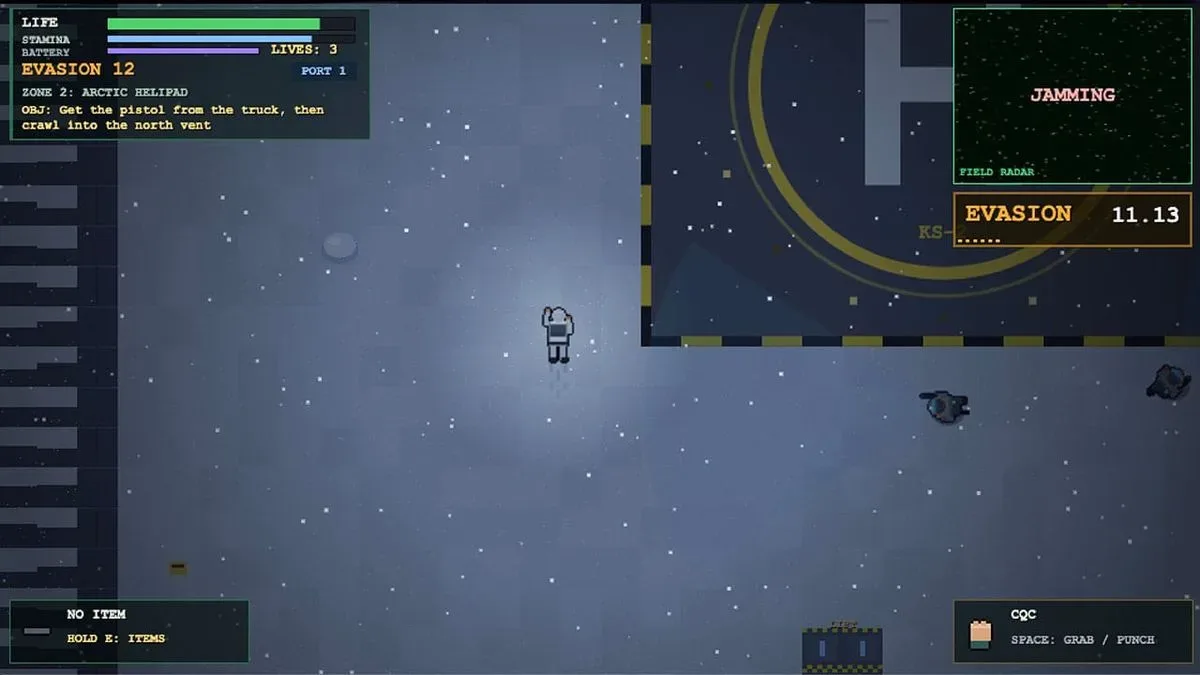
The opening scene gives the campaign its mood and its target. Ginuwine’s character looks at the illuminated office tower and says his records paid for half of it. Control then shifts to the player, who starts outside the building with a guard near the entrance and an initial goal of getting inside.
Its control set supports a light action-and-stealth structure. Players can move, sneak, dodge, punch, and kick, while a separate action button is used for interactions. In practical terms, that means the master-recording theme is delivered through gameplay verbs: avoiding an obstacle, entering a guarded building, and pushing deeper into a fictionalized corporate space.
The game does not present those actions as a guide to resolving an actual music-rights conflict. Instead, it uses the language of an infiltration game to make an abstract industry subject legible. “Masters” can sound like insider jargon; placing them at the center of an objective gives the term narrative stakes even for players who are not already familiar with recording contracts.
What “masters” means in this context
A master recording is the recorded performance itself: the version of a song that can be used for releases and other recording-based uses. It is distinct from the underlying song as written, which involves songwriting rights. The game’s focus is specifically on ownership of recordings, not a claim that every right connected to a song is controlled by the same party.
Related coverage includes Ginuwine Turns His Fight for His Masters Into a Browser Game.
Ginuwine has previously described why that difference has personal weight for him. He said that he might record 25 to 30 songs for an album containing 12 tracks. In his account, because he did not own the recordings, the label retained songs that did not make the album as well. He estimated that Sony still held roughly 100 of his songs.
That explanation gives the game’s premise more shape than a generic “get my music back” storyline. It is not solely about prominent released singles. It also concerns recordings made during album sessions that may never have appeared on the final track list. The game does not establish the legal status of each recording, but it uses the artist’s stated experience as the emotional basis for its mission.
Why the Sony connection is part of the game’s backdrop
MY RIDE sends Ginuwine toward a fictional Sony office, and the Sony connection has clear historical relevance to his career. His first record, “Pony,” was released by Epic, a Sony Music division, through 550 Music. Timbaland produced the track, while Ginuwine and Static Major are among its writers.
There is also an early-career detail that helps explain why the song remains central to the larger story. Recording engineer Jimmy Douglass recalled bringing a two-track recording of “Pony” to Sony before the company signed Ginuwine and Timbaland. The browser game transforms that industry history into an exaggerated narrative setting: an office tower stands in for the distance between an artist’s creative work and the institutions that can control its recordings.
That is an interpretation of the game’s storytelling, not a claim about a specific contract or current legal dispute. Its use of a fictional office is especially important to keep in view. The premise is dramatic; it should not be read as a depiction of an actual attempt to enter Sony property or recover recordings by force.
Who appears in MY RIDE
Ginuwine is the game’s star, and the title screen and credits identify LMG as the creator. Ginuwine is credited with design and direction, putting him in a creative role beyond appearing as the protagonist.
The game also uses a Supafriendz banner for characters connected with Timbaland, Missy Elliott, Tank, Tweet, and Aaliyah. That lineup is a notable part of the game’s presentation, particularly given the creative associations around Ginuwine’s music. But the credits’ character references should not be stretched beyond what they say: they do not establish that those artists recorded voice work, provided new performances, or participated in the game’s development.
Timbaland’s place in the project’s broader orbit is straightforward. He produced “Pony,” one of the key records tied to Ginuwine’s early label history. The game’s use of familiar collaborators and associated artists appears designed to create a world around the player character rather than to make a formal statement about new musical contributions.
Gameplay as an argument, not a legal remedy
Games frequently turn difficult subjects into clear objectives: reach a destination, clear a guarded route, retrieve an item, escape a hostile area. MY RIDE applies that structure to a subject that is usually discussed through contracts, catalog control, and negotiations. The resulting fantasy is easy to understand—go into the building and take back what belongs to the protagonist—even though actual ownership questions are much more complex than a mission marker.
That approach may be the project’s most interesting practical implication. It gives fans an interactive way to encounter the question Ginuwine is raising, while keeping the story explicitly fictional. The player is not being asked to parse the terms of a recording agreement. They are being asked to navigate a dramatized version of the frustration behind his account of recording more material than he released and not owning those recordings.
The game therefore works as both entertainment and a form of artist-led framing. Its action mechanics—sneaking, dodging, punching, kicking, and interacting—supply forward motion, while the master-recording objective supplies the reason for that motion. Even the rain-soaked opening and guarded entrance underscore the story’s basic idea: access to one’s own creative output is being represented as difficult, distant, and defended.
For readers interested in other ways musicians are using new technology to revisit their work, Ja Rule’s consideration of an AI-generated rework of an album offers a separate example of an artist engaging with an existing catalog through a very different medium.
The project’s boundaries are as important as its premise
MY RIDE makes a strong statement without claiming to be the resolution of the issue it depicts. The available description identifies a free browser game, a fictional mission, and Ginuwine’s wish to reclaim his masters. It does not announce litigation, a settlement, a buyback, or a transfer of rights.
It also does not establish that every artist represented under the Supafriendz banner actively worked on the game. Those limits do not diminish the concept; they clarify it. This is a creatively framed game about Ginuwine’s perspective on his recordings and career history, not a documentary, legal filing, or deal announcement.
Alongside the game, Ginuwine has been working with his son on a book about his life. Taken together, the two projects point toward an artist telling his story in more than one format: one interactive and fictionalized, the other centered on his own life. In MY RIDE, the immediate invitation is simple: enter the tower and help him pursue the music he says he wants back.