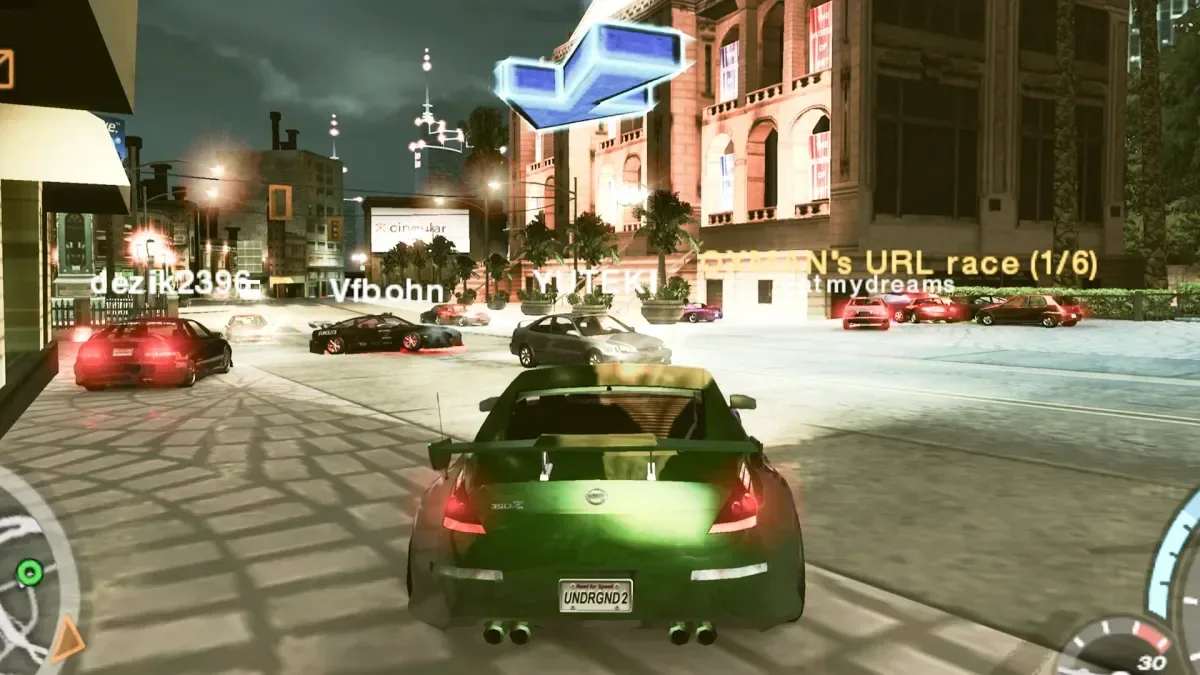
Need for Speed Underground 2 is reportedly running in a web browser through a fan-made project called Underground 2 Revived, turning the racing game into an unusually large-scale online experience. The project’s public-facing pitch is simple: load the game through its browser portal, choose from a substantial list of available servers, and join other racers without installing a conventional client, patching a personal copy of the game, or signing in through an EA account.
That accessibility is the project’s most eye-catching feature and its biggest complication. Underground 2 Revived is described as a browser port built by developer thomk using NFSU2Recomp as a foundation, with Claude Code used in the work of bringing it to the browser. It also reportedly includes a stand-in multiplayer server arrangement supporting hundreds of lobbies at once. Players can find online races, free roam, selectable maps, cars available from the start, friend additions and quick-chat functions.
The result sounds less like a narrowly preserved single-player relic and more like a persistent social racing space built around a game associated with the PlayStation 2 era. There is an important caveat, though: reports of large player counts, hundreds of active lobbies and the underlying performance experience should be treated as claims about a fast-moving fan project rather than guarantees of a consistent service.
A browser doorway to a familiar street-racing world
Browser delivery removes several ordinary barriers to revisiting an older game. There is no reported requirement to track down a physical disc, configure legacy hardware, install a patch or bring an existing EA account. For people who remember Underground 2 as a console-era favorite, that convenience is likely a large part of the appeal.
It also changes the way multiplayer is framed. Rather than needing a small group to agree on a setup in advance, visitors can reportedly browse many live server choices. That can make a decades-old game feel immediate: a race can become something joined on impulse instead of an event arranged around older software and hardware.
The implementation goes beyond head-to-head racing. The project reportedly allows large numbers of racers to enter career mode, creating a crowded and sometimes chaotic opening stretch. That may be entertaining as a spectacle, but it also makes career play a poor fit for anyone seeking the pacing and progression expected from a conventional solo run. The more practical option for players interested in the project’s social side appears to be selecting an online lobby directly, choosing a map, and treating it as an arcade-like session.
What “stand-in server” means here
A stand-in server is, in plain terms, a replacement online service designed to handle functions that would normally rely on an official service. In this case, it is said to coordinate the lobbies that let browser players find one another, race and interact. Its presence is why the project can present multiplayer at a scale beyond a simple local conversion of the game.
That does not automatically mean every server will play alike. Multiplayer racing is particularly sensitive to latency, often called ping: the delay between a player sending an action and the server or other players receiving it. When cars are moving at high speed, a small delay can have a visible effect on positioning, collisions or the apparent timing of another racer’s turn.
Related coverage includes Need for Speed Underground 2 Returns in a Browser With Massive Online Lobbies.
Reports describe the browser version as playable and enjoyable in many situations, but not uniformly smooth. With many players, varied internet connections and rapid vehicle movement in the same session, uneven performance is not a surprising concern. Anyone entering with expectations of flawless modern competitive netcode may be disappointed; anyone treating it as a surprising online revival of a legacy racer may be more willing to accept rough edges.
Features aimed at modern devices
Underground 2 Revived reportedly adds or exposes several quality-of-life options that matter for browser play across current hardware:
- Widescreen mode, intended to better suit contemporary displays than older screen formats.
- 120fps settings, offering an option aimed at smoother motion where a player’s device and display can support it.
- Keyboard, controller and touch controls, widening the kinds of devices that can be used to play.
- Free roam and online races, so players are not limited to a single competitive format.
- Friends and quick chat, adding lightweight social tools around races and driving sessions.
Frame rate is worth separating from network performance. A 120fps option refers to how frequently a device may render frames per second; it can make local motion look more fluid on compatible screens. It does not eliminate latency or ensure a server full of racers will respond perfectly. Smooth rendering and stable online synchronization are related to the overall feel, but they are different technical jobs.
Likewise, wide-screen support can be meaningful even if it does not alter the game’s underlying design. It is chiefly about presenting the game on the displays people use now. Players considering a living-room setup may also want to think about the display and input chain around their console or PC hardware; for example, this site has separately covered a TV listing focused on console-oriented HDMI connectivity. That is not a requirement for this browser project, simply a reminder that control method, screen and connection quality can affect comfort as much as a game’s settings menu does.
Career crowds may be the novelty, not the ideal way to start
Placing hundreds of racers into career mode is the sort of idea that communicates the project’s ambition immediately. It can transform an ordinarily structured opening into a traffic jam of customized cars, competition and confusion. That can be funny, overwhelming or both.
But it is not necessarily the best introduction to the game’s mechanics. Career modes usually depend on controlled progression: earning access, building familiarity and moving through events at an intended rhythm. Heavy online population can disrupt that rhythm, particularly when a player is trying to learn navigation, vehicle handling or the practical rules of a shared session.
For that reason, a direct online-race or free-roam server is likely the clearer entry point for someone specifically curious about Revived’s multiplayer premise. Pick a server with a map that appeals, test the preferred input method, and expect a little adjustment before judging responsiveness. Keyboard users, controller players and touch users may each find the experience differs substantially because steering and acceleration inputs are handled differently across those control styles.
The distribution question cannot be ignored
The project’s frictionless setup is also the source of the central legal concern. It is reported to provide the game directly, without requiring users to supply and patch their own game files or ROM files. That is materially different from a project that merely supplies tools for a player to use with a copy they already own.
Copyright law can vary by jurisdiction, and no legal conclusion should be drawn from a description of the project alone. Still, making an entire commercial game available through a browser without an ownership check or user-provided files raises obvious copyright and authorization questions. The project has been characterized as operating in a legal gray area, but that phrase should not be mistaken for a finding that distribution is permitted or risk-free.
For players, the practical consequence is uncertainty. Fan-hosted projects can change, lose access, be altered or disappear. A busy server list today is not a promise of long-term availability. It is also sensible to exercise normal browser caution: use the stated portal carefully, avoid entering unnecessary personal information, and be skeptical of unofficial downloads or pages presenting themselves as required companions to the browser game.
Thomk reportedly said the project “got a bit out of hand” after its official launch in late October. That description fits the unusual scope: this is not only a compatibility experiment, but an attempt to turn Underground 2 into a broadly accessible gathering place with races, roaming, chat and a potentially enormous amount of simultaneous activity.
Why the idea is drawing attention
The striking part of Underground 2 Revived is not merely that an older racing game can be launched in a browser. It is the attempt to preserve the game’s cars, music and map selection while reimagining its social scale. The original game’s appeal for many players is intertwined with customization, nightlife atmosphere and open driving; a server-based browser revival gives those elements a new reason to be revisited together.
Whether that ambition produces a dependable racing destination depends on factors the feature list alone cannot settle: server stability, player behavior, input responsiveness and the unresolved rights issues around distribution. For now, the project appears most compelling as an ambitious, imperfect experiment—one that makes a familiar PlayStation 2-era racer feel suddenly communal, while carrying the technical and legal uncertainty that comes with that ambition.