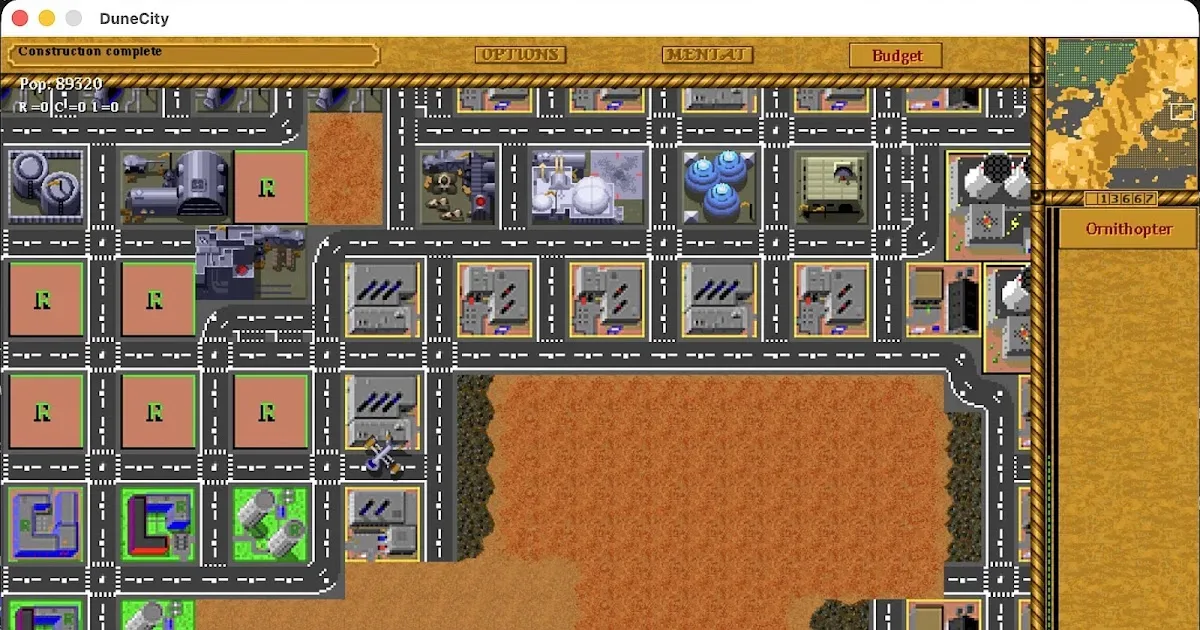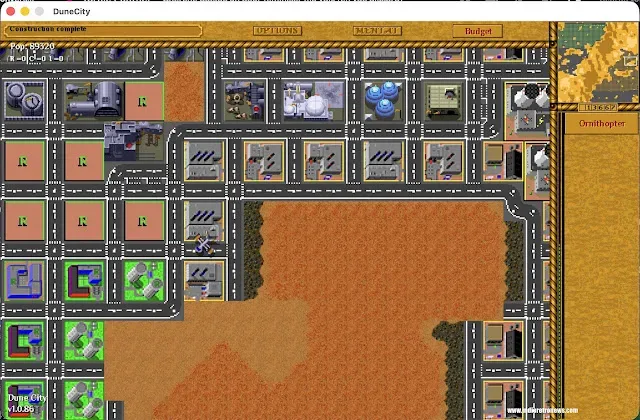
Arrakis has traditionally made a fairly blunt case for urban planning: build something important, defend it, harvest spice, and try not to become a cautionary tale in the sand. DuneCity takes that familiar desert pressure and points it in a notably different direction. Released for PC, Mac and Android, the project turns the open-source Dune Legacy engine toward a city-simulation structure built around infrastructure, municipal management and the stubborn practicalities of keeping a settlement functioning.
That means the central question is not simply which force controls the map. It is whether a growing city can support its own residents and economy on one of fiction’s least forgiving planets. DuneCity frames the spice trade as a vital economic concern, but puts the player in charge of the systems that make sustained settlement possible: residential, commercial and industrial districts; electricity; roads; public services; and a budget that cannot be treated as an infinite supply drop.
The result is a mash-up with an immediately understandable pitch. The strategic legacy associated with Dune II meets the civic problem-solving associated with SimCity. But the appeal of that combination is less about stapling two famous labels together than it is about changing what “survival on Arrakis” asks of the player. Instead of concentrating primarily on conventional real-time strategy warfare, DuneCity makes urban endurance the main contest.
From desert battlefield to municipal headache
DuneCity’s reported structure centers on city planning. Players create separate zones for homes, commerce and industry, the basic spatial puzzle at the heart of many city builders. On Arrakis, however, ordinary planning problems gain a little extra menace. A district placed without proper support is not just inefficient; the setting makes every failure feel like it has been invited to a very hostile climate.
Power is one of the clearest examples. The game requires a working electrical grid, and blackouts can be fatal to the settlement. That gives electricity a role beyond a box to tick after placing a generator. A city’s expansion must remain connected to the systems sustaining it, and growth that outruns capacity carries real risk. The desert may be vast, but it is not especially interested in forgiving a mayor who forgot the cables.
Road design also matters. DuneCity asks players to build networks capable of moving resources without creating traffic bottlenecks. In a city-management game, roads are often where a tidy early layout discovers it has been quietly setting up future problems. A route that seems sufficient for a small settlement may become a choke point once industrial activity, residential growth and commercial needs all depend on the same stretch of pavement.
That emphasis makes the project’s shift in perspective meaningful. The older strategy language of bases, resources and desert control is still part of the atmosphere through the Dune Legacy foundation and the spice economy. Yet DuneCity’s stated focus is on the interlocking civilian systems around those pressures. It is a game about making the city work, not merely putting structures on the map and waiting for an army to arrive with strong opinions.
Zoning is only the start
Residential, commercial and industrial zoning provides a recognizable framework, but the described challenge extends well beyond laying out neat blocks. Every new district creates demands elsewhere. More residents require services and reliable power. More industry needs routes for resources to travel. Commercial areas belong within a wider plan that can support the population and the city’s income. The economic model asks players to weigh expansion against the cost of maintaining what is already built.
Municipal budgets are therefore a key part of DuneCity’s identity. The city has to be developed while finances remain tight, and public services cannot simply be ignored if the aim is to keep inhabitants alive. That combination suggests a planning loop where the player must decide not only what should be built, but when it can responsibly be built. A big project might promise future benefits while making the short-term budget worse. A cheaper layout may save money now but create transport or service difficulties later.
There is a wonderfully appropriate irony in making spice economics part of a civic management problem. Spice is associated with immense value and enormous stakes, but the city still needs unglamorous essentials: functioning roads, dependable utilities and services that reach the people who rely on them. The grand cosmic resource does not excuse a local traffic jam. Arrakis may decide the fate of empires, but someone still has to make sure the industrial district can get its goods where they need to go.
A familiar engine used for a different kind of game
DuneCity is built from the open-source Dune Legacy engine, repurposing a foundation linked with classic Dune strategy play for a different genre emphasis. That detail is important because it explains why the project is more than a desert-themed city builder in name alone. Its premise carries forward the recognizable setting, the importance of spice and the sense that Arrakis is an environment that constantly applies pressure. What changes is the player’s responsibility within that world.
The move from military command to city administration is a particularly neat fit for a setting where logistics and resources have always mattered. In DuneCity, the test becomes whether the player can translate those pressures into a coherent settlement. The war for Arrakis is recast as a struggle to keep an expanding municipality supplied, powered, solvent and mobile.
For players with an affection for older PC strategy games, the project may also land in the space where retro-minded mechanics and modern genre combinations overlap. It does not need to be a historical re-creation to draw interest from people who enjoy revisiting earlier design foundations in new forms. Anyone reorganizing an older library may find our guide to storing retro games so they remain easy to find and play useful alongside a renewed interest in PC strategy history.
Why roads, services and budgets fit Arrakis
City builders work because individual systems push against one another. Income enables construction, construction creates upkeep, population growth changes demand, and transportation either supports the entire arrangement or turns it into a slow-moving argument. DuneCity appears to lean hard into that chain of dependencies. Its Arrakis setting is not merely decorative sand around familiar menus; it gives the infrastructure problem a survival-focused context.
Players are expected to balance growth with public services, maintain a functioning economy and prevent transport trouble as resources cross the city. Each of those components is ordinary in isolation. Together, they create the kind of cascading decisions that define city management: a choice in one district affects conditions somewhere else, often after the player has already committed to an expensive plan.
The approach also distinguishes the game from a simple combat conversion. The stakes are described in civic terms. Blackouts are dangerous. Budgets are constrained. Roads have to work. Residents have to remain alive. Spice remains central, but it is part of a broader economic balancing act rather than the sole marker of success.
That focus on systems may be especially appealing to players who enjoy games where a settlement’s shape becomes a record of decisions, compromises and avoidable disasters. It is the same broad instinct that makes multiplayer rules unexpectedly serious once a couch is involved: see the unwritten rules of couch multiplayer for a lighter look at how quickly games develop their own practical codes. DuneCity’s code is likely simpler, if less merciful: connect the power, mind the roads and do not spend tomorrow’s survival budget today.
Platforms and what is known
DuneCity is available on Android, PC and Mac. The information provided describes its broad gameplay direction and core management systems, but does not establish details such as pricing, storefronts, controller support, specific hardware requirements, multiplayer features or the full scope of its scenarios. Those are questions prospective players will need to verify through the project’s own current channels before making plans for their own desert metropolis.
What is clear is the game’s central idea. DuneCity uses a Dune Legacy-based framework to make Arrakis a site of zoning maps, utility lines, traffic flow and municipal accounting. Its version of desert survival is less about commanding a traditional RTS campaign and more about ensuring that a living city does not collapse under the weight of its own expansion.
It is a premise with a pleasingly cruel internal logic. On Arrakis, the spice must flow. In DuneCity, apparently, so must the traffic, the electricity, the public services and the money. Miss any one of them, and the sand is waiting.