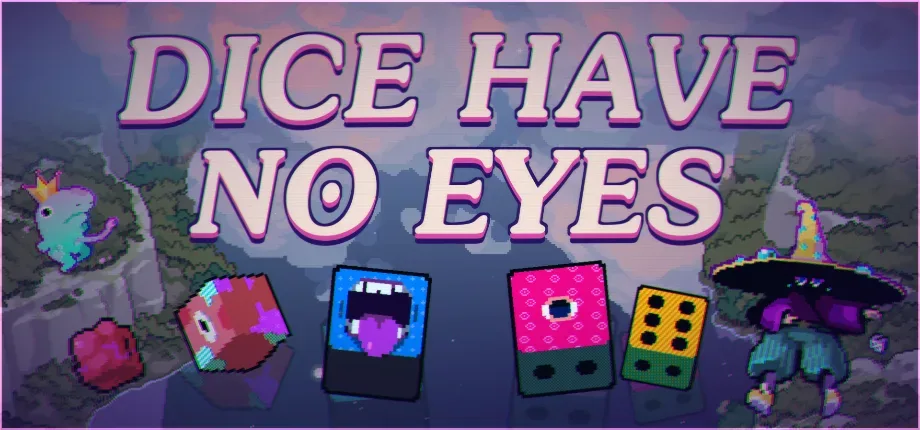

Dice Have No Eyes, the surreal dice-rolling roguelike from indie duo Franek and Max Cahill, has launched in version 1.0. The full release brings an ending to the game alongside new boards, characters, items, babies and Steam achievements, expanding a run-based game built around a very dangerous question: should you take the points now, or risk another roll for twice as much?
Its core premise is deliberately compact. Players roll dice to earn points, then choose whether to bank that result or continue. Continuing can double the score, but it also creates the possibility of going bust and losing the attempt. That push-your-luck structure is the central source of tension: the game does not only ask players to assemble an effective set of tools, but to decide when an already-good outcome is good enough.
In a genre where the headline feature is often an enormous list of objects, cards, weapons or mutations, Dice Have No Eyes puts the uncertainty of a roll front and centre. Its stated focus on luck and greed makes the decision after each successful result as important as the dice themselves. A high score can become a larger score; it can also become nothing.
What version 1.0 adds
The 1.0 update adds the game’s ending, making the release a meaningful milestone beyond a routine content patch. The game also now includes new boards, characters and items, plus babies and Steam achievements. Details on how each new board or character changes play have not been outlined, but their addition fits the game’s broader structure of experimenting with different dice, companions and item combinations across repeated runs.
Multiple endings are among the game’s listed features, so reaching an ending does not necessarily mean every player will see the same resolution immediately. That matters in a roguelike. A roguelike is generally a game designed around repeatable runs, changing circumstances and progress earned through knowledge as much as through a single uninterrupted campaign. Here, the promise of several endings gives players another reason to return after a successful run, while the game’s randomised elements should ensure that getting there is not purely a matter of repeating identical choices.
The achievement support is specifically described as Steam achievements. For players who enjoy completion goals, those can provide a visible record of milestones and unusual accomplishments, though the available information does not specify the individual achievement requirements.
A push-your-luck loop with room to bend the odds
Dice Have No Eyes is not presented as a pure game of passively accepting random numbers. Players can improve and swap dice after clearing levels, collect trinkets, and find combinations described as broken synergies. In game-design terms, a synergy is an interaction in which two or more effects become more useful together than they would be separately. A trinket that changes dice behaviour may be merely helpful in one build, then become run-defining when paired with a spell, snack, companion or magical die effect that takes advantage of that same behaviour.
That is a crucial distinction for a dice game. Randomness determines what results appear, but build choices can influence what those results mean and how much risk they are worth taking. The available feature list points to more than 100 trinkets and over 40 spells and snacks that can be fed to dice or otherwise alter how rolls work. Players are therefore likely to be evaluating several linked questions during a run: which dice to keep, which ones to replace, which effects reinforce the current plan, and when to stop rolling before a promising turn collapses.
Related coverage includes Dice Have No Eyes Reaches 1.0 With Endings, Boards and More.
The phrase “broken synergies” is also an important signal of tone. It suggests the game embraces builds that become unusually powerful or strange rather than treating every combination as something that must remain neatly restrained. In a run-based game, discovering one of those combinations can be part of the reward: an initially modest handful of dice gradually becomes a machine that produces outcomes the player did not expect at the beginning of the run.
Of course, a powerful build does not erase the central gamble. If a roll can still bust, then the player’s decision-making has two layers. First comes the longer-term construction of a build. Second comes the immediate judgement call at the table: with the current score and current tools, is it smarter to secure progress or tempt fate again?
The God n’ Fate engine, explained
The game describes its randomness as being powered by the “God n’ Fate engine.” The name is part of Dice Have No Eyes’ deliberately dreamlike presentation, which also includes an entity claiming to be God. Practically, the relevant term is RNG, short for random number generation. In games, RNG is the system that produces uncertain results: a die face, an item reward, an encounter or another outcome that cannot be selected with complete certainty beforehand.
RNG does not automatically mean that decisions are unimportant. In fact, Dice Have No Eyes appears built around the friction between chance and control. Dice rolls are uncertain, but players can change their dice, use trinkets, deploy spells and snacks, gain magical effects, and recruit companions. The goal is not necessarily to remove uncertainty entirely. It is to reshape the field of possible outcomes in a direction that supports a chosen strategy—then decide whether the current moment is worth risking.
The game’s unusual wording also makes its fiction feel inseparable from its mechanics. “Roll enough sixes and you might wake up” turns a familiar maximum die result into something more ominous than a simple high number. The dice reportedly have no eyes, the game offers night mode, and its worlds are described as dreamy. Those elements position the experience less as a conventional tabletop simulation and more as an uncanny game about dice where the rules, imagery and larger mystery are intended to overlap.
Companions, worlds and strange supplies for dice
Alongside its large trinket pool, Dice Have No Eyes includes 13 companions with distinct powers. Companions are a natural fit for a system concerned with repeated rolls because a persistent power can change the value of each decision throughout a run. A companion might alter the incentives around particular dice, make certain effects more attractive or provide a new reason to keep rolling. The specific powers have not been detailed, so players will need to uncover how much each one changes the rhythm of a build.
The game also lists five dreamy worlds, magical dice effects and the aforementioned spells and snacks. Feeding dice is a particularly odd detail, and the game’s feature list treats that oddness as an asset rather than an aside. Instead of framing dice as static pieces of equipment, Dice Have No Eyes appears to make them things that can be modified, exchanged and supplied with strange resources during a run.
New boards in the 1.0 release could further broaden the conditions surrounding that dice play, though the exact role of boards has not been specified. Their arrival is nevertheless notable because board layout or board-specific rules can be a major way for a dice-focused game to create fresh tactical contexts without abandoning its central loop.
What players should take from the full release
For newcomers, the clearest appeal is a simple rule set with potentially complicated consequences. Roll for points. Consider rolling again for more. Try not to lose the lot. That is easy to understand before a first run, while the trinkets, dice swapping, companions and magical effects promise more depth as players become familiar with the available systems.
For returning players, version 1.0 provides concrete reasons to revisit the game: an ending, additional boards, characters, items, babies and achievement support. The game’s multiple-ending structure and extensive list of build-altering effects indicate that a single successful path need not exhaust its possibilities.
There is also a useful broader context for players keeping an eye on smaller PC releases that grow through substantial updates: Hell Galaxy’s Chop Shop update is another example of a game using a major update to rework and extend its systems.
Dice Have No Eyes now frames its full-release package around a balance of accumulation and loss. Players can chase stronger dice, combine more trinkets, work with one of 13 companions and hunt for the game’s endings. But every attempt still comes back to a choice familiar to anyone who has stared at a favourable roll and wondered if fortune has one more reward left—or a trap.