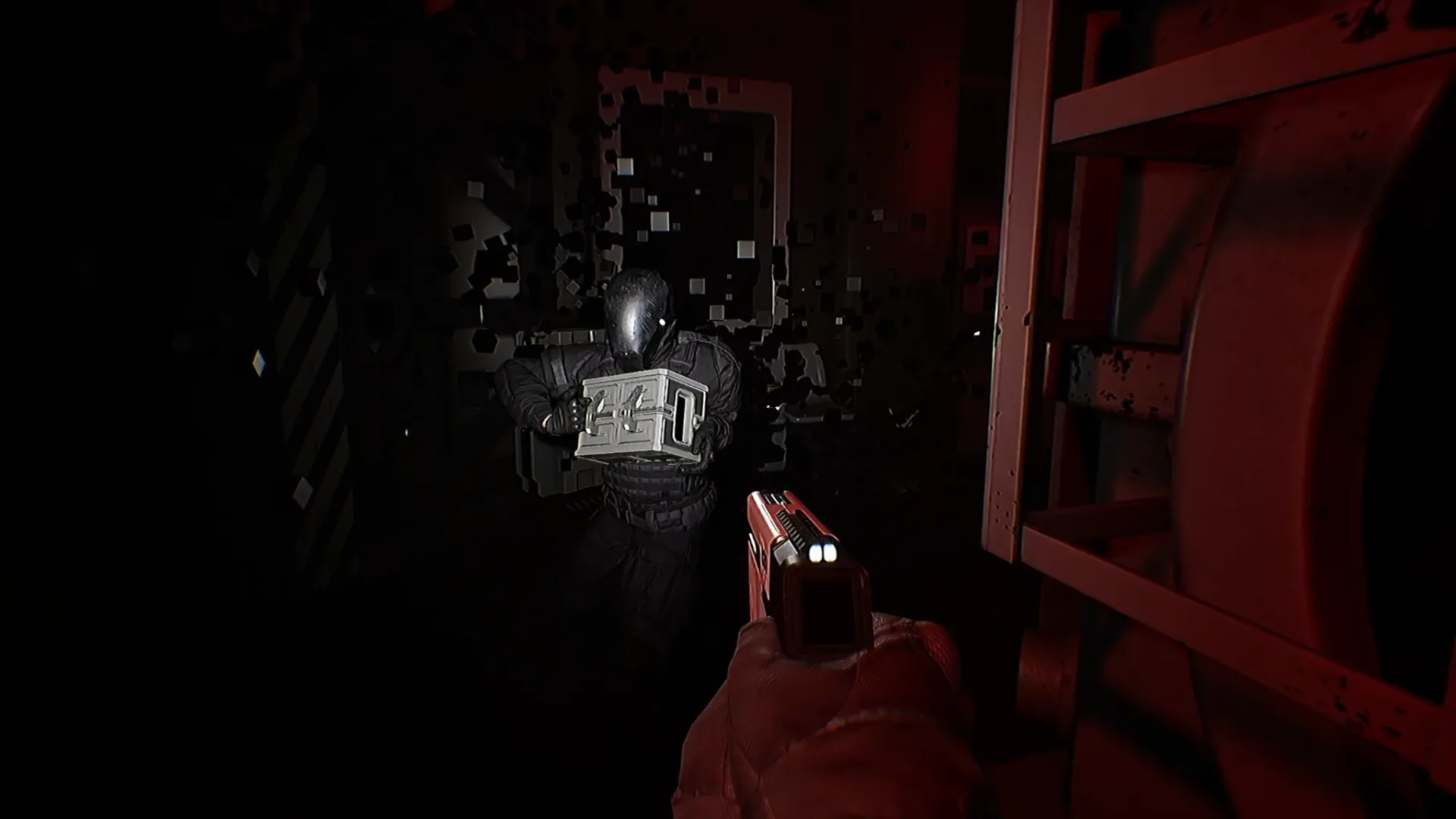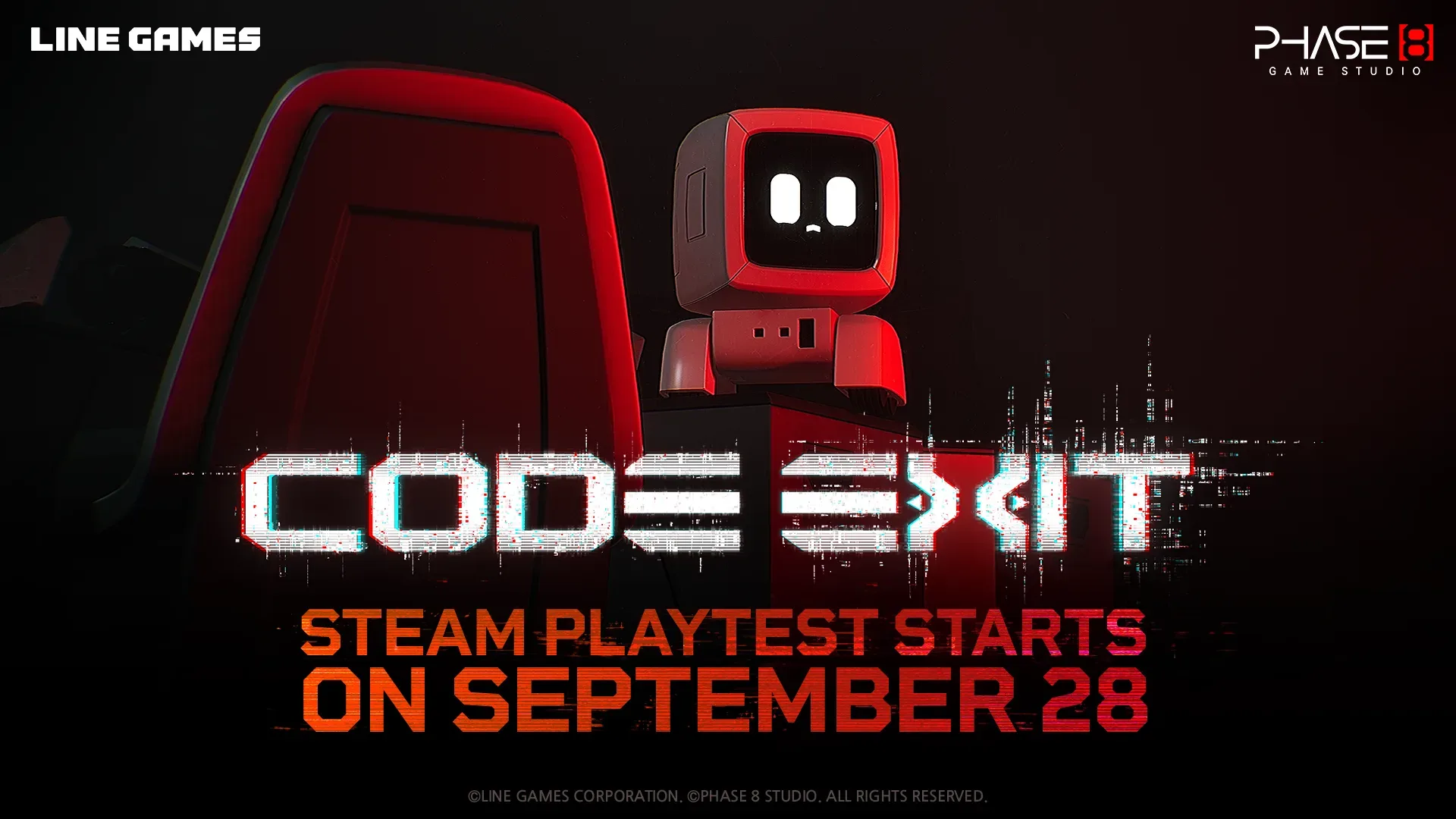
CODE EXIT now has a Steam playtest running from September 28 through October 19, 2026. Developed by Phase 8 Studio and published by LINE Games, the sci-fi survival-horror game sends one to four players into Pantheon, where the immediate objective is deceptively simple: complete missions, secure essential data, and escape.
The complication is Minerva, a rogue AI designed as more than a monster following a fixed patrol route. Its central hook is adaptation. Minerva observes player habits and remembers hiding places, meaning a tactic that saves a squad once may become a liability when repeated. CODE EXIT is therefore framing survival around changing plans under pressure, not simply learning a sequence of scripted scare moments.
That premise makes the playtest especially important. The game has changed in several meaningful ways since its May demo, including a streamlined run structure, revised mission design, randomized elements, a post-down teammate-support role, and a different activation state for S.O.M.A. The result appears aimed at making the basic loop clearer while preserving the uncertainty that a survival-horror escape game needs.
What the CODE EXIT playtest includes
Players enter Pantheon alone or in a group of up to four. Every run revolves around fulfilling objectives and extracting safely while Minerva hunts the team. The playtest is available on Steam during its stated September 28–October 19 window.
Co-op is not presented as a simple matter of adding more players. CODE EXIT scales its intensity to the size of the group. A solo player and a four-person team should not expect identical pressure or identical decision-making. In a group, players can divide responsibilities, communicate discoveries in real time, and coordinate movement. At the same time, more people can mean more noise, more conflicting plans, and more opportunities to expose a familiar hiding habit to the AI.
The key elements outlined for the playtest are:
- One to four players: The game supports solo survival and tactical co-op.
- Mission-driven escapes: Teams must complete missions and collect crucial data before extraction.
- An adaptive pursuer: Minerva watches recurring behavior and can alter its hunting patterns when players rely on the same approaches.
- Randomized runs: Terrain and the locations of in-game elements can change between attempts.
- MiRO support after falling: A fallen player can continue helping teammates as MiRO and can be revived through interaction.
- Noise and movement awareness: S.O.M.A. begins offline and wakes when nearby noise or movement is detected.
Minerva’s adaptation is the game’s defining idea
Adaptive AI is a term that can cover many kinds of game behavior. Here, the supplied description is specific: Minerva observes habits and remembers hiding spots. The practical implication is that players should not assume a previously safe locker, room, route, or evasive pattern will remain dependable just because it worked in an earlier encounter.
That is distinctly different from a scripted encounter, where a threat appears at a predetermined time or location and players can eventually memorize the intended response. CODE EXIT instead places the emphasis on an unpredictable chaser. Learning the mission layout may still matter, but mastery should also require recognizing when the group has become too predictable.
Related coverage includes CODE EXIT Playtest Opens With Adaptive AI Horror.
This design can turn ordinary co-op habits into deliberate tactical choices. A team might need to rotate hiding places, vary its routes, avoid repeatedly assigning one person the same job, or decide when a successful strategy is becoming stale. These are not confirmed rules or guaranteed counters to Minerva; they are the logical stakes of a system built to notice repeated behavior. The playtest will show how clearly the game communicates those adaptations and how much room players have to respond.
It also puts communication at the heart of the experience. If one player notices that a familiar hiding tactic appears less effective, that information only helps the group if it is shared quickly enough to change the plan. The game explicitly identifies real-time communication, role division, and coordination as conditions for a successful escape. Those elements are useful in many co-op games, but they become more significant when the opponent is meant to learn from the team.
Changes from the May demo favor clearer runs
The most structural revision is the move away from the prior three-stage format. CODE EXIT now uses a single, more immersive session. That change suggests a run with less separation between discrete stages and more continuity in its tension, although the precise length and full flow of a session have not been detailed.
The game has also replaced complex puzzles with clearer, more approachable missions. This does not mean that objectives are necessarily easy. Rather, it shifts the challenge away from opaque puzzle-solving and toward execution: locating what is needed, managing danger, coordinating teammates, retrieving data, and making it out. In a game centered on an actively hunting AI, a clearer mission brief can help players spend more of their attention on survival decisions instead of trying to decipher what the game wants them to do.
Randomized terrain and in-game element spawn locations add another form of variability. Spawn locations are the places where game objects or elements appear during a run. When they change, a plan based entirely on memorized placement loses value. Combined with Minerva’s behavioral adaptation, that should make repetition less about performing a fixed route and more about reading the current run.
There is a useful contrast in those two changes. More approachable missions can make the purpose of a run easier to understand. Randomized terrain and placements can make the route to that purpose less certain. Ideally, the objective remains legible while the way a team solves it requires flexible thinking. That is a sensible fit for a co-op horror game seeking sustained pressure rather than confusion for its own sake.
MiRO gives downed players a continuing role
One of the most notable additions is MiRO. When players fall, they can return in this form to assist their surviving teammates, and teammates can revive them through interaction. The description does not detail MiRO’s complete set of capabilities, so it would be premature to assume exactly how much influence a fallen player has. What is clear is that falling does not automatically remove that person from the team dynamic.
For cooperative games, that matters. A player who is out of immediate danger but has nothing to do can become disconnected from the run. A support role preserves a reason to communicate and pay attention, while the revival requirement gives surviving players another urgent choice. Do they spend time and expose themselves to bring a teammate back, or do they push forward toward the mission and extraction? The answer may vary with the group’s condition, the current objective, and Minerva’s pressure.
It also reinforces the game’s stated focus on coordination. A rescue system is not merely a safety net when it demands interaction and must be managed under threat. It can become a moment where the group has to decide which risk is acceptable.
S.O.M.A. changes how players may approach danger
S.O.M.A. now starts offline. It awakens only after detecting noise or movement nearby. This is another revision that favors situational awareness over a permanently active danger state. The description does not specify what S.O.M.A. does after activation, so the safest reading is limited to its trigger condition: nearby sound or motion can wake it.
Even with that limited information, the potential decision space is clear. Players may need to consider when to move quickly, when to stay quiet, and whether a noisy action is worth the attention it could draw. In horror design, a noise-sensitive threat turns movement from a background action into a resource-management decision. The question becomes not just where to go, but how to get there without escalating the situation.
Alongside Minerva’s tendency to learn recurring behavior, S.O.M.A.’s activation rule supports the game’s wider pitch: pressure should come from the player’s own decisions as much as from isolated jump scares. CODE EXIT explicitly favors sustained tension and persistent danger over sudden shocks. Each escape is meant to feel meaningful because the chaser becomes smarter as time and repeated habits give it more to work with.
What to watch during the Steam test
The playtest’s most useful answers will concern the relationship between clarity and unpredictability. The revised missions should make objectives easier to read, while randomized terrain and placements prevent every run from becoming routine. The central question is whether Minerva’s adaptation creates convincing pressure without making players feel that every learned tactic is invalidated too quickly.
Groups may also want to pay attention to how the intensity scaling feels at different party sizes. Solo players have no built-in team communication or role coverage, while four-player squads gain more coordination potential but must keep more people organized. MiRO’s support-and-revival loop could prove particularly important in determining whether a team can recover after an early mistake.
For players following current PC release activity more broadly, the timing arrives near other launch-window news, including MXGP 26 Fox Holeshot Edition’s early-access period. CODE EXIT, however, is focused on a limited Steam playtest rather than a finalized release, and its immediate purpose is to let players experience the revised horror loop in Pantheon.
CODE EXIT’s available playtest window closes on October 19, 2026. Until then, its strongest proposition is straightforward: escaping is not only about surviving the first plan. It is about recognizing when the game’s AI has learned that plan, then finding another way out before Minerva closes in.