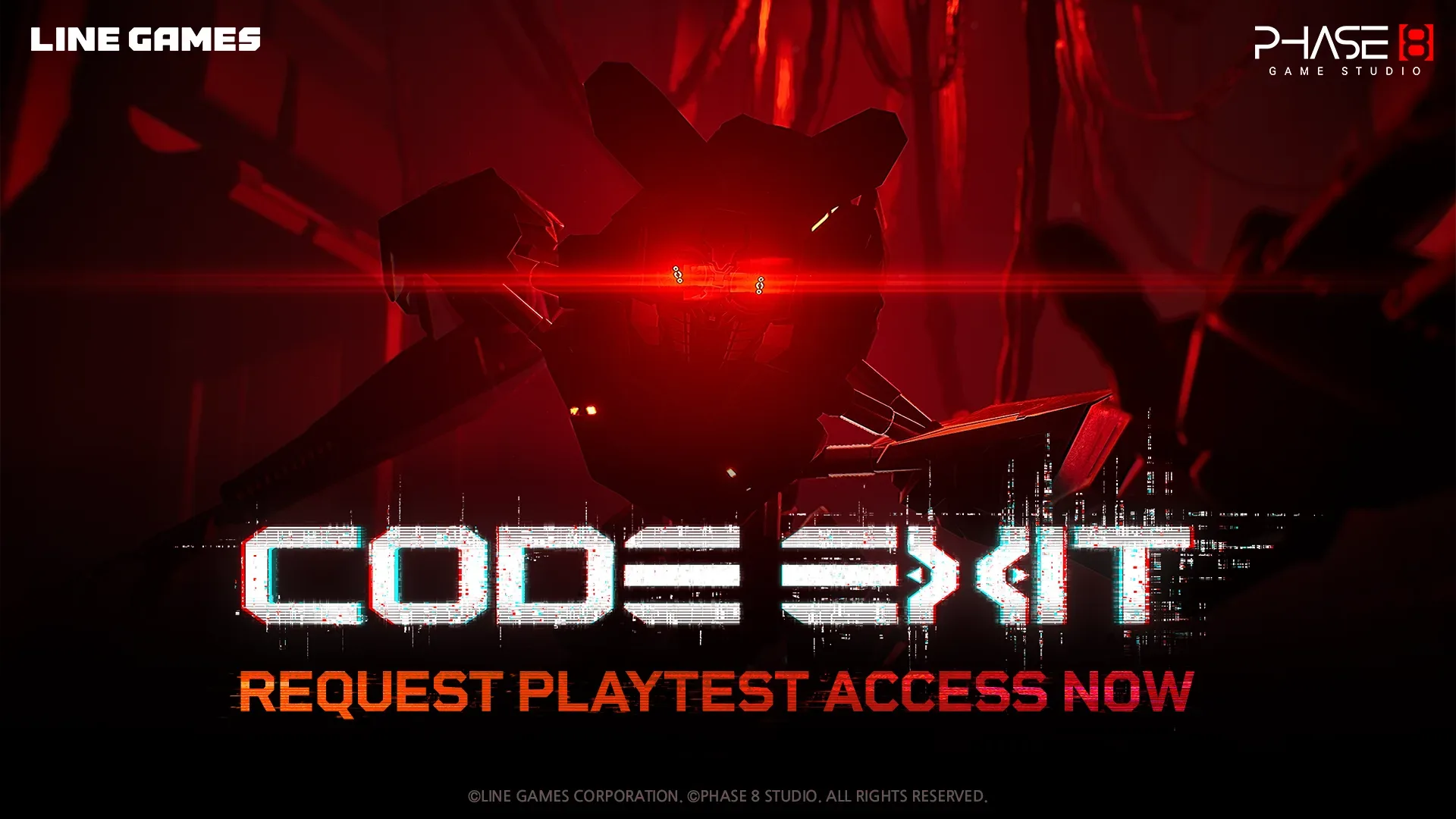
Registration is now open for a new CODE EXIT playtest scheduled to run from September 28 through October 19, 2026. Developed by Phase 8 Studio and published by LINE Games, the test will include newly added content for the sci-fi survival horror game, alongside a new trailer focused on the dangers awaiting players in the fallen city of Pantheon.
CODE EXIT is built around a simple but pressure-heavy objective: enter Pantheon as a Hermes operative, locate scattered pieces of the C.O.D.E., make it back to base, and escape alive. The game supports one to four players, so that structure applies whether someone is tackling an operation solo or assigning responsibilities across a full team.
The catch, naturally, is that Pantheon is not designed to make any of those steps comfortable. Limited sightlines and a deliberately tense audio atmosphere mean players are expected to navigate uncertain corridors, locate useful tools, work through sealed routes, and decide when it is worth pressing deeper into an area. An enemy AI known as Minerva is central to that tension: it is described as learning from player habits and altering how it hunts when it recognizes repeated behavior.
A playtest built around extraction, not just exploration
CODE EXIT’s missions are framed as tactical explorations rather than straightforward trips from an entrance to a finish line. Teams must search isolated facilities, activate terminals, bypass sealed doors, find equipment, pursue secrets, and ultimately attempt an extraction before Minerva closes in.
That word, extraction, matters. In games with an extraction-focused structure, reaching an objective is only part of a successful run. Players must also leave the dangerous space safely. Here, recovering C.O.D.E. pieces is the core assignment, but returning to base and escaping are equally important parts of the stated mission. A group that finds what it needs but cannot get out has not completed the operation.
This creates room for decisions that have more weight than simply clearing every corridor. A squad may need to choose between continuing to search for another useful item, taking time to open a previously inaccessible route, or withdrawing while it still has a manageable path back. The supplied details do not spell out the game’s specific failure conditions or progression systems, but the emphasis on scavenging, tactical planning, and getting out safely points to a structure in which caution and coordination should be meaningful.
What the adaptive Minerva threat could change
Minerva is described as an adaptive chaser. In practical terms, a chaser is an enemy threat that pursues players rather than simply remaining in one location. The adaptive element is the more notable claim: Minerva is said to remember repeated player behavior and modify its hunting patterns accordingly.
That premise has potentially useful implications for co-op play. Many teams naturally develop routines: using the same routes, having the same player lead, returning to the same safe-looking area, or relying on a single response when pressure rises. If Minerva reacts to habits, those routines may become less reliable over time. Players could be pushed to vary their movements, reconsider established roles, and avoid assuming that yesterday’s successful route will remain the best choice.
Related coverage includes CODE EXIT Opens Registration for September–October Playtest.
It is also a premise that may be felt differently in solo play. Without teammates to split tasks or create distractions, a single operative may have to balance navigation, gathering, terminal interaction, and survival alone. Conversely, co-op groups face their own complications: coordinating several people under pressure can be more difficult than setting a solo plan, particularly when the team needs to divide duties.
The playtest is an opportunity for participants to see how that adaptive behavior reads in actual missions. The available information establishes Minerva’s intended role and broad behavior, but does not specify precisely which actions it tracks, how quickly it adapts, or whether players will receive clear feedback about why its tactics change. Those details are likely to make a major difference in whether the system feels legible and strategically engaging rather than merely unpredictable.
Co-op roles and scalable intensity
CODE EXIT supports tactical co-op for between one and four players, with scalable intensity. The game’s stated objectives suggest several natural areas of responsibility: one player can focus on route awareness, another on locating or carrying scavenged tools, another on handling terminals or doors, while others monitor the wider threat and help keep an escape route viable.
Those examples are an interpretation of the described systems rather than confirmed character classes or locked-in jobs. No fixed role system has been detailed. Still, the design’s focus on division of labor means communication is likely to be as useful as quick reactions. A player working on a terminal may need cover; a player who discovers a useful resource may need to guide teammates to it; and a team that spreads out to cover more ground risks losing the ability to respond together if Minerva begins closing the distance.
Scalable intensity also matters because a horror game’s challenge can feel very different depending on party size. A solo player has fewer options for multitasking, while a group has more information and manpower but must manage noise, positioning, and competing priorities. The test does not come with published details about exact scaling values, so players should not assume how enemies, objectives, or resources will change between one-player and four-player runs. What is confirmed is that the game is designed to accommodate that full range.
Players interested in other upcoming multiplayer releases can also keep an eye on PIT OF GOBLIN’s planned six-player co-op and cross-play update, though its action and structure are distinct from CODE EXIT’s tense, facility-based survival-horror setup.
From the July demo to a longer testing window
The upcoming playtest follows a July demo as well as appearances at BIC 2026 and GXG 2026. This new run is therefore not the first public opportunity to encounter CODE EXIT, but it is positioned as a chance to play newer material and return to Pantheon with the game’s central systems in focus.
The testing window runs for just over three weeks, from September 28 to October 19. Registration is required for prospective participants, and players are also encouraged to add CODE EXIT to their Steam wishlists. No further details have been provided here on admission criteria, test access arrangements, supported languages, system requirements, or a final release date, so interested players should treat the registration process as the relevant next step rather than assuming everyone who applies will necessarily receive access.
What to watch for during the test
For players deciding whether CODE EXIT matches their interests, the most important features are its combination of co-op planning, restricted visibility, audio-led unease, and a pursuer intended to respond to familiar tactics. It is not presented as a pure shooting game or a relaxed scavenging exercise. The pressure is supposed to come from performing objectives while deciding what information to trust, which routes to risk, and when a team has enough to justify a retreat.
- Mission flow: Whether finding C.O.D.E. pieces, activating terminals, opening paths, and extracting create satisfying decisions from start to finish.
- Minerva’s readability: Whether players can recognize and respond to changing hunting patterns without the system becoming opaque.
- Solo and squad balance: How the experience changes between one operative and a full four-player team.
- Coordination pressure: Whether tools, doors, and facility exploration create useful teamwork rather than busywork.
- Atmosphere: How limited visibility and audio design support fear and uncertainty during missions.
CODE EXIT’s September–October playtest will put those ideas in front of a new set of players. Registration is open now, with the test beginning September 28 and ending October 19, 2026.