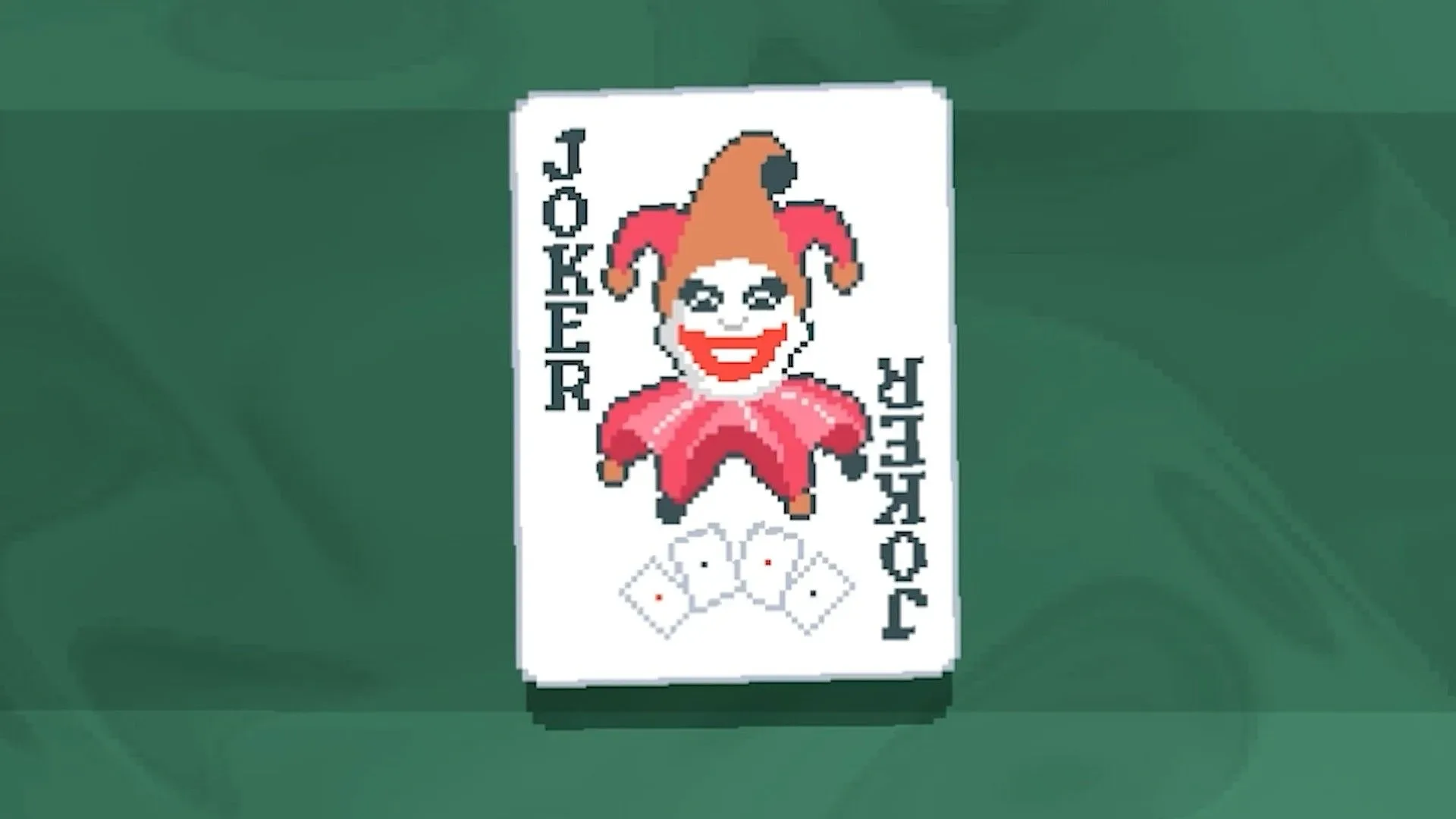
Balatro update 1.1 is still without a release date, but creator LocalThunk has offered the clearest look yet at what is being built for the poker deck-builder. The disclosed work includes at least four new Jokers, additional vouchers, a newly shown Tier 2 voucher named Lunker, a new “when card is drawn to hand” trigger, a blue-stake change that remains under wraps, and compatibility measures aimed at preventing the update from immediately breaking 1.0 mods.
The most consequential detail may not be the new fish voucher art or the Joker count. It is a proposed change to the way upgraded, Tier 2 vouchers are offered. In plain terms, LocalThunk is trying to ensure that expanding Balatro’s voucher pool does not quietly make a player’s desired upgrade less likely to appear. That is a very Balatro problem: more content ought to mean more interesting decisions, not a diluted chance of completing a plan a run has already started.
LocalThunk had previously given 1.1 a 2025 window, but acknowledged that the update has gone beyond it. The developer now says no new release timing is being promised, prioritizing a finished update over what was described as a rushed result. For players, that means the newly shared information is a progress report rather than a launch announcement.
The voucher issue: why a bigger pool can make upgrades harder to find
Vouchers are lasting shop purchases in Balatro, and the current game has 32 in total. Half are Tier 1 vouchers; the other half are their stronger Tier 2 counterparts. A Tier 1 purchase can therefore establish a longer-term goal: find its matching Tier 2 upgrade in a subsequent shop and improve that part of the run further.
LocalThunk’s example uses Paint Brush as a Tier 1 voucher and Palette as its corresponding Tier 2. Under the current 32-voucher setup, taking Paint Brush in ante 1 gives the player a one-in-16 chance of seeing Palette in ante 2. Ante, in this context, is a stage of a run, so this is about the succession of shops and escalating rounds rather than a single poker hand.
The design complication arrives when the total number of vouchers grows. If another 32 vouchers were added, LocalThunk explained, Palette’s chance to appear in that same situation would fall to one in 32. The developer framed that hypothetical as an illustration rather than confirmation that exactly 32 vouchers are coming. Still, the underlying issue is real: a conventional random selection system can make a specific desirable result scarcer whenever more possibilities enter the pool.
The suggested solution tracks Tier 1 vouchers a player owns but has not yet upgraded. It would roll an N in 16 chance to offer one of the relevant Tier 2 upgrades, where N is the number of those unpaired Tier 1 vouchers. If Paint Brush is the only unmatched Tier 1 voucher, the stated example preserves Palette’s one-in-16 chance in the following shop. If several Tier 1 vouchers are waiting for their Tier 2 partners, the system has more upgrade candidates to consider.
What “N in 16” means in practice
This is a probability rule, not a promise that any particular upgrade will show up on command. If N equals one, it is a one-in-16 chance. If N equals two, the chance that the system spawns an upgrade voucher is two in 16, or 12.5 percent. The exact process for choosing between multiple eligible Tier 2 vouchers was not disclosed, so it would be premature to claim that each individual upgrade keeps precisely the same odds once a player holds several Tier 1 vouchers.
Related coverage includes Balatro 1.1 Teases New Jokers, Vouchers and a Smarter Upgrade System.
What has been made clear is the goal: protect the relationship between a Tier 1 commitment and its Tier 2 payoff as the catalogue grows. That could matter a great deal for how players evaluate early shops. A Tier 1 voucher is more appealing when its upgrade path remains meaningfully attainable; it is less appealing if every expansion of the item pool makes the follow-up feel like a lottery ticket buried under more lottery tickets.
This also points to a broader balancing concern for content-heavy roguelikes. Adding options increases variety, but variety can weaken reliability. Reliability is the degree to which players can make informed strategic bets rather than simply hoping a huge random pool cooperates. Balatro’s strongest decisions often involve weighing a payoff that might arrive later against a benefit available now. A system that recognizes outstanding voucher upgrades could preserve that decision-making texture as 1.1 adds more possibilities.
Lunker is real; its effect is not
The one newly named Tier 2 voucher revealed so far is Lunker. Its artwork depicts a large green fish fighting against a hook. LocalThunk shared the art as proof that 1.1 remains in development, while explicitly declining to reveal the voucher’s effect.
That leaves almost everything mechanical about Lunker unknown. Its Tier 1 partner has not been identified, its shop conditions have not been explained, and there is no supported basis for guessing how it changes a run. The useful takeaway is simply that 1.1 contains at least one new Tier 2 voucher and that the upgrade-distribution discussion is tied to genuine incoming content rather than an entirely abstract systems exercise.
Players should be similarly cautious with the teased new blue stake. Stakes are Balatro’s difficulty modifiers, and the existing blue stake applies a minus-one Discard penalty. LocalThunk confirmed a new blue stake but withheld what it does. The developer said it has unusual implications and mentioned using the quadratic formula on a whiteboard while implementing something related to it. That is an intriguing development anecdote, not enough information to reverse-engineer the modifier or call it a particular kind of challenge.
A new trigger could broaden card and pack interactions
Another confirmed addition is a mechanic based on the moment a card is drawn into the player’s hand. Crucially, LocalThunk said this trigger also applies when Tarot or Spectral packs are opened.
A trigger is a condition that causes an effect to occur. “When card is drawn to hand” therefore describes timing: an effect can recognize a card entering the hand, rather than only reacting when that card is played, scored, discarded, sold, or changed by another effect. The detail about Tarot and Spectral packs expands the scope beyond ordinary draws during a round. Opening those packs can also put cards into the hand, which means pack choices may interact with this new timing rule.
No specific Joker, voucher, card enhancement, or reward attached to the draw trigger was shown. But the rule itself is notable because it establishes a shared event that future content can use. The practical implication is not that every pack will suddenly become a combo engine; it is that players may eventually need to account for draw timing in more places than the usual hand cycle. Until the associated cards are revealed, the mechanic’s power level and its interaction with established strategies remain unknown.
At least four Jokers, plus a plan for modders
LocalThunk has also confirmed that version 1.1 includes at least four new Jokers. Jokers are central build-defining pieces in Balatro, so even a small number can open new synergies or revalue existing cards and shop choices. “At least” matters here: four is a minimum confirmed count, not a complete roster. Their names, art, rarity, effects, and unlock conditions have not been disclosed.
For the modding community, the update is expected to include a 1.1 content checkbox intended to let 1.0 modders retain their work. LocalThunk also plans to add a separate Steam branch for the current 1.0 version well ahead of 1.1’s launch. A branch on Steam is a selectable version track of a game. In practical terms, it can give users a way to remain on an earlier build instead of being forced immediately onto the newly updated one.
That approach does not guarantee every mod will work forever, nor does it eliminate the work of updating creations for new content. It does, however, acknowledge a common update problem: new official mechanics can change assumptions made by older mods. Giving players and creators a stable 1.0 option should reduce the pressure to have every project ready the moment 1.1 arrives. Steam version management has become an increasingly meaningful part of PC game preservation and compatibility conversations, as seen in other PC-focused releases and revivals.
What to expect next—and what not to assume
The firmest picture of Balatro 1.1 is now one of an update adding content while also addressing the mathematical consequences of that added content. More vouchers, particularly more Tier 2 vouchers, risk making targeted upgrades harder to locate. The proposed tracking system is designed to avoid that. New Jokers and a new draw-to-hand event suggest more build possibilities, but their actual impacts cannot yet be measured because their effects have not been revealed.
- Confirmed: at least four new Jokers; new vouchers; Lunker as a new Tier 2 voucher; a new drawn-to-hand mechanic that also applies when Tarot and Spectral packs are opened; a new blue stake; a 1.1 content checkbox; and a planned Steam branch for 1.0.
- Proposed and explained: a voucher system that tracks unmatched Tier 1 purchases and uses an N-in-16 roll to preserve upgrade opportunities as the pool expands.
- Not revealed: Lunker’s effect, the new blue stake’s function, the identities and abilities of the new Jokers, the final number of vouchers, and a release date.
For now, the sensible response is anticipation with the brakes on. LocalThunk has said more progress updates and occasional further reveals are planned, but has deliberately stepped away from a fresh schedule. The stated priority is a version of Balatro 1.1 that is ready, balanced, and enjoyable rather than one released to satisfy an old window.