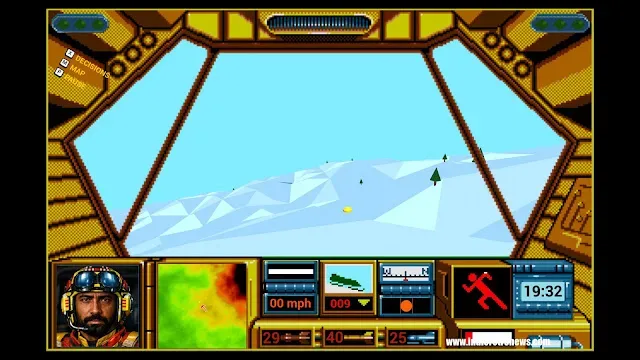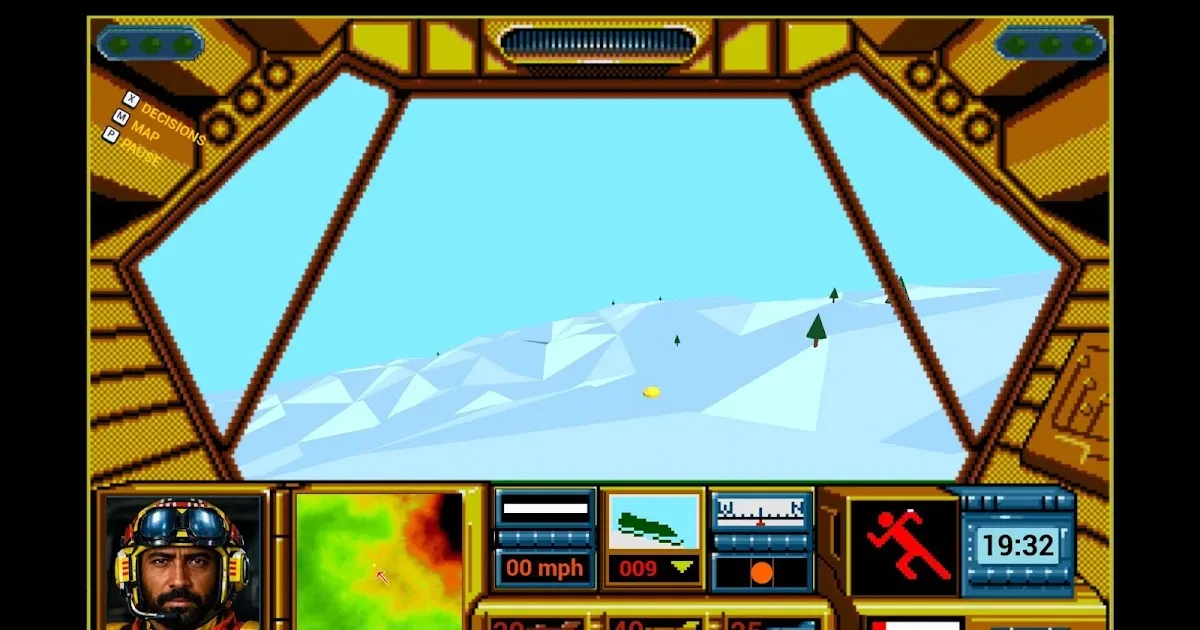
Midwinter Fan Remaster has entered Steam Early Access, returning Mike Singleton’s ambitious 1989 game design to PC screens. The project revisits a game originally released for Amiga and Atari ST, where its mix of large-scale resistance planning, infiltration and first-person action earned strong critical reception and commercial success.
The headline feature remains a daunting one: a frozen territory described as spanning 160,000 square miles. Players are tasked with assembling a resistance from 32 distinct survivors and using that group to stop an invading army. That basic setup matters because Midwinter is not built around a single all-purpose hero. Its structure instead asks players to recruit people, move between characters and make decisions across a war that extends well beyond one location or one style of play.
For a modern audience, that makes this less straightforward than a visual remaster of a familiar arcade challenge. The project is attempting to preserve and further develop a systems-led game: one where the player’s route through the conflict, the people they recruit and the characters they choose to control can alter how a campaign unfolds.
A game built around a resistance, not one protagonist
The central loop in Midwinter Fan Remaster is recruitment. There are 32 survivors who can potentially form the resistance, and switching between recruited characters is a defining mechanic. Rather than treating extra characters as cosmetic alternatives, the design frames them as participants in a wider campaign against the invaders.
That structure is useful to unpack because “character switching” can mean very different things from game to game. Here, it is tied directly to the strategic premise. A player is not merely selecting a preferred avatar before a mission; they are building a force and deciding who should take part in an unfolding conflict across an immense environment.
The supplied description identifies strategy, stealth and first-person shooting as parts of Midwinter’s original blend. In practical terms, those labels describe three different layers of decision-making:
- Strategy concerns the larger resistance effort: recruiting survivors and considering how several playable people fit into the campaign.
- Stealth concerns avoiding or managing danger rather than treating every encounter as a direct fight.
- First-person shooting puts the player into an immediate, character-level action perspective when combat is required.
The unusual part is not that any one of those ideas exists. It is that the original Midwinter combined them within the same broad premise in 1989. The remaster’s appeal therefore rests on more than nostalgia for an old platform or its presentation. It offers a chance to revisit a design that gave the player both campaign-level responsibilities and direct control within the same icy theatre of war.
Why the 1989 original still makes for an interesting return
Midwinter originally appeared on Amiga and Atari ST in 1989 and received ratings above 90% alongside commercial success. Those facts explain why a fan-led return has an audience, but they do not automatically make a modern version easy to deliver. An old game can be celebrated while still presenting difficult choices around which parts of its design should be retained, clarified or expanded for contemporary players.
The fan remaster is approaching that question through Early Access. Its developer is working alone and has chosen an open-development route because the game’s large, systems-heavy world can produce player decisions and outcomes that one tester could not realistically exhaust. That is a particularly relevant reason to invite a community into the process: the more ways a game lets players recruit, switch roles, travel and confront an army, the harder it is to anticipate every combination of choices.
Early Access is a development model in which players can access an unfinished version while work continues. It should not be read as a guarantee that every requested addition will arrive, nor does it mean the game’s final priorities are already settled. In this case, the stated purpose is more specific: early adopters are intended to help identify which complex mechanics deserve deeper development next.
That makes feedback potentially meaningful in a way it may not be for a tightly linear game. A linear title can be tested around a relatively fixed sequence of events. A sprawling resistance simulation has more moving pieces. If players can approach recruitment, travel and character control in different orders, they may expose confusing interactions, underdeveloped systems or compelling possibilities that are not obvious from a single intended route.
The scale is a design promise, not just a large number
The stated 160,000-square-mile setting is an eye-catching figure, but the meaningful question is how that size supports Midwinter’s resistance fantasy. A large world is not inherently valuable simply because it is large. Here, its relevance is tied to the idea that the invasion is a regional problem and that the player has to operate across frozen territory while gathering allies.
In that sense, scale supports distance, uncertainty and logistics. When potential recruits, threats and objectives are separated across a broad map, deciding where to go and whom to involve becomes part of the pressure. The remaster’s premise suggests that the world is not only a backdrop for shooting; it is part of the strategic challenge.
That is also why the project can be discussed alongside the lineage of open-world design without overstating the connection. The original’s broad territory, freeform movement and overlapping systems make it an early example of ideas that later became common in open-world games. It is reasonable to see a family resemblance to later crime-sandbox games such as Grand Theft Auto in the sense of player agency across a large space, but Midwinter Fan Remaster should be judged on its own resistance-management and multi-character framework rather than as a substitute for a modern urban sandbox.
Readers interested in how contemporary open-world expectations continue to be debated can also see the discussion around GTA 6’s interface and long-term online prospects. The comparison highlights how much the genre now encompasses, while Midwinter’s return points back to a much earlier experiment in broad player choice.
A solo project with a community-facing development plan
It is notable that the remaster is described as a solo passion project. Projects built by one developer can move with a clear individual vision, but a game of this scope also creates a difficult testing problem. The developer’s decision to place the work in Early Access acknowledges that limitation directly rather than pretending the world’s every possibility has already been accounted for.
For players considering an Early Access purchase, the practical implication is straightforward: participation is part of the proposition. The release offers access to the current build and an opportunity to influence the order in which mechanics receive more attention. It is not presented as a finished product with a locked feature set.
Players who value polished certainty may prefer to wait until the project’s eventual final form is clearer. Players attracted to the original’s unusual premise, on the other hand, may see value in helping surface the strengths and weaknesses of systems that depend on unpredictable choices. Neither approach changes the project’s current status: it is in Steam Early Access, and its development priorities remain open to community input.
Disclosure: the optional modern art mode uses generative-AI portraits
The project includes an optional modern art mode with character portraits for playable characters and enemy officers. Those portraits were made during development with generative AI image tools. The disclosure is specific on an important technical point: the images are fixed files packaged in the build, and no images are generated while the player is playing.
That distinction describes how the feature functions, not a judgment on whether every player will welcome it. “Generative AI” here refers to image-generation tools used in the production process. It does not mean the game dynamically creates new portraits, queries an image service during play or changes art based on player prompts. The optional mode uses pre-made assets included with the game.
Making the mode optional gives players a clear choice about its presentation. It also makes the project’s approach more transparent at a time when the use of generative tools in game art remains a point of scrutiny for many players. Anyone evaluating the remaster can separate the underlying gameplay proposition—recruiting and switching among resistance members across a huge frozen conflict—from their own preference regarding that optional art treatment.
What defines the remaster’s early appeal
Midwinter Fan Remaster is arriving with a distinctive proposition: revisit an Amiga and Atari ST classic whose ambitions were unusually broad, while helping a solo developer test and shape a modern return. Its campaign is centred on 32 survivors, a hostile army and a frozen world measured on an enormous scale. Its identity comes from the interaction of strategy, stealth and first-person action, rather than any one feature in isolation.
The crucial uncertainty is also the most honest part of the release. Because it is in Early Access, the final balance and depth of its mechanics are still being shaped. What is already clear is the direction: a multi-character resistance game that asks players to make choices across a giant landscape, and that treats community feedback as part of finishing the work.