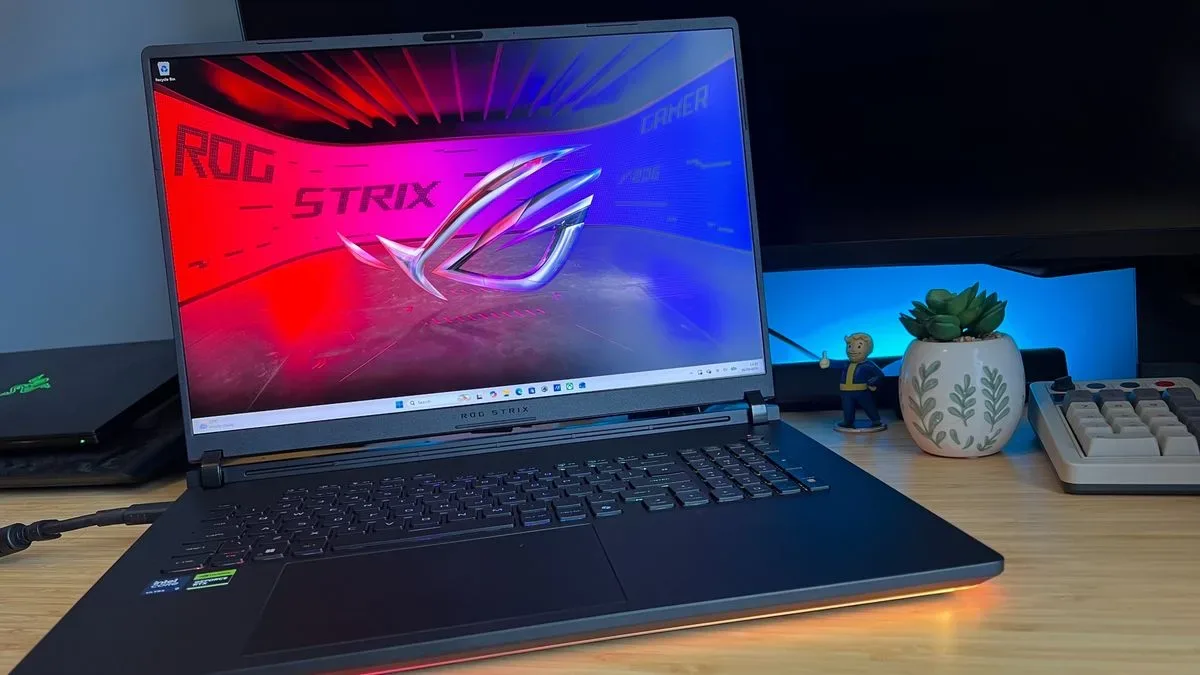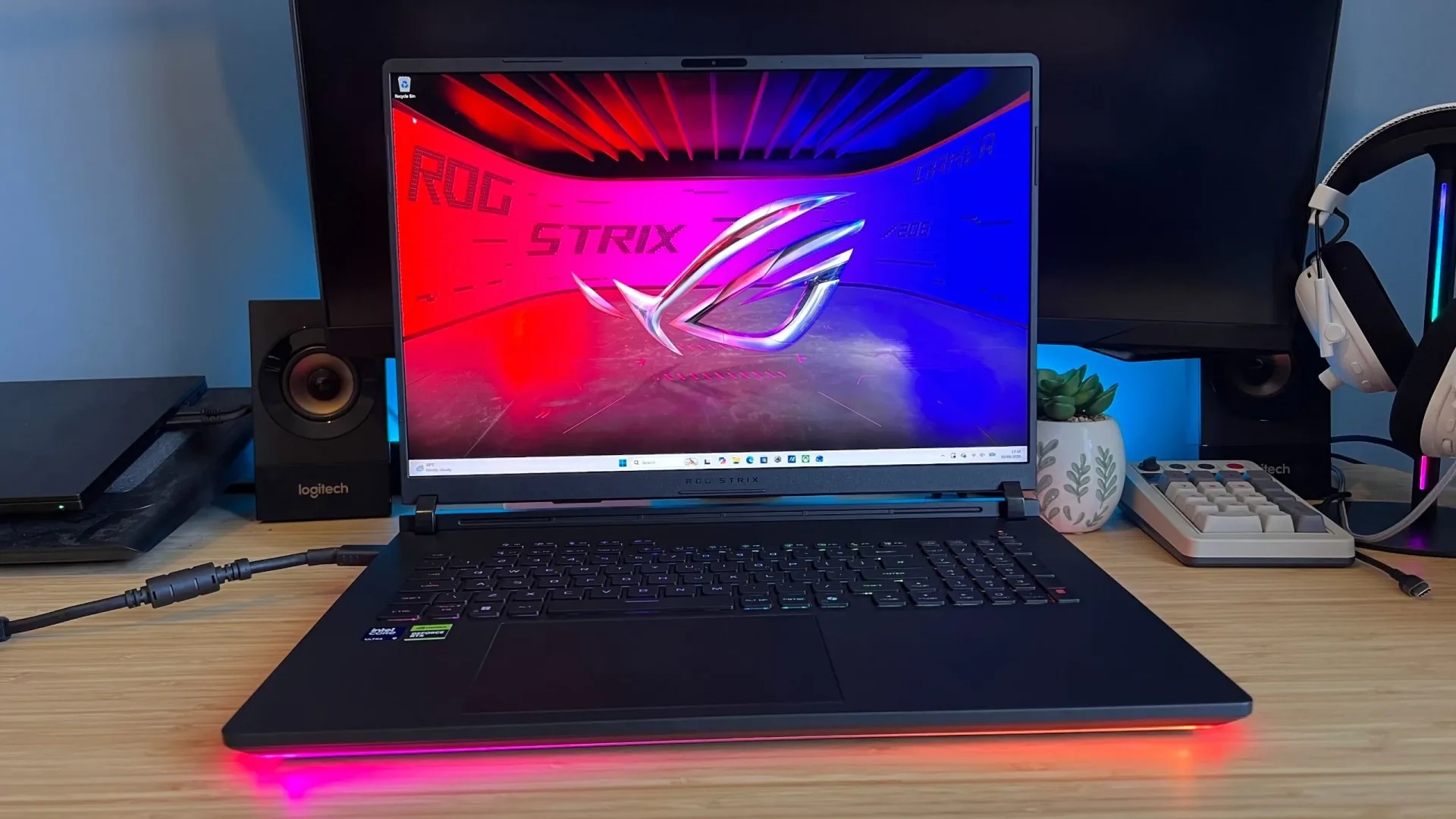
The 2026 Asus ROG Strix Scar 18 is not making a case for gaming on the move so much as making a case for putting an entire high-end PC setup in a large, foldable slab. Its strongest update is easy to identify: an 18-inch UHD+ Mini LED display that can reach 4K at 240Hz in Ultimate performance mode. Combined with Nvidia RTX 5080 or RTX 5090 laptop graphics, Intel’s Core Ultra 9 290HX Plus, revised cooling and up to 64GB of RAM, it is built for the part of the market where portability is a compromise rather than the goal.
That proposition has a conspicuous catch. Available configurations are listed from $4,299.99 to $5,299.99 in the US, and from £4,199.99 to £5,499.99 in the UK. A tested RTX 5090 model with 64GB of RAM and 4TB of NVMe storage in RAID did not have a specific street price, but comparable RTX 5090 versions were expected to cost around $5,000 even with less storage. This is emphatically premium territory, where a buyer should care about the screen, ports and desk setup as much as raw frame-rate results.
A desktop replacement with a sharper purpose
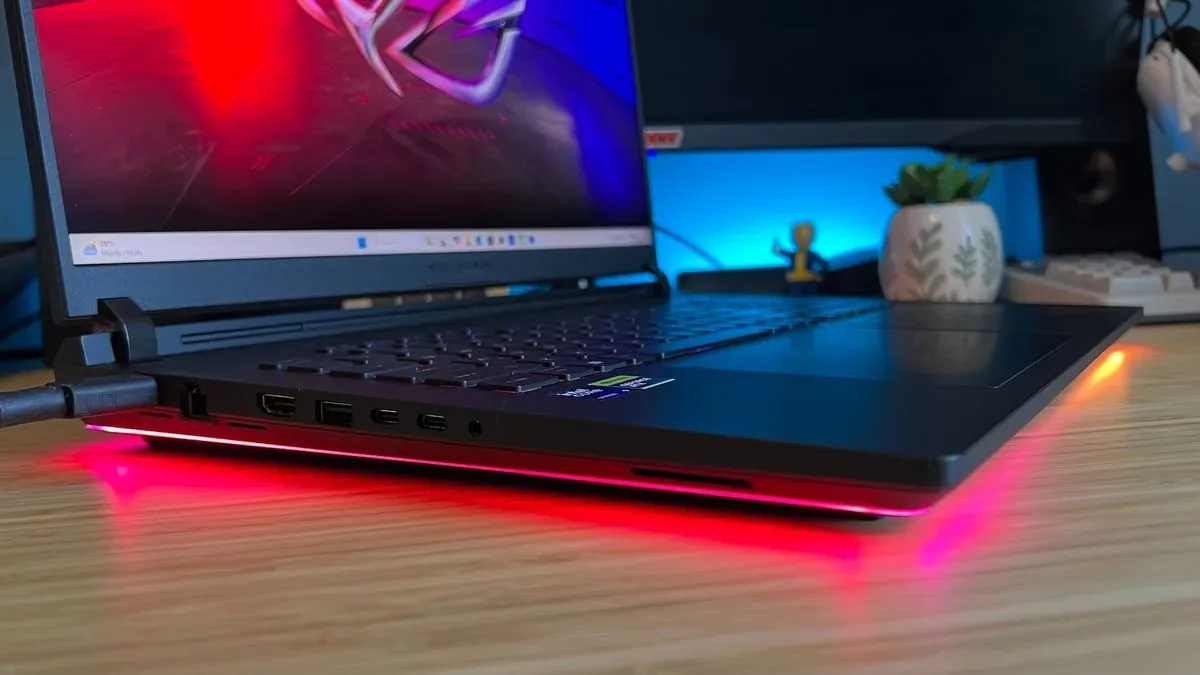
Asus has retained the more restrained matte-black exterior introduced on the prior generation. That is a meaningful fit for a machine at this price, especially compared with older versions of the Scar 18 that used a translucent chassis treatment. The keyboard deck uses a soft-touch plastic finish and the overall build is described as solid, although there is more flex around the deck than its price would suggest. The hinge can wobble slightly, too, even if it remains smooth, secure and usable with one hand.
The dimensions tell the more important story. The RTX 5090 model weighs roughly 3.7kg and measures 1.38 inches thick, 15.71 inches wide and 11.73 inches deep. That is a jump from the previous generation’s reported 3.3kg, and it places the Scar firmly in “move between rooms or take on an occasional trip” territory rather than everyday commuting territory.
Its closest rivals show how deliberate that tradeoff is. The Razer Blade 18 is cited at 3.1kg and 1.1 inches thick, while the MSI Raider A18 HX A9W is listed at 3.6kg and 1.26 inches. The Blade’s CNC-milled aluminum body also gives it a more traditionally premium physical presentation. Asus instead appears to be spending its extra mass on cooling headroom and the kind of display specifications normally associated with a desk-bound enthusiast setup.
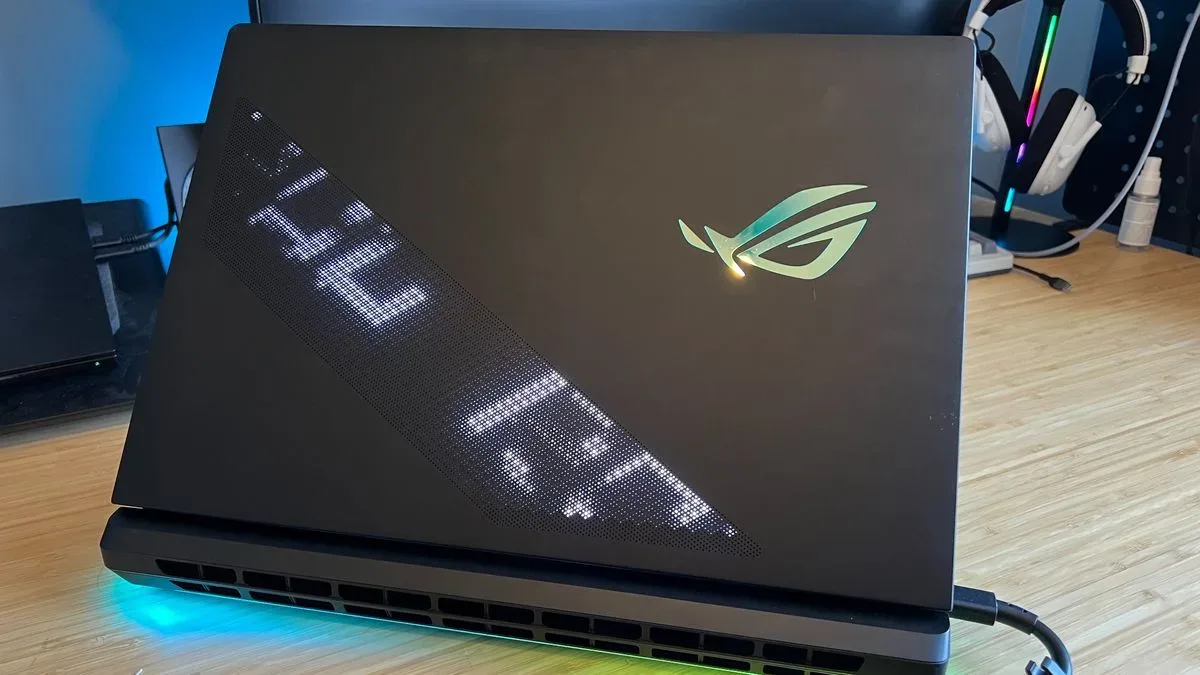
There is also an illuminated dot-matrix panel on the lid. It remains an aesthetic extra rather than a practical necessity, and it can be disabled in Armoury Crate. For prospective buyers, that matters less as a performance issue than as a reminder that a laptop already sitting at several thousand dollars includes decorative hardware they may not value.
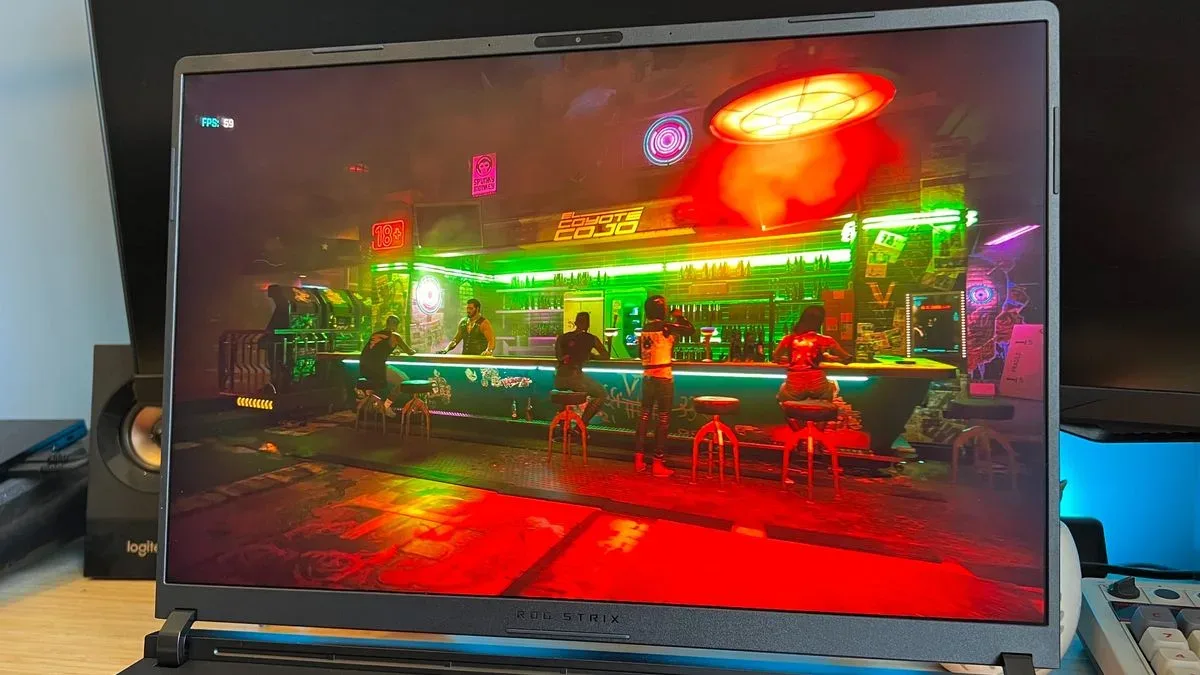
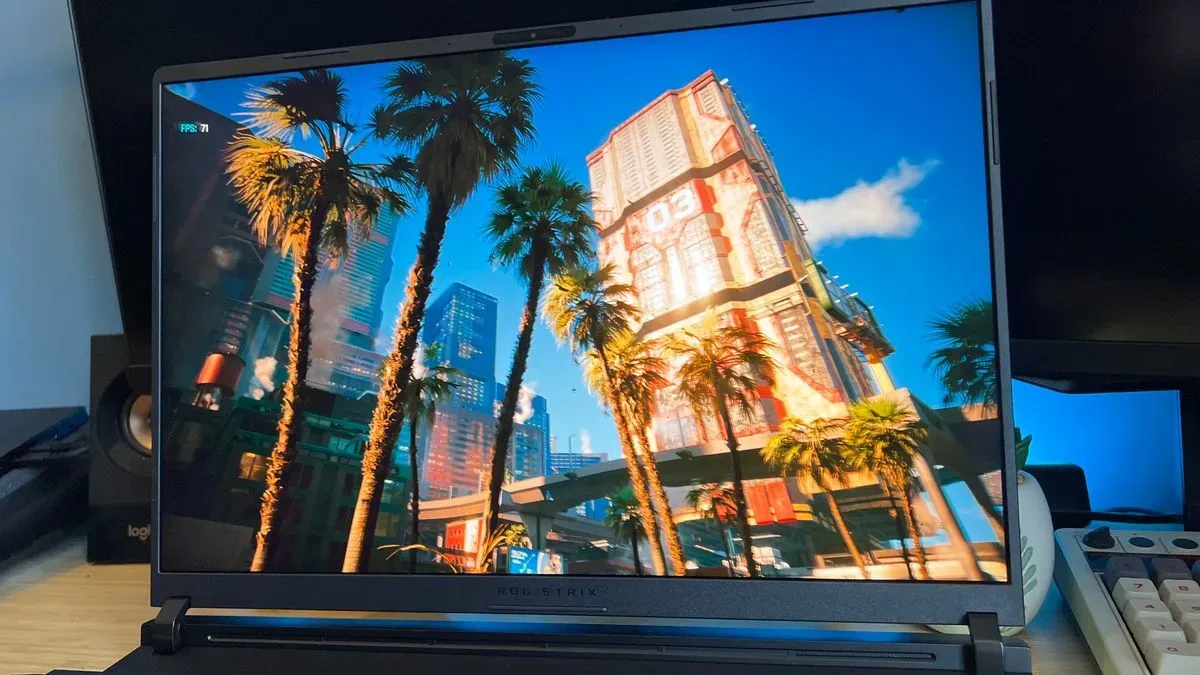
The 4K 240Hz Mini LED panel is the main event
The Scar 18’s biggest advantage is not simply that it has a 4K panel. It is that Asus combines UHD+ resolution with a reported 240Hz refresh rate, accessible through Ultimate mode. Refresh rate is the maximum number of times the display can update in a second; 240Hz creates the potential for smoother motion than 120Hz when a game and the hardware can provide enough frames. That does not guarantee every visually demanding game will run at 240 frames per second at 4K, but it gives the machine useful headroom for lighter games, older games and lower-resolution settings.
Mini LED is also central to the pitch. The screen reportedly has 2,000 dimming zones. In a Mini LED LCD, separate backlight zones can be brightened or dimmed independently, allowing much deeper blacks and stronger contrast than a conventional uniformly lit LCD can typically produce. It is not the same thing as OLED, where each pixel emits its own light, but local dimming can substantially improve dark scenes while preserving the very high brightness that helps in well-lit rooms.
Related coverage includes Asus ROG Strix Scar 18 (2026) Review: A 4K 240Hz Gaming Laptop Built to Rule the Desktop.
Reported observations describe wide color, uniform images and enough brightness to contend with sunny conditions. More significantly, the display exposes several local-dimming choices: one-zone, multi-zone balanced and multi-zone strong. One-zone means the backlight behaves as a single area, a mode that can simplify behavior but limits the benefit of local dimming. The multi-zone settings offer differing balances between dark-scene detail, brightness and visual impact.
There is a practical complication: this is a screen designed to be tuned. True Color HDR was reported as the most effective setting, but it limits access to further visual controls in Armoury Crate. HDR, or high dynamic range, concerns the range between dark and bright parts of an image and can make compatible games and video appear more lifelike when the display and content are properly configured. Buyers who want a consistent, quick-start experience may find the amount of adjustment less appealing than those who enjoy tailoring a panel game by game.
Still, Asus has a clear specification advantage over the two 18-inch alternatives named in the comparison. At UHD settings, the Razer Blade 18’s IPS display tops out at 120Hz, while the MSI Raider A18 HX A9W’s Mini LED screen also reaches 120Hz. Razer can hit 440Hz at FHD+ resolution, but does not provide a QHD middle ground. The Scar’s mix of 4K, 240Hz and display modes makes it unusually flexible for someone who wants one panel for both visually elaborate single-player games and higher-refresh competitive play.
That flexibility also gives the machine a sensible role beyond benchmark staples. A game such as Songs of Glimmerwick is a reminder that PC libraries are not composed solely of punishing graphics showcases; a high-resolution, color-rich display can matter just as much to stylized art, interface work and general desktop use.
Performance: close competition, different strengths
The Scar 18’s component list is appropriately uncompromising. RTX 5080 and RTX 5090 options are paired with an Intel Core Ultra 9 290HX Plus processor and either 32GB or 64GB of memory. The tested specification included the RTX 5090, 64GB of RAM and a 4TB NVMe M.2 SSD RAID arrangement. RAID refers to a storage configuration using multiple drives together; in this case, the extra capacity is not presented as the main reason for the laptop’s gaming performance.
The Core Ultra 9 290HX Plus is characterized as a modest step in real-world gaming performance compared with the preceding CPU, with more emphasis on heavier AI-oriented workloads. That distinction is worth keeping in mind. A new processor name does not automatically turn into a major gaming leap when the graphics processor, cooling system and game engine exert enormous influence on the final result.
Reported comparisons at 1080p saw the Scar ahead of the MSI Raider in Total War: Three Kingdoms and Horizon Zero Dawn Remastered, but just behind in Shadow of the Tomb Raider and Cyberpunk 2077. It also stayed ahead of the Razer Blade 18 in that set of results. At QHD, Asus reportedly took a clearer lead over both systems in Shadow of the Tomb Raider, Total War and Cyberpunk, with Horizon Zero Dawn Remastered the exception where it dipped slightly behind.
At 4K, the differences narrowed. The Blade led in Shadow of the Tomb Raider, though the Scar’s result was described as nearly identical. The Scar and Raider produced the same result in Total War: Three Kingdoms. In Horizon Zero Dawn Remastered, the Raider edged ahead while the Blade and Scar were effectively matched. Cyberpunk gave the Scar a technical lead, although all three machines only just exceeded 60fps under the reported conditions and the Blade dropped at RT: Ultra. RT, or ray tracing, is a rendering technique for more realistic lighting and reflections that can demand substantially more GPU performance.
These outcomes are more useful than a simple declaration of one universal winner. They suggest that the Scar has the cooling and graphics capability to sit at the front of the 18-inch class, but that its position changes by game, resolution and workload. A prospective owner should not expect 4K at 240fps in every modern release merely because the panel supports 240Hz. Instead, the hardware gives users a broad range of viable choices: prioritize resolution and image settings for cinematic games, or lower some settings and resolution to pursue higher frame rates.
What the synthetic numbers add
Standardized synthetic tests paint a similarly mixed, but impressive, picture. In 3DMark Fire Strike, an easier benchmark that can help separate very fast systems, the Scar 18 reportedly scored 41,777 points. That put it above the Blade 18 and closest to the still-leading Raider. It scored 24,194 in 3DMark Time Spy, ahead of both MSI and Razer in that comparison.
Steel Nomad, presented as the more relevant synthetic measure for demanding modern games, placed the Scar closer to the middle of the 18-inch comparison group, though still comfortably ahead of the prior year’s Scar. The MSI Raider retained the edge in Steel Nomad and in more of the hardest tests. Across the stated 1080p, 1600p, 2400p and 3DMark comparisons, the Scar finished first seven times, while the Raider did so six times.
The CPU comparison also favors MSI in one specific measure. The Raider’s AMD Ryzen 9 9955HX3D averaged 3,186 in single-core Geekbench 7 user tests, compared with 2,874 for the Scar’s Intel processor. Single-core performance measures how quickly one CPU core handles work; it can matter to some games and everyday tasks, but it is not a complete verdict on a laptop’s total performance. GPU power, memory, cooling and the exact application all remain relevant.
Ports and input: capable, but cables live at the sides
Connectivity is plentiful: HDMI 2.1, three USB 3.2 Gen 2 Type-A ports, two Thunderbolt 5 ports, 2.5G LAN, a 3.5mm audio connection, Wi-Fi 7 and Bluetooth 5.4. Thunderbolt 5 is the high-bandwidth connection in the set, while 2.5G LAN is a wired Ethernet option capable of exceeding conventional gigabit networking where the rest of the network supports it.
The limitation is placement. All of the ports sit along the sides. That can become inconvenient for the very desk setup this laptop invites: external display, wired network, storage, controller, headset and power can quickly create a crowded edge. Asus at least places HDMI and the two Thunderbolt 5 ports on the left, reducing the chance of cables encroaching on a right-handed mouse area. But rear-mounted permanent connections would be tidier on a chassis this large.
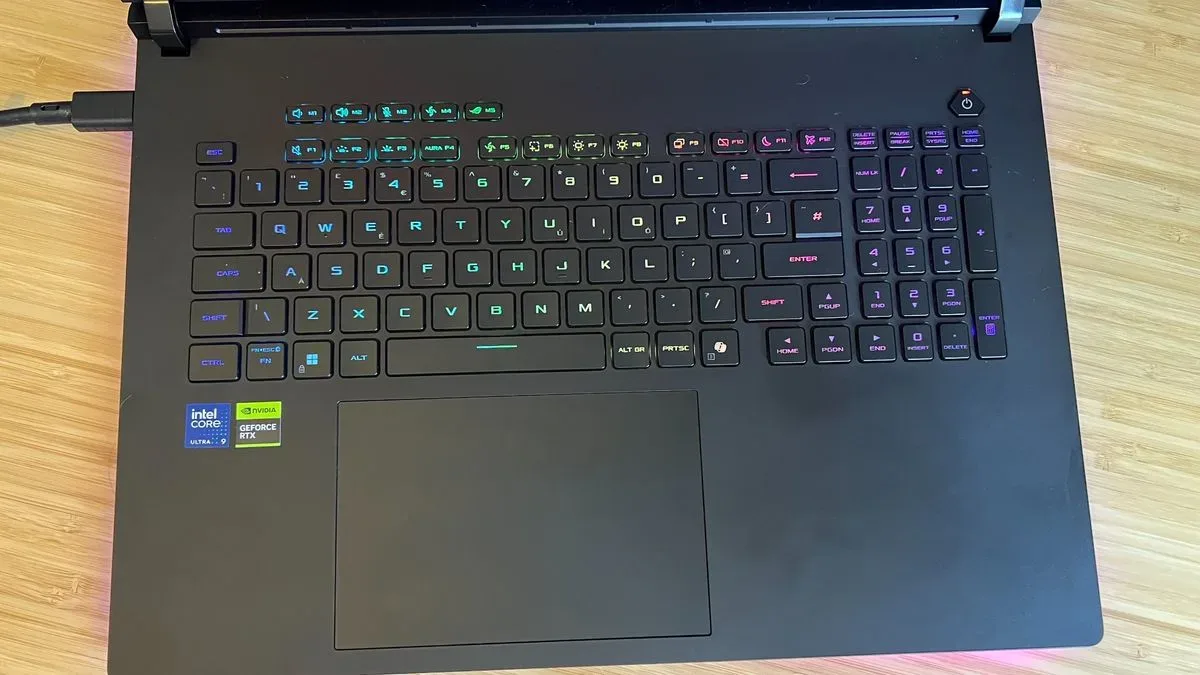
The keyboard is reported to have light actuation, a tactile response and a satisfying return for games, although typing feels a little soft and deck flex is noticeable. Asus includes a half-size number pad, full-size arrow keys and dedicated volume, microphone, fan and Armoury Crate controls. The trackpad is described as smooth, stable and accurate with gestures. None of this redefines laptop input, but it avoids making a powerful system feel compromised when a separate keyboard and mouse are not in use.
Who the Scar 18 makes sense for
The 2026 ROG Strix Scar 18 is best understood as a highly customizable 4K gaming station that happens to close shut. Its screen is the feature that makes the asking price more intelligible: Mini LED, 2,000 dimming zones, 4K resolution, HDR support and 240Hz capability are a rare combination in an 18-inch gaming laptop. Its performance is consistently elite, even if the Raider can take the lead in several of the most demanding scenarios.
Choose the Scar if the display is a priority, a mostly permanent desk setup is acceptable, and the budget can accommodate an RTX 5090 machine near $5,000. Consider the Blade 18 if smaller dimensions, lower weight and a more premium-feeling metal build matter more than extracting the strongest results. Consider the Raider if peak results in the toughest workloads are the overriding priority.
For everyone else, the Scar 18’s price, 3.7kg weight and side-port layout are meaningful reasons to look elsewhere. But for the narrow audience that wants a high-specification 4K, high-refresh laptop display without conceding top-tier GPU hardware, Asus has built a persuasive flagship. It does not win every benchmark, and it makes no attempt to travel lightly. It does, however, assemble one of the most complete screen-and-performance packages in the 18-inch category.