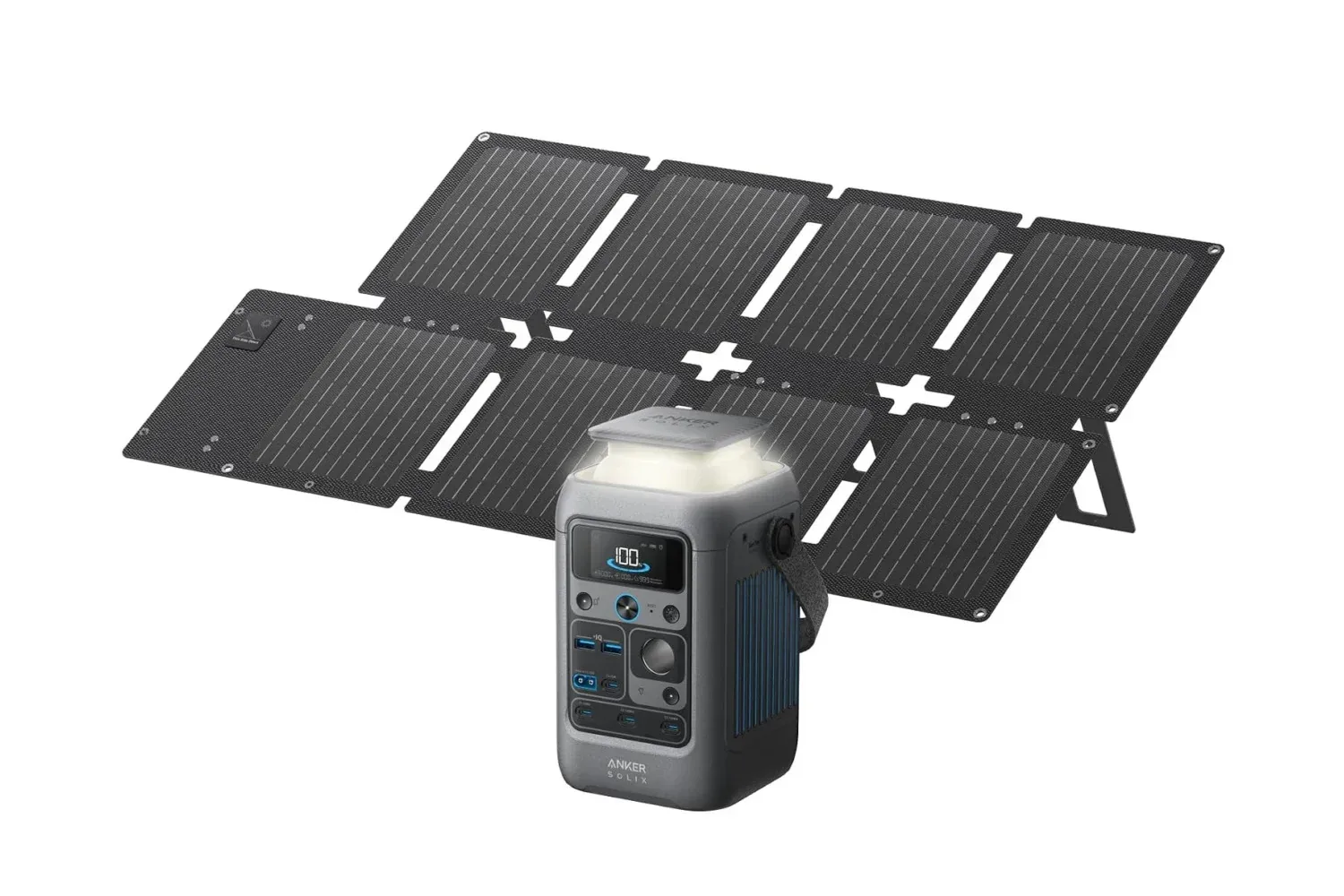
A portable gaming setup is only portable right up until a phone, controller, handheld, laptop or camera needs power. Anker’s SOLIX C300 DC bundle is aimed squarely at that problem, and the package is currently listed at $270, a $50 reduction from its usual $320 price. The bundle includes the compact power station and a 60W solar panel, rather than treating sunlight charging as a separate accessory purchase.
For players planning camping trips, vehicle-based travel, outdoor meetups or a modest emergency device kit, the interesting part is not merely the sale price. It is the combination of a 300W maximum output, a heavily USB-C-oriented port selection and a solar panel in the box. But shoppers should also separate what those figures actually mean from what they do not: output tells us how much power the unit can provide at one time, while runtime depends on battery capacity and the power draw of each connected device. A battery-capacity figure is not provided here, so it would be premature to promise a certain number of laptop or handheld charges.
What comes with the SOLIX C300 DC bundle
The package consists of the Anker SOLIX C300 DC portable power station, a 60W solar panel, a solar-to-XT-60 charging cable, an extension cable, a 60 cm 140W USB-C-to-C cable and a warranty card. The station has a built-in carry handle and is described as lightweight enough for easy carrying, while a built-in light can cover basic illumination when a separate camping light has been forgotten.
That contents list matters because solar compatibility alone is not the same thing as arriving ready for solar use. Here, the panel and the necessary solar charging cable are included. For someone building a travel kit around phones, a portable display, a camera and game hardware, that avoids one immediate compatibility question.
The current $270 price is described as a limited-time discount, so it should be treated as a snapshot rather than a permanent new price. A listed discount can end or change, and prospective buyers should confirm the price and bundle contents at checkout.
The 300W figure: useful, but not a runtime estimate
Watts (W) measure power: in plain terms, the rate at which a device uses or supplies electricity. The C300’s 300W total output is therefore most useful as a ceiling for the combined load of devices attached to it. It is not a statement of how long the power station will run those devices.
That distinction is especially important for gaming gear. A smartphone, earbuds, controller and small light are all very different loads from a laptop or portable projector. Connecting several items is convenient, but their demands add together. The practical task is to total the requirements of the devices expected to be running simultaneously and ensure they fit beneath the station’s stated output limit.
Watt-hours (Wh), by contrast, are generally the figure used to describe stored battery energy and help estimate runtime. No watt-hour capacity is specified in the available details. That means buyers can make a reasoned judgement about simultaneous-power headroom from the 300W rating, but cannot calculate a reliable session length from the provided information.
That is not a minor technicality. A portable power station can be an excellent shared charging hub even when it is not intended to run larger equipment for extended periods. Anyone shopping specifically for long off-grid play should seek the capacity specification and compare it against the power draw of their own equipment before deciding whether this is the right size.
A port layout built around modern device charging
The C300 DC has seven outputs: a 120W car socket, two 140W USB-C ports, one 100W USB-C port, one 15W USB-C port and two 12W USB-A ports. The abundance of USB-C is the clearest part of its pitch. USB-C is the connector widely used by newer phones, tablets, many laptops and a growing amount of gaming hardware, making one power source more flexible for mixed-device travel.
- Car socket: listed at 120W, for compatible 12V car-style accessories.
- Two USB-C ports: listed at 140W, suited to higher-power USB-C charging needs where the connected device and cable support it.
- One USB-C port: listed at 100W, another option for devices with substantial USB-C charging requirements.
- One USB-C port: listed at 15W, appropriate for lower-demand charging.
- Two USB-A ports: listed at 12W, useful for older cables and smaller accessories.
The supplied 140W USB-C-to-C cable is a welcome inclusion for a high-power USB-C connection, though a cable’s rating does not make every device charge at that level. The device, its charger protocol and the relevant port all have to support the requested charging rate. In everyday use, that simply means checking a laptop or handheld’s charging requirements instead of assuming that every USB-C port behaves identically.
It is also worth noticing what is and is not described. The connectivity list is centered on car-socket and USB ports; a conventional household-style AC outlet is not listed among the seven outputs. That makes this bundle a more obvious match for USB-powered devices and compatible car-socket accessories than for gear requiring a standard wall plug. Buyers with a particular monitor, console dock or charger in mind should check its input and plug type before treating the C300 as a universal replacement for a wall outlet.
Where it fits a gaming travel kit
The product description presents the C300 as capable of serving a phone, tablet, laptop, earbuds, gaming console, portable projector, drone camera and camping light. Taken together, that is a plausible travel checklist for a group that wants power management rather than a single-device charger. The built-in light also adds a small practical benefit: finding cables and ports in a dark tent, car or campsite is easier when the station itself can provide light.
The strongest use case is likely a device-heavy day away from reliable mains power. A player can keep personal electronics topped up while also supporting the peripherals that often accompany a trip: cameras, drones, lights and tablets. The port count reduces the need to choose one device at a time, although the 300W total remains the limit that governs the whole setup.
It could also be relevant to players assembling a portable PC or VR-adjacent setup, where the hardware conversation is increasingly about flexibility as much as raw specs. That broader question is central to Steam Frame’s wireless PC streaming proposition, although a portable power station solves a separate and more basic issue: keeping compatible supporting devices charged when a regular outlet is unavailable.
Wall charging and solar charging are different conveniences
For a fast turnaround near mains electricity, Anker says the C300 can recharge from zero to 80% in 50 minutes through a wall outlet. That is useful when the station is being packed between trips or topped up during a short stop with access to power.
The included 60W solar panel is the slower but more independent option. The stated estimate is about four hours to recharge the station to 100% via the panel. Solar charging depends on sunlight, so the quoted time is best treated as an estimate rather than a promise for every weather condition or placement scenario. Still, including the panel changes the bundle’s role: it can replenish away from a wall outlet instead of merely redistributing a charge that was loaded at home.
There is a practical trade-off. The solar panel brings more gear to carry and set up, but it is valuable precisely when wall charging is not possible. Meanwhile, users who only need an emergency backup at home may value the 50-minute wall-charge claim more than the panel. The included extension cable may also help place the panel where it can receive sunlight while keeping the power station and connected devices in a more convenient spot.
Who should consider the deal—and what to verify first
At $270, this bundle makes the most sense for people who want a compact, multi-port DC charging hub and see real value in having the 60W panel included. It is particularly aligned with USB-C laptops, phones, tablets, accessories and other portable electronics. The seven ports support a shared setup, while the handle and built-in light make the unit sound purpose-built for trips rather than permanent desk duty.
Before buying, verify the requirements of the devices that matter most. Confirm their charging connector, their expected wattage, whether they need a conventional AC outlet, and how much runtime is required. Most importantly, find the station’s battery-capacity specification if time away from a wall outlet is the deciding factor. The advertised 300W output is meaningful, but it answers a different question than endurance.
For the right kit, the discount turns an all-in-one portable power setup into a more approachable purchase: $270 for the station, 60W solar panel and cables. Just treat it as a limited-time listing, not a guaranteed long-term price.
Shop the products
Check current price, model and availability at the retailer.