OFFBEAT, Whetstone Games’ music-production game, has received its Synthwave update. It is a substantial early-access patch built around more ways to play, arrange and learn inside the game: MIDI/controller support, three new musical objects, 11 additional jobs, a new scale mode, placement controls and several quality-of-life improvements are all part of the release.
The headline addition is the long-requested ability to connect a MIDI keyboard. That does not merely add another input option. It potentially changes the relationship between OFFBEAT’s sequencer-based setup and players who are already comfortable making musical ideas with keys under their fingers. The update also supports playing through a computer keyboard, with quantisation intended to keep notes in key.
MIDI support gives the sequencer a more direct performance route
MIDI, short for Musical Instrument Digital Interface, is a standard used to send performance information between compatible devices and software. In practical terms, a MIDI keyboard can transmit which key was pressed, when it was pressed and released, and sometimes other expressive data. Here, players can plug in a MIDI keyboard and use channels 1 through 4 to control instruments routed through OFFBEAT’s sequencer.
A sequencer is a system that organizes musical events into a timed pattern or arrangement. Rather than treating a keyboard performance as the whole track, OFFBEAT’s routing means that input can be directed into the instruments already being managed by that system. The supplied details do not specify every MIDI function, controller type or routing configuration, so players should not assume broader compatibility beyond channels 1–4 and sequencer-routed instruments. Still, the stated implementation is meaningful: it connects external physical hardware to the game’s musical workflow.
Computer-keyboard performance offers another on-ramp. Its note quantisation is designed to keep input in-key. In music, quantisation can refer to correcting timing or restricting notes to a defined set. In this case, the stated purpose is tonal: helping players avoid notes outside the chosen key. That should make experimentation less punishing for people who do not yet know a scale layout, while leaving the act of choosing rhythms and phrases in the player’s hands.
This is especially relevant alongside the update’s newly added Phrygian mode. A mode is a particular scale structure, and Phrygian is one of the named musical modes now available in the game. OFFBEAT’s new input assistance and added scale option point in the same direction: making it easier to turn a musical idea into something that fits the selected tonal framework without requiring prior theory fluency.
Three musical objects lean into the Synthwave theme
The patch introduces three new musical objects, each with a deliberately playful concept:
- VHS drum: positioned for heavy basslines.
- FM-powered synth: a versatile synthesizer inspired by arcade racing wheels.
- Smoothie maker: an object that introduces players to chorus and flanger effects.
The FM synth is the most technically notable description of the three. FM, or frequency modulation, is a synthesis approach in which one audio-frequency signal changes another, producing a wide range of tones. The update describes this instrument as versatile, but does not list presets, parameters or a precise sound palette. Its arcade-racing-wheel inspiration nonetheless fits the patch’s Synthwave framing, where stylized electronic color and retro-leaning audiovisual associations are clearly part of the appeal.
Related coverage includes OFFBEAT Synthwave Update Adds MIDI Support, New Instruments and 11 Jobs.
The smoothie maker is also doing more than serving as a joke-shaped prop. It is an entry point to two well-known audio effects. Chorus thickens or widens a sound by layering subtly shifted copies of it, creating an impression of multiple voices or instruments playing together. Flanger combines a signal with a slightly delayed version of itself, then varies that delay to create a sweeping, shifting texture. The update does not promise professional production instruction, but presenting effects through an object with a memorable identity can make an abstract concept easier to approach.
Meanwhile, the VHS drum is described as a source of heavy basslines. That wording is worth keeping distinct from a claim that it is only a conventional drum machine or only a bass instrument; the update simply identifies its intended musical role. Together, the three additions broaden the game’s available sonic tools while maintaining OFFBEAT’s object-driven sense of humor.
Eleven jobs expand the game’s musical prompts
Eleven new jobs have been added. These assignments give players new scenarios in which to make music, and the examples suggest that OFFBEAT continues to treat production challenges as colorful prompts rather than dry exercises.
Among the listed jobs are making a television advert for an anti-sleep device, taking part in a vaporwave session with DJ Sludgepump, and producing a set for Lilith’s haunted family dinner. Those premises do not reveal every objective or reward attached to each job, and no such details should be assumed. What they do establish is the tonal range of the new material: commercial absurdity, genre-specific styling and supernatural domestic chaos all have a place in the update.
For players who find a blank arrangement intimidating, scenario-led tasks can be useful creative constraints. A request for an advert or a themed dinner set supplies a starting point, even if the player is still deciding what kind of beat, chord movement or texture they want to build. That is analysis of the role such prompts can play, rather than a claim about any particular objective structure in OFFBEAT’s new jobs.
Manual grid placement addresses arrangement precision
Another functional improvement is manual grid placement. Players can now place instruments precisely after taking them out of storage. The detail may sound smaller than MIDI support, but precise positioning matters in a workspace built around multiple musical objects. It gives the player more control over where tools sit rather than relying on a more automatic placement behavior.
The update also enlarges the in-game notebook with elementary chord theory. A chord is a group of notes heard together, while chord theory broadly concerns how those note groups are formed and relate to one another. “Elementary” is an important qualifier: the patch is adding foundational material, not claiming to turn the notebook into a comprehensive music-theory course. Paired with scale-aware keyboard quantisation and the new Phrygian mode, though, it makes OFFBEAT’s learning tools more visible within the act of making music.
That blend of instruction and accessibility is one of the more practical consequences of the patch. A player can work with a MIDI keyboard if they already own one, use a standard computer keyboard if they do not, and consult introductory chord material in the notebook when they need terminology or a foothold. The announced features do not eliminate the creative decisions involved in composing, but they give more routes into the process.
Quality-of-life work includes better desync diagnostics
Beyond content, the Synthwave update includes multiple quality-of-life changes and bug fixes. Most notably, error handling has been improved to help prevent and diagnose desync bugs.
A desync, short for desynchronization, happens when parts of a system that should agree no longer line up correctly. The available information does not specify OFFBEAT’s exact desync conditions or guarantee that every such issue is resolved. The significance of improved error handling is therefore diagnostic as well as preventative: it can help identify what has gone wrong when a mismatch occurs, rather than only dealing with the symptoms.
For an early-access music-production game, this is not glamorous patch-note material, but it is important. Creative software and games alike depend on players being able to trust their tools enough to keep experimenting. Fixes and clearer failure handling do not generate the immediate novelty of a new synth, yet they can have a real effect on whether a session remains productive.
What the schedule means for OFFBEAT’s next steps
Whetstone Games has described Synthwave as OFFBEAT’s last major content update of 2026. Future early-access updates will be spaced farther apart to give the team more development time. A smaller festive-season update is planned before the next major content update, which is scheduled for January 2027.
The schedule sets sensible expectations: players should not read the current patch as the final word on early access, but neither should they expect another major content drop before the end of the year. The stated plan is for a lighter seasonal update first, then the larger January update. Specific features for either forthcoming patch have not been supplied.
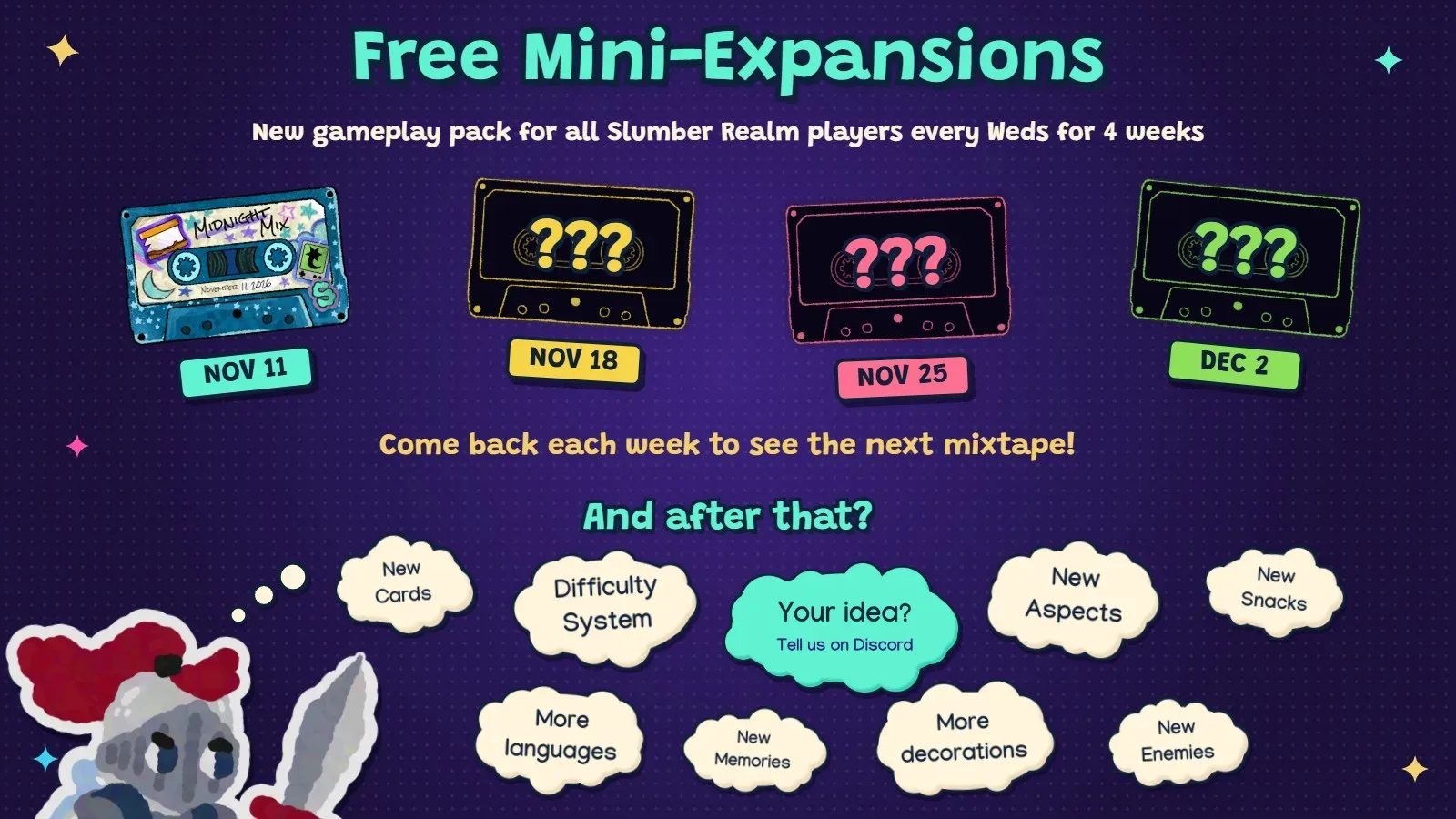
OFFBEAT’s Synthwave release is consequently both a content expansion and a usability pass. The new instruments and job scenarios provide fresh material; MIDI and computer-keyboard options make performance more approachable in different ways; scale tools and chord notes add basic educational support; and placement and desync work address the daily feel of arranging and troubleshooting. For another recent example of a PC game building momentum through ongoing additions, see this look at Slumber Realm’s planned mini-expansions.
Most importantly, the update’s components reinforce one another. External keyboard control makes an idea easier to perform, quantisation can keep that idea within the selected key, new instruments give it a different character, and jobs provide unusual reasons to try it. That is a coherent direction for a music game: more expressive tools for experienced players, with more guardrails and explanation for those still learning how the pieces fit together.