No Man’s Sky is now ten years old, which is a sentence capable of making even the hardiest interstellar traveller check whether their exosuit has developed a few grey pixels. Hello Games’ enormous exploration and survival game has spent that decade accumulating free additions, gradually expanding what a player can find, fly, fight, collect and construct across its universe.
The newest step in that long-running evolution is the Cosmos update, which arrived on September 9. The update is attracting attention for an especially ambitious pair of possibilities: claiming a space station and creating a base in open space. For a game whose construction was previously associated with planetary real estate, the prospect of becoming a deeply overcapitalized mayor of the vacuum is understandably proving irresistible.
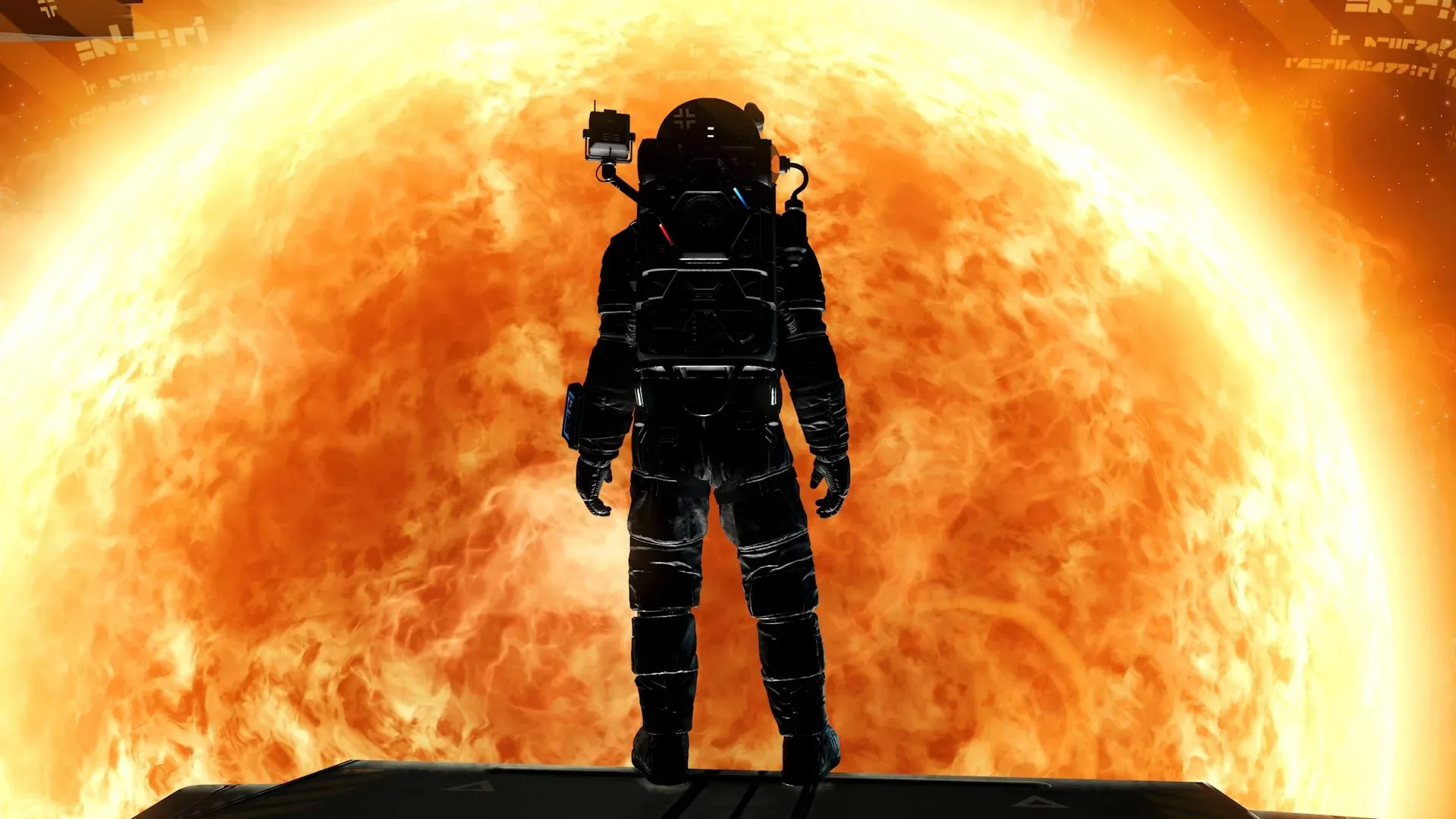
There is also an update-note item called “The Sun”, and its blunt implication is exactly as dramatic as it sounds: players can apparently fly into a sun and burn up. It is a fine reminder that the universe can now offer both astonishing building opportunities and a large, incandescent disciplinary measure for reckless piloting.
From planetary plots to orbital ambition
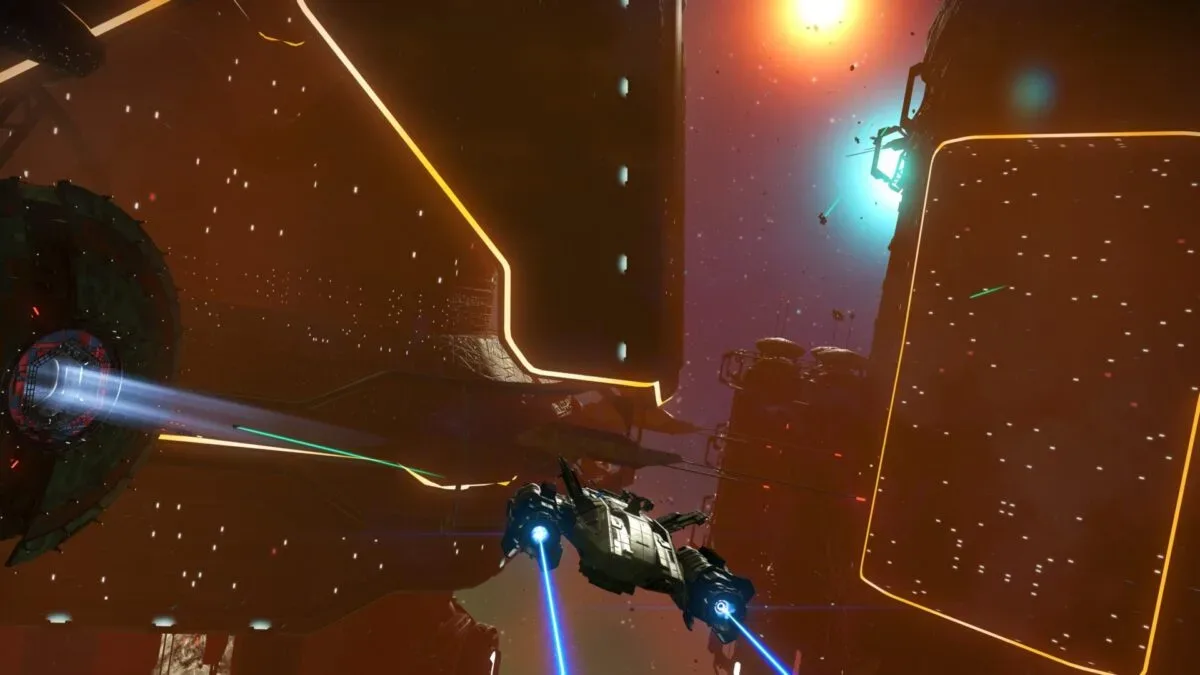
Before Cosmos, building was limited to planets. The new update is being discussed as opening the door to construction beyond those surfaces, including bases associated with claimed stations and structures situated in space itself. Community clips and images circulating after the update have already focused on dense, neon-lit station interiors and enormous city-like projects.
The appeal is obvious. Planetary bases have always let players put a personal stamp on a discovered world, but open-space construction changes the fantasy. A builder is no longer restricted to choosing the correct moon, paradise planet, frozen wasteland or suspiciously radioactive beachfront. In principle, the build can become part of the travel network: an orbital landmark, a staging point, a social showpiece or an unapologetically impractical monument to having far too many resources.
That distinction matters in a game built around scale. No Man’s Sky has never lacked sky, stars or places to travel. The notable change is the ability to turn a stretch of that vastness into something owned, organized and recognizably yours. The void has finally entered the property market, and it appears the vacancy chain is extremely selective.
A billion units is not a casual decorating budget
The new capability does not appear to be a quick early-game unlock. Reports from players indicate that claiming a station costs one billion units. In addition, a player reportedly needs to reach reputation level 40 before gaining access to the right to establish a space base.
Those thresholds put the system firmly in long-term-goal territory. A billion-unit requirement is less “I will pop by after lunch” and more “I have constructed a financial empire from minerals, trade routes and an alarming commitment to inventory management.” The reputation requirement similarly suggests that space-station ownership is intended as a reward for a well-established traveller rather than a feature handed to someone who has just emerged from their first damaged starship.
Related coverage includes No Man's Sky Cosmos Update Lets Players Claim Space Stations and Build Among the Stars.
It also gives the bases a certain status. Plenty of games let players make impressive homes, but an expensive claimed station signals persistence as much as architectural taste. A visitor may admire the lighting, the hangar arrangement or the towering cyberpunk skyline. They may also silently calculate the years of virtual economics standing behind every polished corridor.
Of course, a high barrier can create a more competitive hunt. If the system has an attractive location, easy travel access or a spectacular view, it may become a coveted target for players with the funds and standing to claim it.
Location could matter as much as decoration
The practical case for an open-space base may be just as strong as the visual one. A station positioned at a useful warp point could function as an operations hub for expeditions and ordinary travel. Instead of treating it solely as a floating mansion, players could use the location to support exploration across nearby systems.
That is where Cosmos could make construction feel different from simple ornamentation. In a game of nearly endless destinations, placing a persistent point of activity near a useful route offers a reason to think about geography on a galactic scale. A station can be a destination, but it can also be infrastructure.
Then there is the less practical, entirely understandable alternative: build somewhere popular and make every passing traveller confront the magnitude of your achievement. There is a long and honorable tradition of multiplayer construction projects that are part shelter, part artwork and part declaration that somebody had a plan, a deadline-free weekend and access to industrial quantities of building materials. No Man’s Sky players appear ready to bring that tradition to orbit.
Community-made projects have long helped games remain lively long after launch. The same shared enthusiasm that makes events and collaborative spaces memorable elsewhere in gaming is part of why initiatives such as Games Done Quick’s community-focused Gamescom debut matter: players frequently turn systems into spectacles that go far beyond their original utility. Cosmos gives No Man’s Sky builders a particularly enormous new canvas for that instinct.
Prime stations may not stay unclaimed for long
There is a catch for anyone planning to claim a famous or fashionable location. Players posting in the No Man’s Sky community have reportedly warned that others are already finding widely shared spots and taking ownership before late arrivals can prepare the required resources.
That means planning may be important. Anyone hoping to establish a station base may want to ensure the units and necessary progression are in place before becoming too attached to a location. A gorgeous system, convenient warp route or community-highlighted station may be less a leisurely future project than a race against another traveller who also saw the same impressive view and had a billion units ready to deploy.
The competitive wrinkle is a natural consequence of making valuable places claimable. It introduces a small land rush into a game famous for cosmic abundance. There may be innumerable stars, but a particularly useful or photogenic spot can still become scarce once thousands of people know where to look.
It also encourages a different sort of discovery. The best base is not necessarily the one that has already gone viral. A player may find more satisfaction in locating an overlooked system, choosing a functional position and creating the station that later becomes a destination in its own right. In a universe this large, the next remarkable location may be waiting one warp jump away from somewhere nobody thought to bookmark.
Cosmos continues a decade-long expansion
Ten years after No Man’s Sky launched in 2016, the Cosmos update illustrates how radically a live game can change through sustained additions. The headline feature is not merely another decorative part or a new patch of terrain. It is a shift in where players can place their creations and how those creations can fit into travel, status and community discovery.
Details around the full limits of open-space construction, station claiming and placement will naturally matter to ambitious builders, especially as more players test the new systems and identify the most desirable destinations. For now, the broad picture is already enough to inspire the community: planetary construction has a new companion in orbital architecture, provided the traveller has earned the reputation and assembled the astronomical bank balance.
And if the search for the ideal station becomes frustrating, there is always the sun. Cosmos has reportedly made it possible to fly directly into it. That is not a recommended financial recovery plan, but it is certainly a memorable way to end a stressful day of galactic real estate shopping.