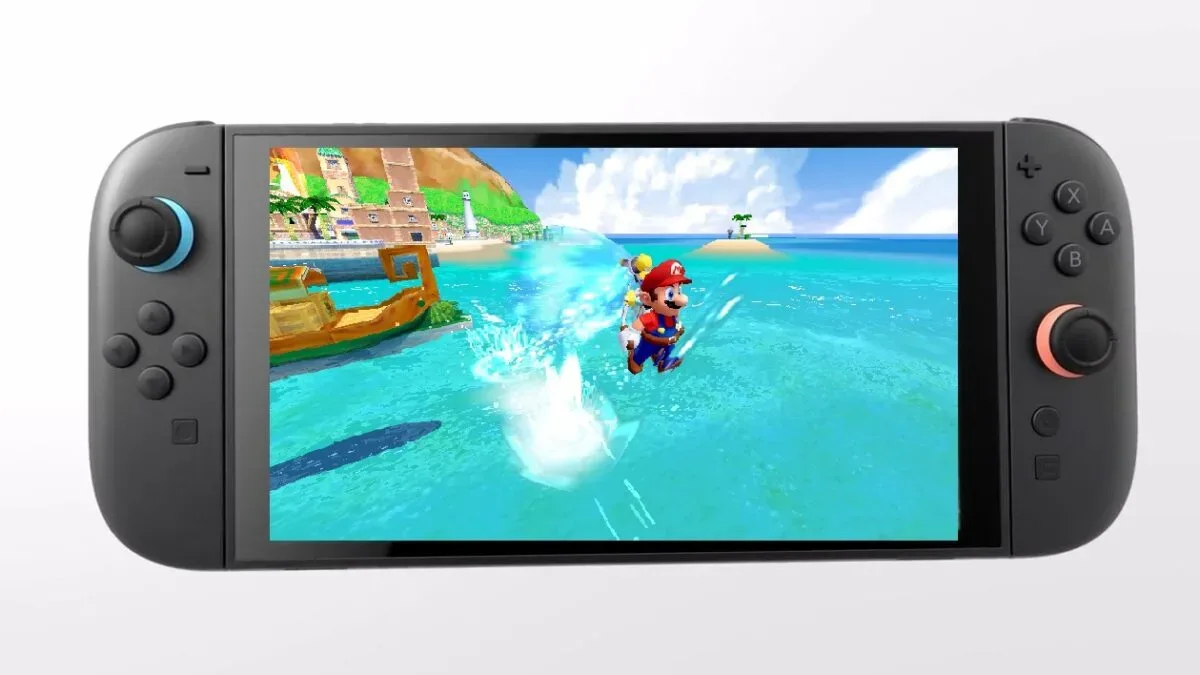
Super Mario Sunshine is set to join the Nintendo GameCube – Nintendo Classics library on Nintendo Switch 2 on August 13. Access will be available to Nintendo Switch Online + Expansion Pack members, giving the GameCube-era Mario adventure a new route onto Nintendo’s current hardware.
The trip back to Isle Delfino is noteworthy for more than the usual retro-library roll call. Sunshine remains one of the most distinctive, divisive, and strangely influential games in Mario’s 3D history. It is remembered as a sunny vacation that immediately turns into municipal cleanup duty: Mario arrives at a tropical island, finds its spaces polluted, and spends much of the adventure washing away grime with a talking water-powered device called FLUDD.
That premise has never been especially subtle, and that is part of its charm. Where many Mario games ask players to leap through carefully designed obstacle courses, Sunshine makes movement, water management, environmental tasks, and exploration part of the same big, wet mess. For players who missed the GameCube original, the Switch 2 catalog arrival offers a chance to revisit—or finally investigate—why the game has held such an unusual position in the series for so long.
A GameCube Mario Game With a Different Job Description
Super Mario Sunshine’s central tool is FLUDD, a water-spraying backpack that assists Mario in cleaning polluted areas. The gadget also reshapes how players move through the world. Rather than acting as a simple item used in a few isolated challenges, it is at the heart of the game’s structure and personality.
This makes Sunshine feel unlike the more straightforward platforming sandbox approach associated with other 3D Mario games. Its levels lean heavily into environmental puzzles and cleanup tasks, with the water system doing the work of both a theme and a mechanical hook. Mario is still Mario, but he is also, for once, a plumber-adjacent public-works employee with a high-pressure hose and an extremely talkative piece of equipment.
That design choice is a major reason the game remains controversial. Fans who want a Mario game built around clean, direct platforming may see the water-cleaning focus as an interruption. Others appreciate how thoroughly Sunshine commits to its setting and tools. Either way, it is difficult to mistake the game for a safer repeat of what came before it.
Its legacy can be seen in later Nintendo ideas. The freewheeling movement and sandbox sensibility invite comparisons to Super Mario Odyssey, while the very notion of solving problems by spraying colorful spaces with liquid naturally calls Splatoon to mind. Even FLUDD’s willingness to speak has an obvious family resemblance to Nintendo’s more recent habit of giving players chatty companions—though not everyone will be eager to welcome another voice in their ear.
August 13 Brings the GameCube Catalog to 10 Games
Sunshine’s addition will bring the Switch 2 GameCube collection to 10 games. The GameCube – Nintendo Classics lineup is currently exclusive to Switch 2, so this is not simply an expansion of the original Switch’s retro-app selection. It is part of the newer system’s specific GameCube offering.
Related coverage includes Super Mario Sunshine Joins Switch 2's GameCube Library on August 13.
For Nintendo Switch Online + Expansion Pack members, that distinction matters. The August 13 date is for the catalog version of the game rather than a newly announced standalone release. Anyone hoping for a separate retail edition or a full remake should keep expectations in check: the information available confirms Sunshine’s arrival in the subscription library, not a ground-up rebuilding of the GameCube title.
There is also another GameCube game waiting in the wings. Pokémon Colosseum has been confirmed for the Switch 2 GameCube library, although it does not yet have a release date. Sunshine therefore arrives as the catalog continues to grow, while leaving a conspicuous Poké Ball-shaped appointment on the calendar for later.
What Is Known About the Switch 2 Version
The announcement material does not show gameplay, so specific technical details for Super Mario Sunshine have not been confirmed. That means there is no firm basis yet to promise particular resolution targets, performance changes, control revisions, or other game-specific upgrades.
There is reason for cautious interest, though. Other GameCube additions to the Switch 2 library have included enhancements such as improved resolution. It would be reasonable to watch for similar treatment here, but it remains an expectation rather than a confirmed feature until Nintendo provides details or the game becomes available on August 13.
This is an especially curious case because a remastered version of Sunshine already appeared on Nintendo Switch through the Super Mario 3D All-Stars collection. That collection is no longer available as a current release, which makes a subscription-catalog appearance potentially useful to players who did not pick it up during its original run. Still, the two situations are not automatically identical: a past remastered collection and a Switch 2 GameCube library version should not be treated as the same product without confirmed technical information.
Retro re-releases can also inspire an immediate question about how an older game will look and connect on modern displays. Players revisiting original hardware have separate concerns from those using the Switch 2 catalog, and our guide on mapping the connection before buying a retro console HDMI adapter is useful for the GameCube faithful still planning a physical-console detour to Delfino.
Why Sunshine Still Draws Such a Big Reaction
Mario games are frequently judged against the almost unfair standard of their own family tree. A title can be broadly liked and still become the one fans argue about most loudly at a gathering, in a group chat, or while waiting for someone to stop hogging the good controller. Sunshine has long occupied that role.
Its defenders tend to value its individuality. Isle Delfino gives the game a cohesive tropical identity, and FLUDD gives Mario a toolkit that immediately differentiates the adventure from its peers. Its critics have never lacked for material either, particularly if their ideal Mario experience emphasizes pure jumping over cleaning, spraying, and puzzle-oriented detours.
Neither response is likely to disappear when the game reaches Switch 2. In fact, the new catalog placement may make the discussion livelier. Subscription libraries are ideal for the games that everyone “really should play someday,” especially when that recommendation is followed by a lengthy warning that the recommender also has several complicated feelings about it.
Sunshine’s return can therefore serve two audiences at once. For longtime fans, it is a chance to revisit a favorite that has often been treated as the odd entry in the Mario canon. For skeptics and newcomers, it is a low-friction opportunity to see what all the cleaning-related commotion is about. The game’s reputation is not built on consensus; it is built on the fact that it took a large swing.
What to Expect on August 13
- Game: Super Mario Sunshine
- Platform: Nintendo Switch 2
- Library: Nintendo GameCube – Nintendo Classics
- Access: Nintendo Switch Online + Expansion Pack membership
- Date: August 13
- Confirmed technical details: The announcement does not provide gameplay footage or game-specific upgrade details.
For a game once defined by a sun-soaked island in need of a serious rinse, the timing feels appropriate: Super Mario Sunshine is about to wash back into a Nintendo library, carrying FLUDD, cleanup assignments, and every old argument about where it belongs among Mario’s 3D adventures. On August 13, Switch 2 owners with the Expansion Pack can decide whether Isle Delfino was an underappreciated holiday, an eccentric detour, or both at once.