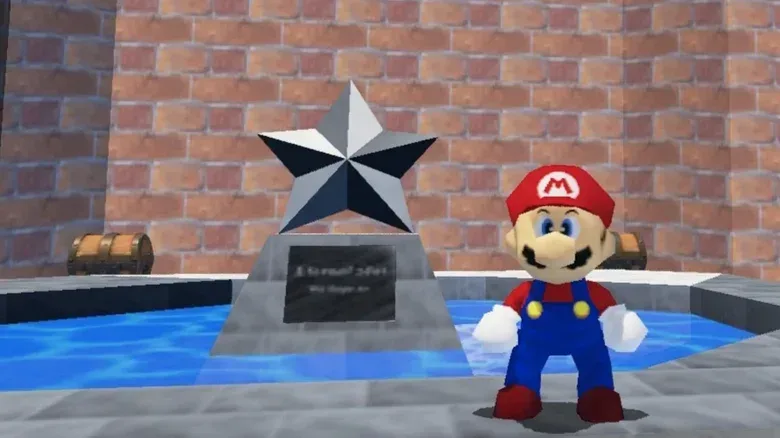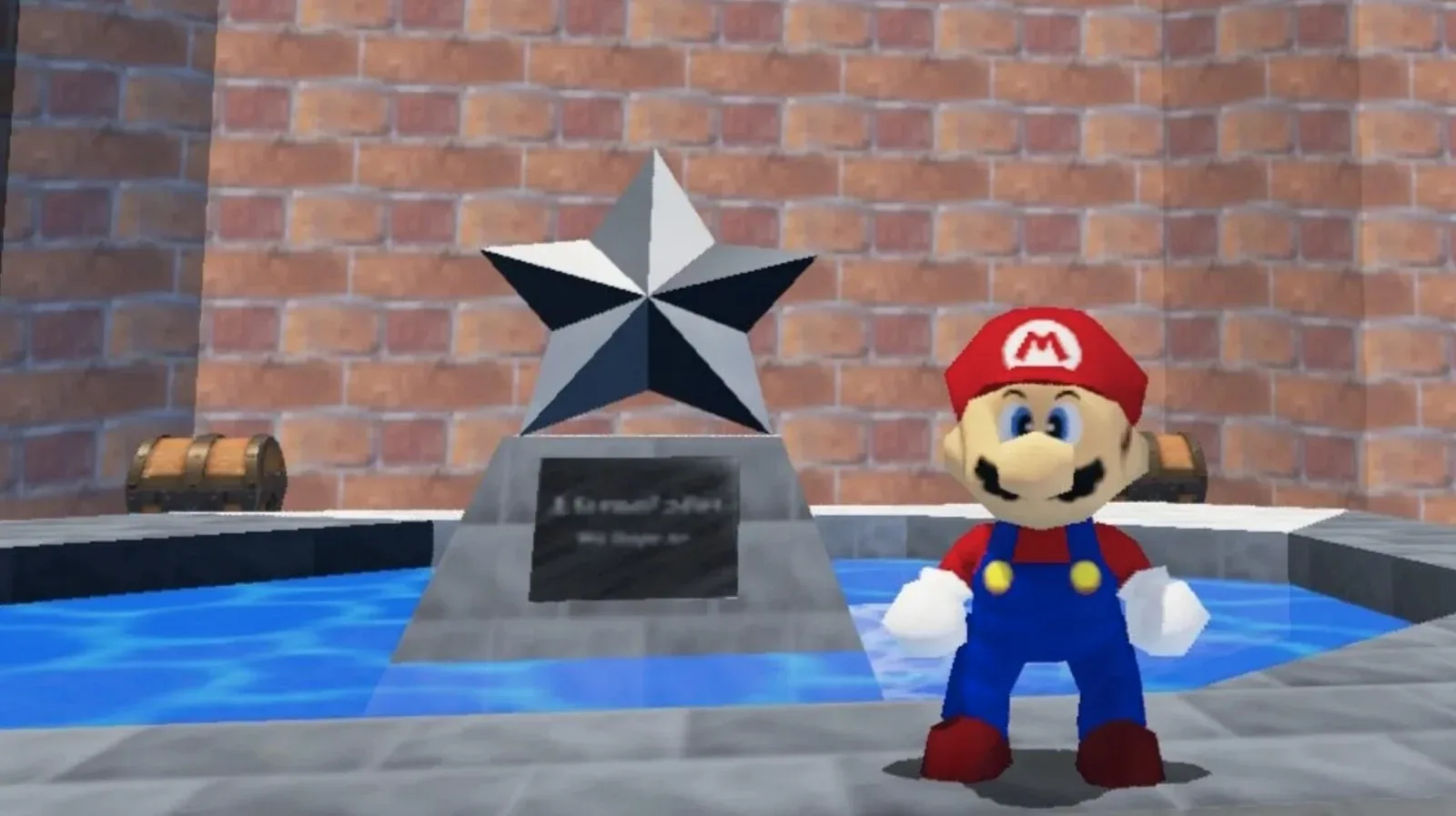
For decades, a tiny, blurry plaque in Super Mario 64 has had an outsized hold on the imagination of Nintendo 64 players. It sits in the castle courtyard beneath a giant star statue, but its lettering has always been too indistinct to settle through ordinary observation. That uncertainty helped turn a background object into one of the game’s longest-running mysteries—and, inevitably, into fuel for rumors about a certain green-clad plumber.
A new computational attempt offers the most concrete proposed reading so far. Programmer Mochi64 used open-source analysis software to compare the plaque’s pixels against millions of possible word and font combinations. The closest result suggests that the upper line reads “Eternal Star” and the lower line reads “We hope so.”
That is not the same as a recovered developer document, a clean texture file, or a statement from Nintendo. It is a best match generated by a large comparison process. But it matters because it approaches the question differently from the methods that have repeatedly failed players: staring at enlarged screenshots, sharpening a low-resolution image, or treating an old rumor as if repetition made it evidence.
What the analysis actually claims
The key distinction is between image upscaling and a matching analysis. Upscaling tries to make an existing image appear larger or clearer. It cannot reliably restore visual information that was not captured in the original pixels. The plaque is apparently too blurry for that approach to provide a decisive answer, and later releases retaining the same blurred look have not solved the problem either.
For more context, explore Ron Koslow, Creator of TV’s ‘Beauty and the Beast,’ Dies at 81.
The reported approach instead treats the plaque like a constrained comparison problem. The software examines potential words and fonts, then checks how closely their rendered appearance corresponds to the fuzzy shape and shading visible on the sign. Mochi64’s proposed phrases were the closest outcome after millions of comparisons.
That gives the finding a useful but limited meaning. It does not prove that every letter has been independently read from the original game asset. It says that, among the tested combinations, “Eternal Star” and “We hope so” best fit the available pixels. A different phrase could still be the actual text, particularly if it was absent from the candidate pool, rendered in an untested style, or happened to produce a similar blurred silhouette.
In other words, this is evidence with uncertainty attached—not a magical decoder ring. The restraint is important, because the plaque’s history is largely a history of certainty arriving far ahead of proof. Readers looking for a compact rundown of the renewed debate can find additional context on the proposed plaque reading.
Why “Eternal Star” fits the courtyard
Of the two proposed lines, “Eternal Star” is the easier one to place in the game’s setting. The plaque is located below a huge star statue, making the phrase feel like an identifying inscription or a bit of atmospheric labeling rather than a secret instruction. It fits what a player can plainly see in the courtyard.
“We hope so” is stranger, and therefore more likely to invite interpretation. One possible reading is that it functions as a playful nudge toward collecting every star. That idea remains interpretation rather than established intent; the analysis identifies a visual match, not the developers’ reason for choosing the wording. Still, the pairing has a modestly whimsical quality that suits a plaque positioned under a star monument.
There is a practical lesson in that apparent mundanity. Not every unresolved game detail conceals an unlock condition, a developer confession, or an encrypted teaser. Sometimes an object becomes legendary precisely because it is too blurred to read, leaving fans free to supply a more dramatic message than the one that may actually be there.
The shadow of “L is Real 2401”
No account of this plaque can avoid the phrase that defined its myth: “L is Real 2401.” Players and rumor-circulators interpreted that supposed wording as a clue that Luigi could be found or unlocked somewhere in Super Mario 64. The theory spread widely through the 1990s and continued well beyond them.
The claim gained cultural weight because it was treated seriously in prominent corners of game media. A gaming website even offered a $100 reward for someone who could demonstrate how to unlock Luigi, while a game magazine referenced the “L is Real 2401” theory in an April Fool’s issue. Those moments helped preserve the mystery, but neither established that the sign ever contained the phrase.
The Luigi speculation also had a real piece of development history to cling to. Shigeru Miyamoto said the team had experimented with a two-player mode, but abandoned the idea to save memory. An early build showing Mario and Luigi running around a bare room further encouraged the belief that Luigi content must have been left hidden in the retail game.
That distinction is crucial: a cut or abandoned idea is evidence that the concept existed during development. It is not, by itself, evidence that a playable version remains accessible in the finished game. In the plaque debate, the known two-player experiment made the Luigi theory feel plausible enough to endure, even though the blurry lettering never delivered a verifiable path to him.
Why millions of comparisons are useful—and why they are not final
“Millions of comparisons” sounds definitive, and it does give this work more weight than casual visual guesswork. A broad search can test possibilities consistently rather than relying on a person deciding that a few vague pixels look like the letters they already expect to see. That is especially valuable in an old mystery dominated by an extremely memorable rumor.
Yet the strength of a comparison is tied to what is being compared. If the program tests many word and font combinations, it can identify the closest candidate from that set. It cannot guarantee that the correct phrase was included, nor can it overcome every limitation imposed by the original blurry texture. A close result is a ranked candidate, not automatic ground truth.
There is also a human factor. Once players know a candidate phrase, they may begin to see it more readily in the plaque—a familiar effect when ambiguous visual information is involved. That does not invalidate the analysis, but it is a reason to separate the observed result from the confidence people attach to it.
- Supported claim: Mochi64’s analysis found “Eternal Star” and “We hope so” to be the closest match among millions of examined word-and-font possibilities.
- Reasonable contextual observation: “Eternal Star” makes visual sense for a plaque directly beneath a giant star statue.
- Unresolved point: The exact original wording remains unconfirmed without an official answer or a more direct form of evidence.
- Unsupported leap: Treating the new result as proof of a hidden Luigi, or treating the old Luigi rumor as the plaque’s established text.
A better way to handle old-game mysteries
The plaque is a tidy example of why retro-game mysteries can survive for so long. Low-resolution visuals create ambiguity. Incomplete knowledge of development creates openings for speculation. A compelling rumor gives people a phrase to search for, and each retelling adds durability even when the original evidence is weak.
Computational analysis can be a valuable corrective because it makes the process more explicit. Rather than saying a phrase “looks right,” an investigator can explain that it produced the closest visual correspondence across a large field of candidates. That is a more useful standard, even if it remains probabilistic.
For players, the sensible response is neither to dismiss the work nor to declare the case closed. “Eternal Star / We hope so” is now a strong proposed answer with a transparent reason for being considered. It is also still a proposed answer. The plaque has moved from free-form legend toward a testable reading, but it has not crossed the line into official certainty.
And perhaps that is the most fitting outcome for a courtyard artifact that has spent roughly three decades being asked to reveal far more than a handful of pixels could ever comfortably contain. The sign may be a small bit of star-themed flavor text after all. The much bigger secret was how effectively a blurry surface could convince generations of players that it was guarding the Mushroom Kingdom’s greatest hidden door.