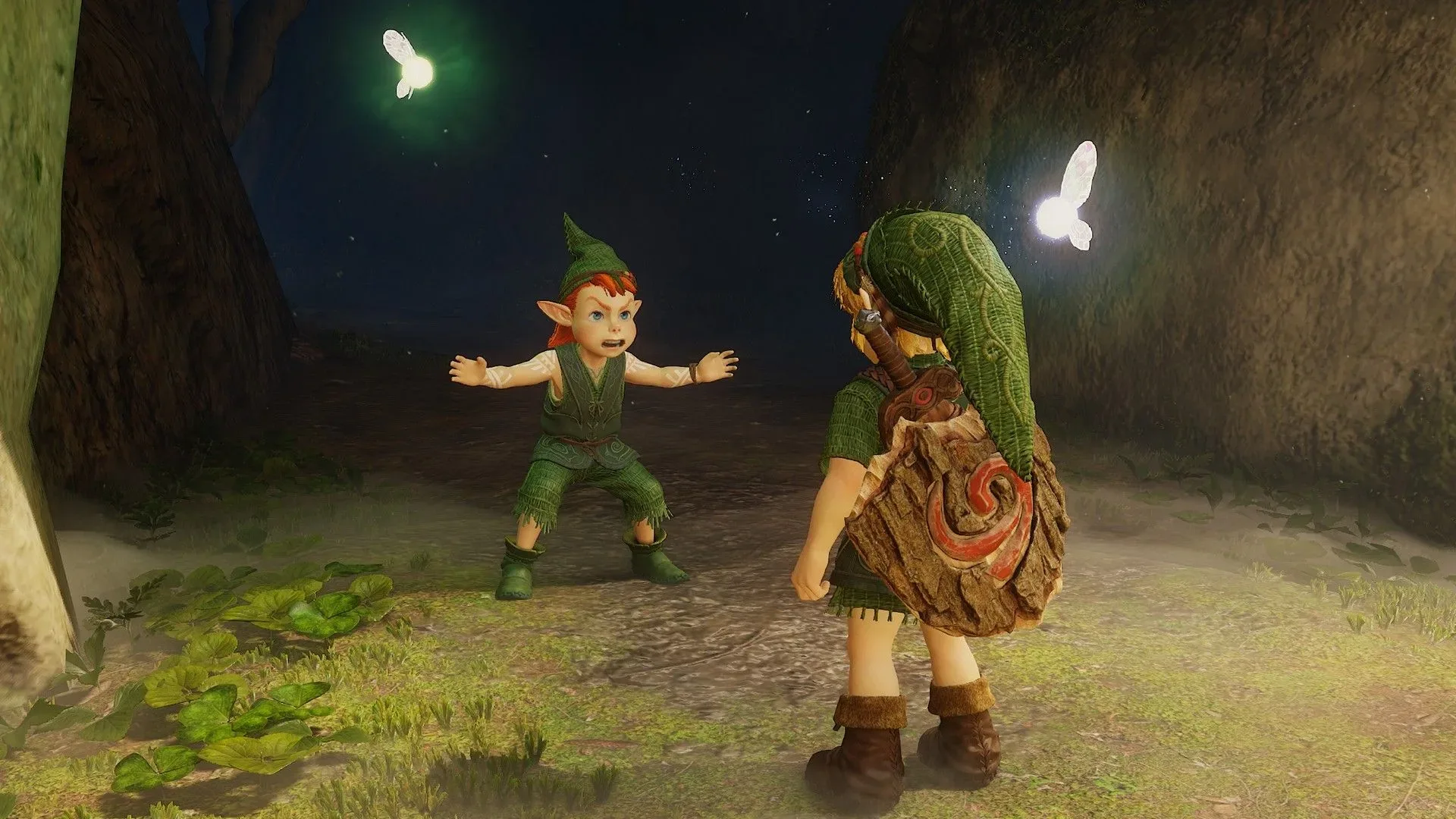
A dedicated jump button is being positioned as one of the notable control changes in the upcoming The Legend of Zelda: Ocarina of Time remake. But the idea is not quite new to Link’s 3D adventure. A 2011 conversation between Nintendo veterans Yoshiaki Koizumi and Satoru Iwata indicates that the Nintendo 64 game began development with button-activated jumping, before the team ultimately adopted the auto-jump behavior associated with the released game.
That revelation gives the remake’s new input a more interesting context. It is not simply a modern feature being laid on top of an older design; it revives an option that existed during the project’s early formation. The available discussion does not establish exactly how that original jump control worked, how long it remained in development, or why it was removed. It does, however, make one point unusually clear: automatic jumping was a later design choice, not an assumption built into Ocarina of Time from day one.
An early control scheme that went in a different direction
Koizumi recalled that players had to press a button to jump when work on Ocarina of Time first began. Iwata then explicitly confirmed that the game initially lacked auto-jump.
In the final Nintendo 64 release, Link automatically leaps in particular circumstances, such as approaching an appropriate ledge. That removes an input from the player’s decision-making. Instead of requiring someone to press jump, judge timing and accept the possibility of a bad landing caused by that timing, the game determines when a leap is appropriate.
That distinction may sound tiny on a controller diagram, but it affects the entire texture of movement. A dedicated jump button is a verb: it gives players an action they can attempt whenever the game permits it. Auto-jump is more of a contextual action: the game interprets where the character is and triggers the move when its own conditions are satisfied.
Neither model is inherently better. The important point is what each model asks players to focus on. A manually triggered jump can make positioning, momentum and timing central concerns. An automatic system can make traversal feel more directed and can reduce accidental failures at ordinary gaps. It can also leave designers more control over where jumping happens and what routes players can plausibly take.
Mario and Zelda were considered together
The discussion also frames the change as part of a wider distinction Nintendo was drawing between its major 3D series. Koizumi described Mario and Zelda games of that period as often being developed “in pairs,” saying both belonged to a broad category of 3D open-world action games. Iwata offered a concise way to separate them: Zelda was the one in which players did not press a button to jump.
That observation is especially revealing because it describes a design identity rather than a hardware limitation. The early version of Ocarina of Time did have manual jumping. The absence of a jump button in the finished game was therefore part of the line the developers chose to draw between Link’s adventure and Mario’s more movement-led style of play.
Related coverage includes Ocarina of Time Once Had a Jump Button Before Nintendo Embraced Auto-Jump.
Koizumi further explained that the team was thinking about Ocarina of Time throughout development of Super Mario 64. In that process, the developers discussed reducing the action emphasis in Zelda and increasing its puzzle emphasis.
That statement is the strongest available clue about the design thinking behind auto-jump, though it should not be overstated. No explicit explanation has been provided saying, “the jump button was removed solely to make Zelda more puzzle-focused.” The direct evidence establishes the sequence—manual jump first, auto-jump later—and establishes that the team was discussing less action and more puzzles. Connecting those two points is a reasonable interpretation, not a documented one-sentence rationale.
Why removing a button can change a game
In game design, a control input does more than occupy a button. It creates expectations. If players have a reliable jump command, they will naturally test edges, platforms, unusual geometry and shortcuts. They may expect to clear obstacles through skillful timing, or at least expect that failure to clear them was their own mistake.
When jumping is automatic, the game can communicate a different promise: certain ledges are intended traversal points, and reaching the right spot is more important than performing the leap itself. The challenge can move away from reflex execution and toward reading spaces, finding routes, using items or solving environmental problems.
This does not mean auto-jump makes every part of a game a puzzle, nor that a jump button prevents thoughtful problem-solving. It means the control scheme gives developers a way to weight those elements differently. Koizumi’s comments suggest that this balance was actively under consideration while Nintendo was differentiating Zelda from Mario in 3D.
It also helps explain why the old design choice remains memorable. For many players, “Link does not have a normal jump button” became one of the immediately recognizable traits of 3D Zelda. The 2011 exchange shows that trait emerged from iteration. It was a decision made during development, with a particular gameplay emphasis in mind, rather than an unchangeable rule of the series.
What the remake’s jump button does—and does not—tell us
The remake trailer reportedly shows a dedicated jump button, and the remake is said to arrive on November 5. That means players will be able to directly command Link to jump rather than relying exclusively on proximity-triggered ledge leaps.
Still, the presence of the button alone does not reveal the full impact on the game. The supplied information does not say whether jumping can be used everywhere, whether it changes combat, whether it enables sequence breaks, or whether areas and puzzles have been rebuilt around the new freedom. A button can be transformative, but it can also be tightly limited by level boundaries, animation rules and environmental design.
The remake is also reported to include new sidequests, more difficult minigames and subtle dungeon changes. Taken together, those details indicate a project willing to alter more than presentation. Yet none of them on their own confirm how radically the core route through the game has been reworked.
For returning players, the practical question is likely to be simple: will manual jumping create new choices, or mainly make existing traversal feel more responsive? The answer will depend on implementation rather than on the button’s existence. A free-form jump may invite experimentation and allow alternate approaches. A contextual version could preserve much of the original structure while giving players clearer agency over familiar moments.
A small historical detail with a useful lesson
The resurfaced conversation is valuable because it shows how easily a final-game convention can be mistaken for an original plan. Development is a process of testing alternatives, discarding some, and refining others until a game’s systems reinforce its intended identity. Here, the available record captures a rare, direct example: Ocarina of Time began closer to one control philosophy and shipped with another.
It is also a reminder that Mario and Zelda’s differences were not merely cosmetic. Both could be discussed as 3D open-world action games, but their controls helped tell players what kind of attention each game wanted from them. One key distinction was whether a jump was an action to perform or an event the game could handle on the player’s behalf.
The remake’s decision to restore a dedicated jump command makes that old fork in the road newly relevant. It brings back a possibility that Koizumi says existed at the project’s start, while placing it in a version also said to include sidequest, minigame and dungeon adjustments. For a seemingly humble button, it carries a surprising amount of design history.
And if a single jump input can turn a routine gap into a moment of debate, imagine the stakes when a controller is shared one player at a time—an idea explored in this community-controller relay experiment.