There are serious speedrun attempts, there are Halloween streams, and then there is the wonderfully specific overlap where a runner dressed as Mario takes another chunk out of one of gaming’s most fiercely optimized records.
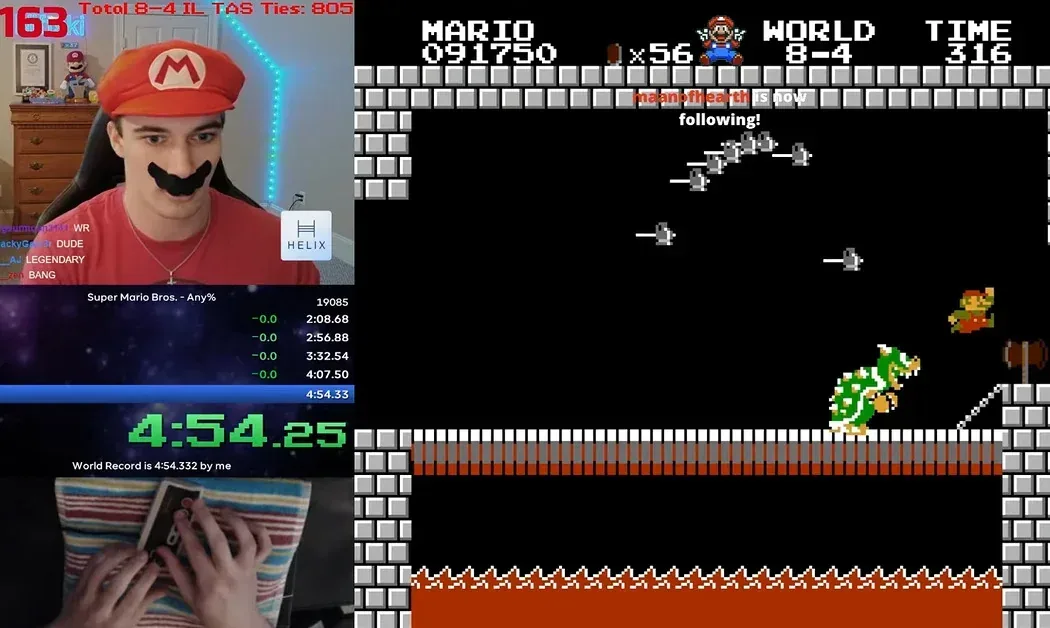
Niftski has set a new Super Mario Bros. any% world record with a time of 4:54.299. The run, achieved during a Halloween stream, improves on his own 4:54.332 record from August by 0.033 seconds—33 milliseconds. That margin is tiny in ordinary life. In a 1985 platformer whose fastest routes, techniques, glitches and execution demands have been examined for decades, it is enormous enough to change the line at the top of the leaderboard.
The setting made the result even more memorable. Niftski was wearing a Mario costume, complete with a troublesome mustache, and eventually committed to a Mario-style voice during the lengthy stream. His immediate celebration stayed in character: “IT’S MARIO! WHAT IN THE WORLD I CANNOT BREAK CHARACTER!”
It is a funny image, but the number behind it is very real. The new mark is said to sit just two frames, or three milliseconds, from a theoretical perfect performance. Niftski identified the opening stretch of the game as the place where those two frames were lost.
A record measured beyond the decimal point
Speedrunning is the practice of completing a game as quickly as possible under a defined ruleset. The ruleset matters as much as the timer. Two runs of the same game can pursue completely different records if one allows skips or glitches while another does not.
Any%, the category Niftski improved here, generally means reaching the end as fast as possible while allowing techniques permitted by that category’s rules. In a game as old and intensively studied as the original Super Mario Bros., that produces a high-pressure test of routing and mechanical precision rather than a casual dash through the Mushroom Kingdom.
Niftski also holds leading records in warpless and glitchless categories. “Warpless” means a run does not use warp zones to bypass worlds; “glitchless” bars glitches and exploits under that ruleset. Those labels are useful because they show why there is no single universal answer to “How fast can Super Mario Bros. be beaten?” Each category asks a distinct question and establishes its own competitive standard.
- Any%: Finish as quickly as possible using the techniques the category permits.
- Warpless: Finish without using warp zones to skip ahead.
- Glitchless: Finish without glitches or exploits forbidden by the category rules.
For the any% record, the difference between 4:54.332 and 4:54.299 is not a new world, a different boss fight or some broad alteration of the game. It is the sum of minute decisions and inputs across a run that ends with World 8, King Koopa’s defeat and the Princess’s rescue. At that level, a mistake so small that most viewers would miss it can decide whether a run is historic.
Related coverage includes Niftski Sets New Super Mario Bros. Any% World Record in Full Mario Costume.
Why “two frames from perfect” is such a big claim
A frame is one displayed image in the sequence that creates motion on screen. Frame-level language is common in speedrunning because game actions and timings can be bounded by these very small units. When a record is described as two frames away from a theoretical perfect run, the idea is not that the game has become easy; it is the opposite. There may be exceptionally little time left to save under the known fastest route and known conditions.
That is the extraordinary context for a 4:54.299. The original Super Mario Bros. was released in 1985, yet it remains an active competitive game because its movement is readable, its runs are short enough to repeat, and its ceiling has proved remarkably difficult to reach. Over years of attempts, runners have examined its permitted shortcuts and exploits so thoroughly that improvements now increasingly come down to near-flawless human execution.
The milestone below five minutes itself was once difficult to imagine. The record first went under that threshold around 2010, when Andrew Gardikis helped revitalize competitive interest with a blueprint that influenced later runners. More than a decade later, Niftski is operating in a landscape shaped by that accumulated knowledge—where the broad route is understood, but converting it into a near-perfect completed attempt remains brutally hard.
That distinction is important. A mature speedrun is not necessarily “solved” in the practical sense just because runners understand it. Knowing what must happen and reproducing it across an entire run are different challenges. A single hesitation, a slightly imperfect movement sequence or a minor loss early on can survive all the way to the final time.
The costume may have been a competitive advantage
Niftski’s Halloween bit was not planned as a record-setting method. Before the run, he joked that getting the record that day would be very stupid. Yet after spending part of the stream wrestling with the voice and facial-hair prop, he suggested the performance had an unexpected benefit: it reduced the nerves that usually accompany a world-record attempt.
“It made me not nervous at all,” Niftski said. “It doesn’t even feel real. It felt so casual.”
That is a revealing detail, even if it should not be mistaken for a proven speedrunning strategy. No costume creates frame-perfect inputs. The evidence here is personal rather than scientific. Still, elite competition is not purely a matter of technical knowledge. A runner must execute familiar, demanding sequences under the knowledge that a near-perfect pace may disappear instantly. Anything that makes a high-stakes attempt feel less intimidating can change how the moment is experienced.
In this case, the Mario voice seems to have shifted the stream from a conventional record chase into a performance. The joke gave Niftski something to focus on besides the burden of defending and extending a world record. Then, somehow, it became the backdrop for a run that improved the benchmark again.
What the new time means for the chase
The new record does not mean that the category is finished. It does mean the remaining space is exceptionally narrow based on the theoretical target described during the stream. At this stage, future progress is likely to demand not just a runner capable of the necessary individual sequences, but an attempt where those sequences align across the full game.
That makes the record compelling beyond the novelty of a Mario costume. Super Mario Bros. has lasted as a speedrunning fixture because it turns a compact platforming adventure into a precision contest with a clear clock and a nearly endless appetite for refinement. The game’s age has not diminished that pressure; if anything, decades of route development have concentrated it.
For retro games, that sustained competitive life is also a useful reminder that “old” and “inactive” are not synonyms. Some classic releases remain cultural artifacts; others remain living games because communities continue to find demanding ways to master them. The same enduring interest in legacy games can be seen in questions around preservation and re-releases, including the rights obstacles that can keep a classic such as Dune II from receiving a modern re-release.
Niftski’s 4:54.299 is now the relevant target in Super Mario Bros. any%. It is a world record earned in a category where milliseconds matter, capped by a celebration that could only have happened on a Halloween stream: the runner who had just pushed one of gaming’s oldest speedrun battles closer to perfection could not break character.