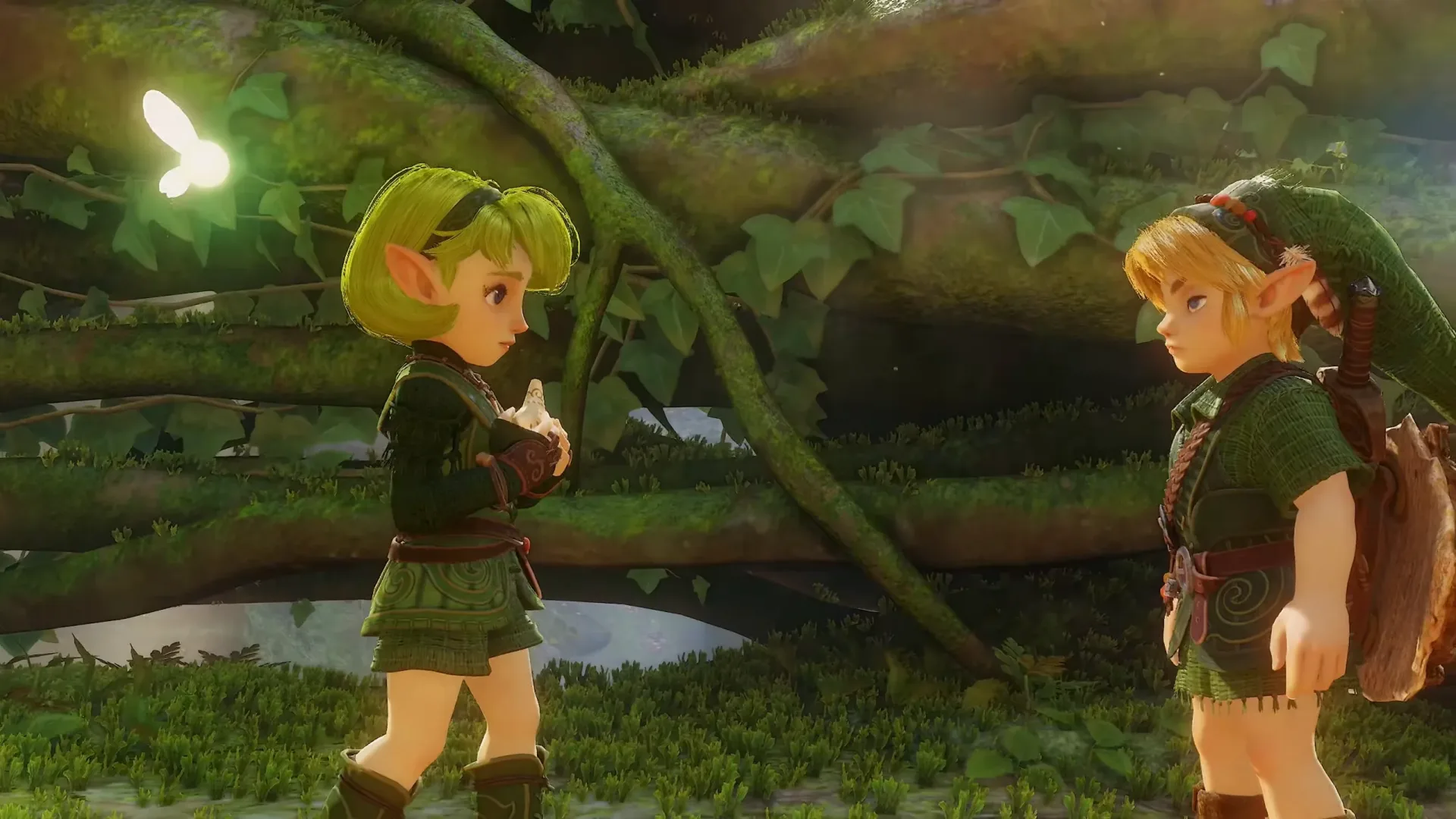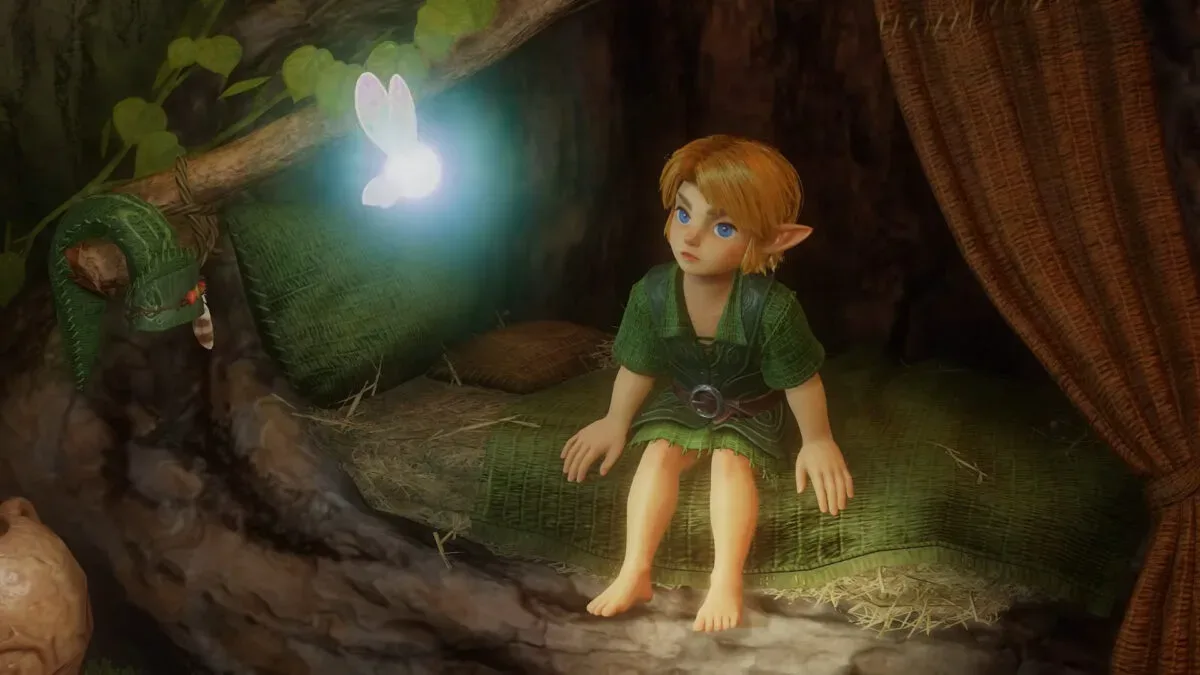
The familiar call of “Hey!” may have a particularly familiar source in The Legend of Zelda: Ocarina of Time remake—at least in its Japanese trailer audio. Fans have been comparing Navi’s new Japanese voice clips with the original performance and believe Kaori Mizuhashi, who voiced the fairy companion in the original game, could be reprising the role.
That remains unconfirmed. Nintendo has been asked to clarify whether Mizuhashi is involved, as well as to identify the remake’s English-language Navi actor, but no official casting confirmation is established here. The available material is trailer audio and fan recognition, not a credit listing or a company statement.
Still, the possibility has landed because Navi is not merely a helpful character: her short, repeated prompts are part of the sound memory of Ocarina of Time. A remake can reconstruct landscapes, menus and combat cues with remarkable precision, but voice performance is one of the quickest ways for returning players to notice that a beloved game has changed. If the Japanese voice is Mizuhashi, it would offer a notable thread of continuity between the original and the remake.
Why Navi’s voice draws such immediate attention
Navi’s dialogue in the original was compact and highly recognizable. Her function as Link’s fairy guide means the player hears her often, through brief alert-style lines rather than long scenes. That makes her performance unusually exposed: a slight change in voice, rhythm or emphasis can stand out more than it might for a character who only appears in occasional cinematics.
The remake is said to have substantially more voice acting than the original game. That changes the scope of the role. In the earlier version, Navi’s memorable contribution was tied chiefly to short prompts such as “Hey!” and “Listen!” A modern remake with expanded spoken material asks more of every localized cast, including the performer playing a companion who has to remain present without becoming exhausting.
That distinction is important when discussing an original performer’s potential return. Being ideally suited to reprise a character in Japanese does not automatically mean recording every version of that character across multiple languages would be sensible. Voice localization generally means creating performances for a particular language, with dialogue written and delivered around that language’s phrasing, timing and emotional cadence. It is not simply a matter of translating one actor’s work word for word.
In other words, a possible Japanese reprise and a new English actor can coexist without either choice being a rejection of the other. A remake can preserve a piece of its original identity for one audio track while still building a separate performance that fits expanded English dialogue.
What is known about Kaori Mizuhashi
Mizuhashi was Navi’s original voice actor and remains active in game and anime work. Her more recent game roles include Eirika in Fire Emblem Engage. She is also associated with Mami Tomoe across Puella Magi Madoka Magica projects spanning anime, film and games.
Related coverage includes Fans Think Navi's Original Japanese Voice May Return in Ocarina of Time Remake.
That continuing career is why the theory has a straightforward practical basis beyond resemblance alone: the original Navi performer is still working. But availability is not confirmation, and neither is a voice match in a trailer. Until Nintendo identifies the actor, the most accurate description is that fans think the Japanese Navi sounds like Mizuhashi and that she may have returned.
Japanese audio could matter to returning players—if it is selectable
The discussion naturally raises another question: whether players will be able to choose Japanese voice audio for a full playthrough. The possibility is appealing to players who associate Navi with Mizuhashi’s original performance, but the supplied information does not establish the final remake’s language options or explain how any setting would work. Trailer language is not, by itself, a complete feature list.
If multiple voice tracks are offered, the choice would be less about one being the “correct” version and more about what a player wants from the experience. Japanese audio could potentially give longtime fans a sense of performance continuity if Mizuhashi is confirmed. English audio, meanwhile, would present the work of the newly cast actor and the version designed around the remake’s English dialogue.
There is also an accessibility and comfort angle. Players generally benefit when games support language choices that match their reading preferences, familiarity with the material or desire for a specific performance. But until Nintendo provides official details, it is best not to assume the remake will offer a language toggle, subtitles paired with every voice option, or any particular regional configuration.
A casting question with more weight than a single prompt
It is easy to reduce the conversation to an old catchphrase, especially given Navi’s long-running reputation among players. Yet the response to the Japanese trailer points to something more useful: small roles can become foundational to a game’s identity. Navi is heard repeatedly, accompanies the player through the adventure and is one of the clearest recurring voices tied to the original release.
That makes casting a remake’s Navi a balancing act. The actor has to evoke a character people know intimately, while serving a project that apparently contains much more spoken material than its predecessor. Sounding identical may not be the only goal. The new performance also has to support additional scenes and dialogue naturally.
For that reason, the respectful response to the English performance matters as much as the enthusiasm for a potential Japanese return. The available discussion describes the English actor as doing strong work, even as fans speculate about Mizuhashi’s involvement. Those ideas are not in competition. One is appreciation for a new localized interpretation; the other is interest in whether an original performer has rejoined a defining role.
Until official credits or confirmation arrive, fans should treat every claimed identification cautiously. The trailers have created a convincing conversation, not a verified cast announcement. But they have also highlighted why voice direction and localization deserve attention in a remake: the right two-word fairy prompt can carry decades of player memory.
For another story about how older Nintendo adventures can continue to inspire new work, see Foxhollow and the prospect of a proper General Scales finale.