Eiji Aonuma has put words to a feeling shared by generations of The Legend of Zelda: Ocarina of Time players: the Water Temple needed another pass. The original game’s director, now a producer and leader on the franchise, described revisiting the dungeon as “overdue homework” 28 years after creating it.
That is a remarkably direct acknowledgement for one of Nintendo’s most notorious dungeons. The Water Temple remains memorable precisely because its central idea is strong. Players manipulate the water level to reveal routes, make doors reachable and change how rooms connect. It asks them to build a mental map of a space that is continuously transforming. But the execution in the original version also placed a great deal of friction between the player and that idea.
In the updated version arriving November 5, the development team has targeted the two most frequently cited sources of frustration: the repeated need to manage equipment through menus, and an interior layout that could make it difficult to understand where rooms sat relative to one another. The change matters because it is not simply a matter of making a hard dungeon easier. It is an attempt to let its intended puzzle design come through with fewer interruptions.
Why the original Water Temple wore players down
The Water Temple’s governing puzzle is its changing water height. Link needs different water levels to access different doors, paths and chambers. A route that is useless at one level may become essential at another. That structure makes the dungeon a navigation puzzle as much as a sequence of individual challenges: players must remember what they saw, decide what has changed and work out which previously inaccessible location is now worth revisiting.
That can be rewarding confusion. A dungeon that shifts under the player’s feet is meant to create uncertainty, discovery and eventual understanding. The trouble was that the original version paired this complexity with a cumbersome routine involving the Iron Boots.
Link could not freely swim underwater in the original game. To descend, players equipped the Iron Boots so he would sink; to rise again, they removed them. Those boots were accessed through the menu rather than assigned for immediate use. Every descent or ascent meant stopping movement, opening the menu, locating the equipment page, changing the boots and returning to the dungeon.
In game-design terms, that is interface friction: effort demanded by the controls or menus rather than by the actual decision a game wants the player to make. The intended decision is potentially interesting—should Link be grounded on the floor or moving through the water? The repetitive menu procedure is not. It repeatedly breaks the player’s spatial concentration just when the dungeon asks them to hold a complicated three-dimensional layout in mind.
A required chest hidden beneath a moving platform added another notorious sticking point. Missing that chest could leave a player unsure whether they had misunderstood the dungeon’s water-level logic, overlooked a route or simply failed to notice a concealed objective. In a maze-like dungeon, a single unclear discovery can turn a productive search into an exhausting loop.
Related coverage includes Eiji Aonuma Revisits Ocarina of Time's Water Temple With Long-Overdue Changes.
Aonuma’s original goal was underwater atmosphere
Aonuma’s comments also make clear that the Water Temple was not conceived merely as a machine for confusing players. Its starting point was the sensation of being submerged. He has said that freediving informed his interest in how different underwater spaces feel: sound changes, familiar surroundings become unfamiliar, and the player occupies what feels like a separate kind of environment.
“I had some overdue homework: I wanted to do something about the Water Temple I created 28 years ago.”
At the time, the ability to move through underwater areas in a 3D game was far less common. The Water Temple was designed to make underwater traversal itself part of the appeal. Its water is therefore more than decoration and more than an obstacle. It changes movement, sightlines and access to the dungeon’s architecture.
That background helps explain why a straightforward simplification would not necessarily be the right answer. Removing the water-level system would remove the dungeon’s identity. The more interesting revision is to retain the shifting environment while reducing the ways its interface and visual construction obscure the player’s understanding of it.
There is a useful distinction here between challenge and obscurity. Challenge asks a player to observe, reason and act. Obscurity withholds enough information—or interrupts access to it often enough—that progress can feel detached from reasoning. The Water Temple’s reputation came from a mixture of both. The remake’s stated adjustments suggest the team wants players wrestling with its water puzzles rather than its menus.
What is changing in the new version
Remake director HokWai Ng has identified two broad revisions. First, item toggling has been made substantially easier. That directly addresses the Iron Boots issue and should reduce the number of times players are removed from the dungeon to perform a basic movement change.
Second, some walls that previously contributed to disorientation have been replaced with lattice-style structures. These allow players to see rooms beyond them and gain a clearer sense of the overall space. This is a subtle architectural adjustment with major implications for navigation.
In a multi-level dungeon, opaque walls can make every room feel isolated. Seeing through parts of the structure provides spatial readability: visual information that helps a player understand connections, height, distance and possible destinations. A lattice does not hand over a solution, but it can show that a chamber exists beyond a barrier, reveal that a passage is vertically aligned with another room, or remind a player that a route seen earlier belongs to the same area.
That is especially relevant in a dungeon built around changing water elevation. The player may need to anticipate what a water level will do to a room before they change it. Better visibility can support that reasoning without flattening the dungeon into a set of obvious markers.
- Easier equipment changes reduce interruption during underwater movement.
- Lattice-style walls improve visibility into adjacent spaces.
- Clearer spatial cues should help players form a usable mental map while the water level changes.
- The water-level premise remains central, preserving the dungeon’s core identity rather than replacing it.
Swimming may change the feel of the puzzle
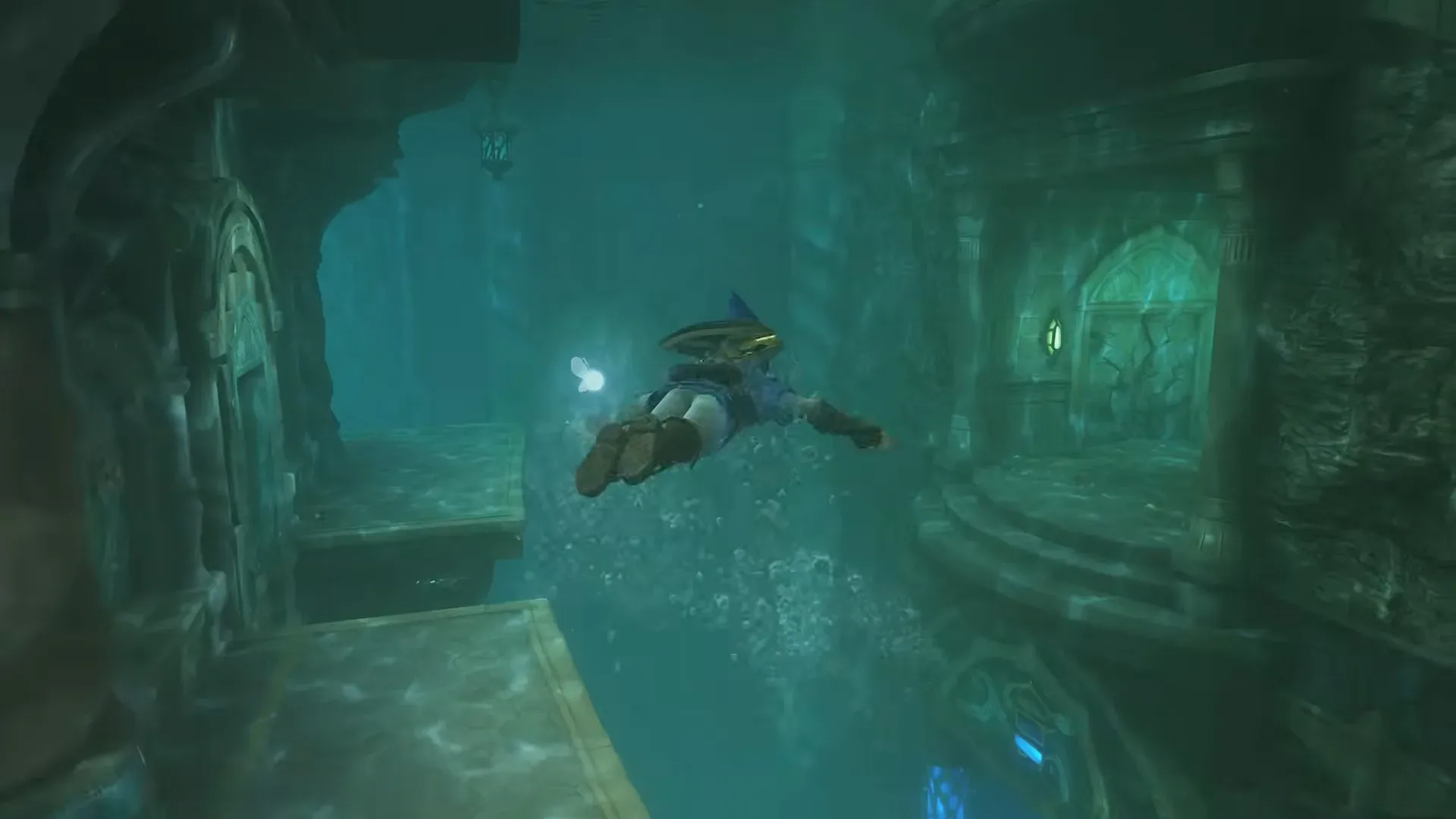
The new version also gives Link proper underwater swimming, unlike the original. The available details do not fully explain how every Water Temple puzzle has been revised around that change, so it would be premature to assume the old solutions work exactly the same way. Still, the basic role of the Iron Boots is clear: they ground Link on the floor, while free swimming offers a different mode of movement.
That creates a potentially cleaner interaction than the original setup. Rather than using the boots chiefly as a laborious way to sink or float, players can distinguish between free underwater movement and deliberate grounding. Grounding may be necessary for interacting with specific puzzles or navigating the dungeon floor; swimming can provide motion and positioning that the original version could not offer with the same precision.
This is an important design shift because movement precision affects puzzle design. When a character has only limited underwater behavior, designers must build objectives around those limits. When the character can navigate underwater with greater control, rooms can communicate scale and verticality differently, and players may be able to inspect their surroundings more naturally. Whether that ultimately changes individual puzzle solutions remains an open question from the information currently available.
The earlier Nintendo 3DS remake had already made the Iron Boots more convenient by allowing players to assign them to a single button, and it adjusted a cutscene to make the important chest easier to spot. The newer revision continues the same overall direction: preserve the Water Temple’s atmosphere and structural ambition, but remove avoidable impediments to following it.
What players should expect
Players returning from the original should not expect the Water Temple to stop being a Water Temple. Its water-level system, complex structure and emphasis on orientation remain the point. The significant difference is that the game is now designed to better support the player while they work through those ideas.
For newcomers, that should mean fewer moments spent wondering whether a lack of progress is caused by an unsolved puzzle or by a buried menu action and an unreadable room connection. For veterans, it offers a chance to revisit one of the series’ most famous dungeons with its underlying design more exposed.
There is a broader lesson in the revision. Older games can contain ambitious mechanics that were constrained by contemporary controls, interfaces or ways of presenting 3D space. Updating them does not automatically mean sanding away their personality. It can mean identifying where the intended difficulty ended and the unnecessary overhead began.
Players who enjoy puzzle-driven action games may also find useful navigation and objective help in this guide to unlocking and repairing the Flaming Mane in Phantom Blade Zero. The exact puzzles differ, but the same practical principle applies: clear information makes it easier to spend time solving the game’s intended problem.
Aonuma’s “overdue homework” line lands because it does not dismiss what made the Water Temple distinctive. Instead, it recognizes that an inventive underwater dungeon can be both influential and unnecessarily irritating. The coming version will test whether smoother item handling, stronger visual connections and freer swimming can retain the dungeon’s uneasy, submerged mystery while leaving the menu screen out of the adventure.