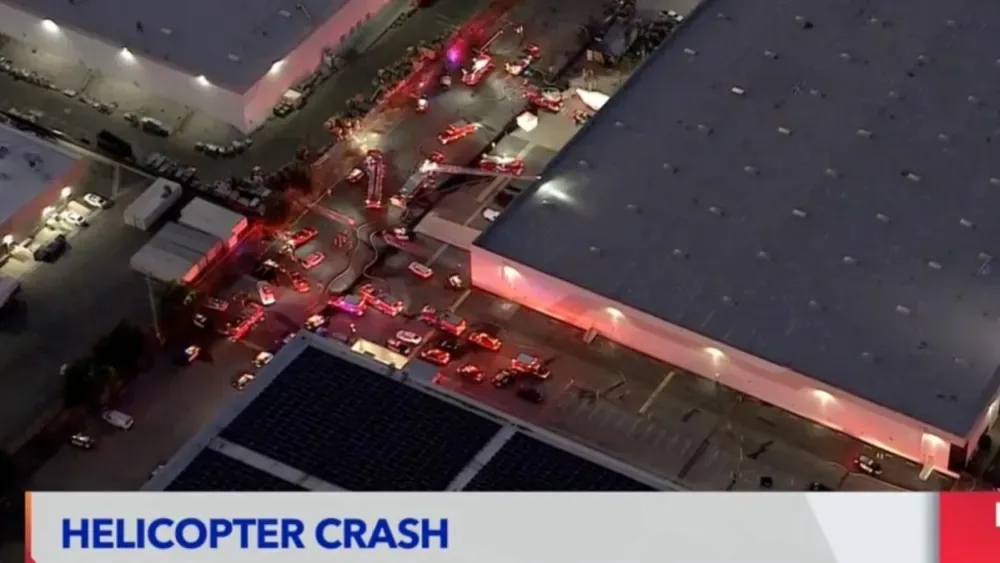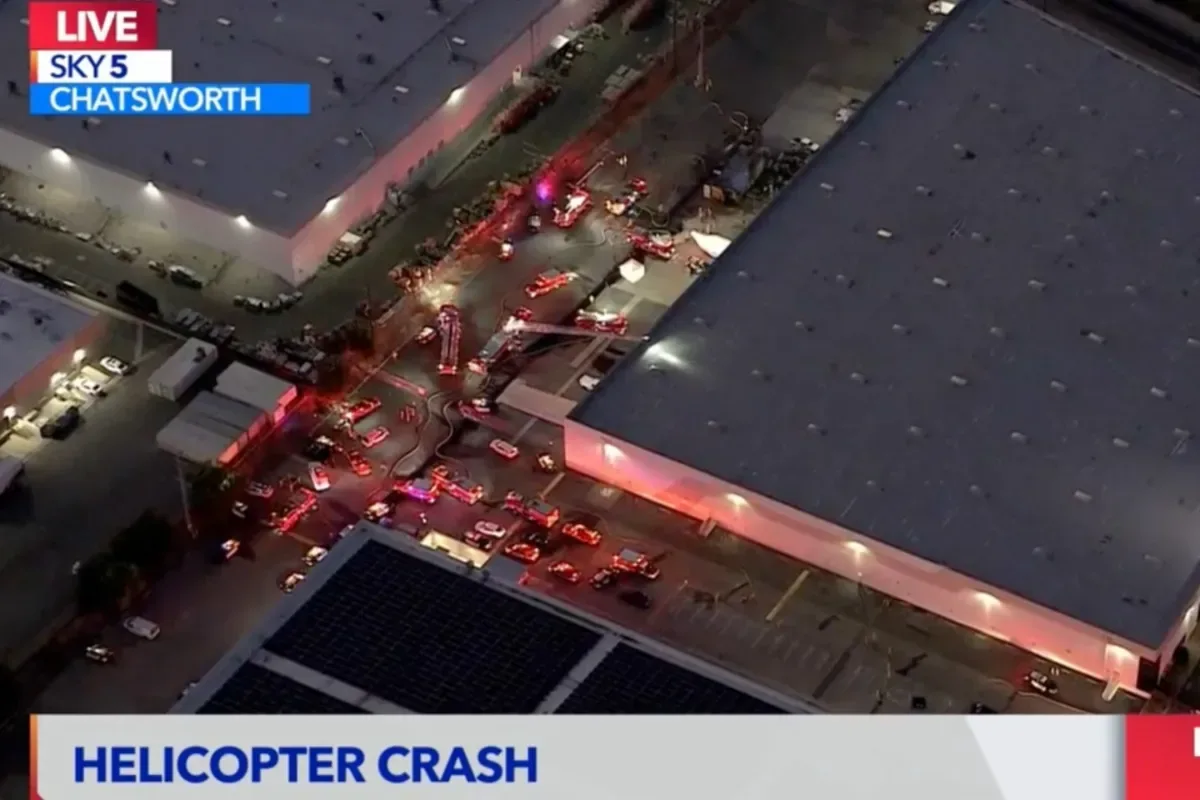
A news helicopter crashed Tuesday evening in Chatsworth, Los Angeles, in the same area where an earlier collision involving an SUV and an L.A. Metro bus had already left two people dead and six hospitalized.
The helicopter went down shortly before 7 p.m. PT between commercial buildings at 9151 N. Mason Avenue. Initial accounts indicated that it struck two shipping containers and nearby parked vehicles. The crash was reported as being connected to a local television station’s news helicopter, and an on-air anchor said the station had lost contact with the aircraft shortly after the incident.
The Los Angeles Fire Department confirmed at least one person outside the helicopter was pronounced dead at the scene. Early reporting also put the overall death toll at three, but officials had not confirmed how many people were aboard the helicopter. That distinction is important: an initial fatality figure can be reported while the location, identity, and number of people involved remain under active verification.
What is confirmed, and what remains unclear
The confirmed details establish two separate, serious incidents in close proximity on Tuesday evening:
- An SUV collided with a Metro bus operating on Line 166 at roughly 5 p.m. PT.
- Two people in that earlier crash were pronounced dead at the scene, and six others were taken to hospitals.
- The collision trapped bus passengers, requiring an emergency response.
- A news helicopter later crashed near commercial buildings on Mason Avenue, shortly before 7 p.m. PT.
- One confirmed fatality was a person who appeared to have been outside the helicopter when it came down.
Several material questions were unresolved in the immediate aftermath. Officials had not established the number of helicopter occupants, and no cause for the aircraft’s descent was identified in the available information. It was also not established whether the person confirmed dead outside the helicopter had been directly struck by the aircraft, debris, or another part of the incident.
Those are not minor details. A helicopter crash scene can involve occupants, pedestrians, people in vehicles, and workers or visitors around an industrial or commercial property. Emergency crews must determine who was in the aircraft, who was on the ground, and whether people may have left the immediate area or been transported before a complete accounting is available.
Why preliminary reporting can change
In a fast-moving emergency, first reports often combine observations from witnesses, broadcast crews, dispatch traffic, fire personnel, and law-enforcement activity. They are valuable for alerting the public to an immediate hazard, but they are not the same as a completed investigation.
In this case, the reported figure of three deaths should be read alongside the Fire Department’s statement that the number of victims inside the helicopter had not yet been confirmed. A count can change as responders inspect damaged areas, identify the aircraft’s occupants, notify families, and reconcile information from flight operations with the scene itself.
“Patient” is emergency-services terminology for a person evaluated or treated by responders; it does not by itself indicate whether that person was in a vehicle, on foot, or connected to an aircraft. Similarly, “declared deceased on scene” means death was determined at the incident location rather than after transfer to a hospital. These terms help clarify the response but do not substitute for a full identification of those involved.
The location also matters. Reports placed the helicopter between two commercial buildings and described damage involving shipping containers and parked vehicles. That setting presents a different set of risks than an aircraft crash in an open area: structures can obscure sight lines, debris can be difficult to assess, and vehicles or containers may conceal damage or injured people during the initial sweep.
Two emergencies, one concentrated response
The helicopter crash occurred only blocks from the earlier Metro bus collision. Although the available information does not establish a causal connection between the two events, their timing and location would have compounded demands on emergency personnel in Chatsworth.
The bus involved was traveling on Line 166 when the SUV struck it. Passengers were trapped inside after the collision, and two people were pronounced dead at the scene. A rescue involving trapped occupants can require a deliberate process of stabilizing damaged vehicles, creating safe access, removing people from confined spaces, and getting them medical care.
A subsequent aircraft incident nearby requires another complex response: securing the crash area, looking for fuel or fire hazards, checking adjacent structures and vehicles, and separating confirmed facts from early witness accounts. With both incidents occurring during the evening, the challenge for officials is not only managing the physical scenes, but also communicating clearly about what is known and what is still being investigated.
What “lost contact” means in the initial hours
The television station’s on-air statement that it had lost contact with its helicopter conveyed an urgent operational concern, but it did not establish why the aircraft went down. In broadcast use, a news helicopter is an aircraft used to gather aerial video and support live coverage. Loss of contact may refer to a breakdown in communications or a failure to receive a normal update from the crew; by itself, it does not identify a mechanical failure, weather issue, pilot action, or other cause.
Any explanation for the crash will require official investigative findings. It would be premature to infer that the nearby bus collision caused the aircraft accident, that the helicopter was covering that crash at the time, or that one incident affected the other. The available facts only place the two emergencies close together geographically and within a roughly two-hour window.
The human stakes behind an aerial-news operation
Aerial reporting is often most visible when a developing event is already drawing a large emergency response. It can provide the public with a broad view of traffic disruptions, fire activity, or rescue operations, but the aircraft itself remains part of a high-risk physical environment. When an aircraft crashes in a developed area, the consequences extend beyond its crew to anyone nearby.
The confirmed death of a person outside the helicopter underscores that ground safety is central to the investigation, not an afterthought. The reported impact with shipping containers and parked vehicles illustrates how quickly an aircraft emergency can become a larger scene involving businesses, property, road access, and people who may have had no connection to the flight.
For viewers, the event may also be a reminder that local television news relies on people working in the field, including crews operating under changing conditions around breaking stories. The Los Angeles television landscape has faced broader production shifts in recent years, including developments involving major entertainment programming, as covered in this report on a production move affecting Los Angeles. But a local news helicopter incident is fundamentally different: the immediate priority is the safety of victims, emergency workers, and the surrounding community.
What an investigation will need to establish
No cause was provided in the initial information, and responsible coverage should not fill that gap with speculation. Investigators will need to establish the basic facts of the flight and crash sequence, including the number of people aboard, the aircraft’s route and purpose, the point of impact, and the condition of the surrounding area.
They will also have to distinguish between damage caused directly by the helicopter, damage caused by falling debris, and any pre-existing conditions around the commercial site. Identifying everyone affected is especially important where parked vehicles and structures are involved, since a preliminary scene assessment may not capture the full scope of harm.
The earlier Metro crash will have its own investigative path. The available account says an SUV struck the Line 166 bus, trapping passengers. That establishes the basic sequence reported in the initial response, but does not explain how or why the SUV and bus collided. The confirmed deaths and hospitalizations make that investigation significant in its own right, independent of the later aircraft crash.
As officials release additional verified information, the key points to watch will be whether the reported helicopter death toll is formally confirmed, how many people were in the aircraft, the identities of those killed or injured once families are notified, and any official finding on the cause of the crash. Until then, the clearest picture is of two separate fatal emergencies that placed an extraordinary burden on Chatsworth responders Tuesday evening.