A previously unseen Jordan silhouette has stepped into view in Detroit. Dominique Debnam, Jordan Brand’s VP of Global Footwear, wore the Jordan Vail during the Black Footwear Forum, where she appeared alongside The Whitaker Group’s James Whitner and Dr. D’Wayne Edwards.
The Vail is described as an entirely new lifestyle shoe rather than a retro revival or a casual remix of an existing performance model. That distinction matters: Jordan Brand has not formally announced the model, and there is currently no confirmed release date, price, size range, material breakdown, or wider launch plan. What exists so far is an on-stage reveal and a set of visible design cues worth examining without turning unknowns into specifications.
Its first appearance also gave the shoe a setting beyond a conventional product campaign. The panel’s focus was collaboration and supporting the sneaker community, with particular attention to Black professionals and leadership in footwear. In that context, the footwear became an unplanned focal point: the Vail was on Debnam’s feet, but it was also introduced inside a conversation about who shapes the industry and how creative communities are built.
What the Jordan Vail looks like so far
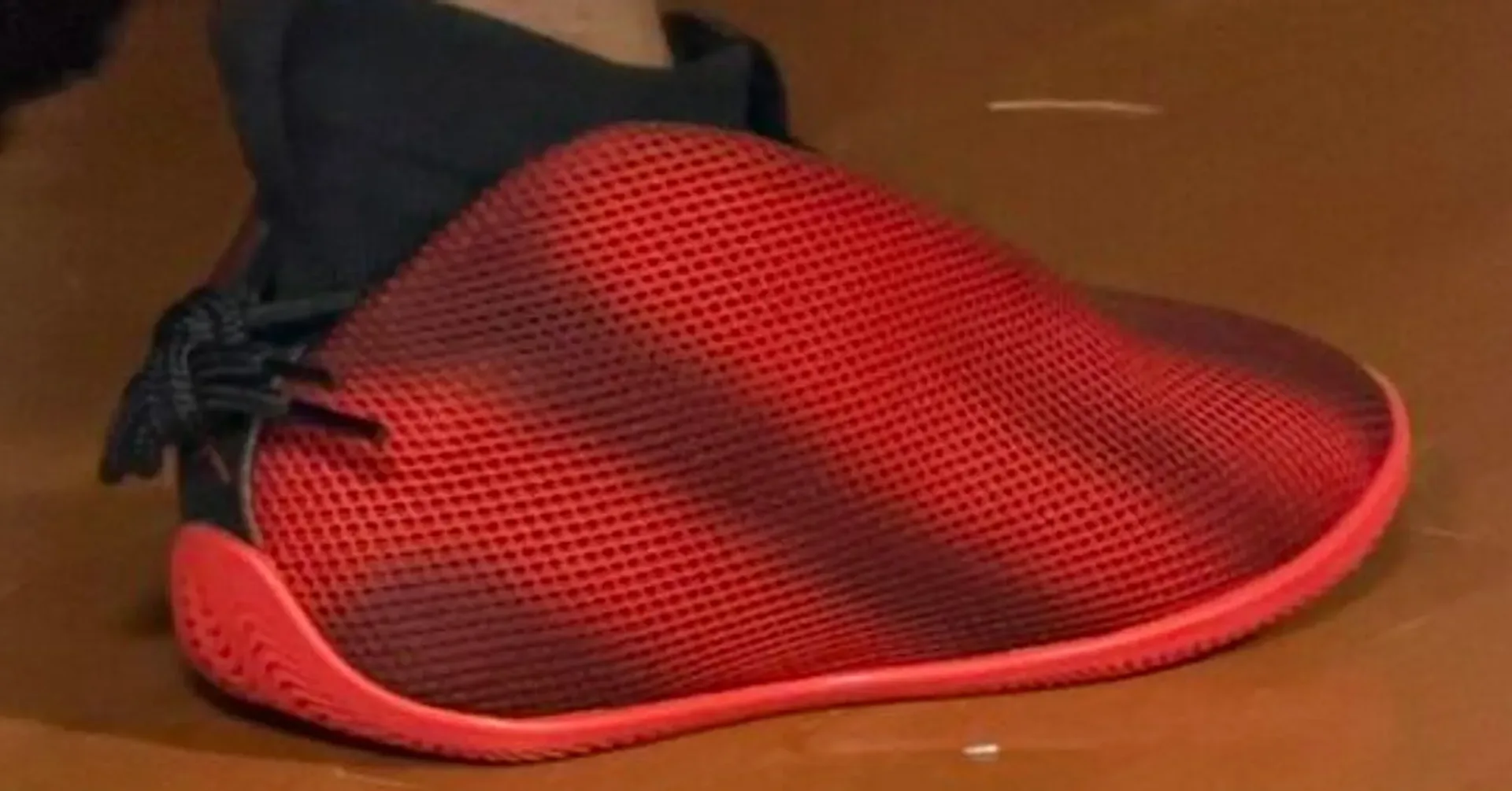
The shoe shown in Detroit uses red and black, a familiar Jordan Brand color pairing that recalls the Bulls-associated palette. However, its construction does not appear to be chasing the usual visual language of a classic basketball Jordan.
Most of the upper appears to be a single textured piece, interrupted by dark-red diagonal striping. A black structure wraps around the ankle area in a looser, bootie-like cradle. The result is a less segmented look than many basketball sneakers, which frequently make their support panels, overlays, cushioning units, and branding elements visually prominent.
That upper arrangement deserves a little terminology context. A one-piece upper refers to an upper section that reads as one broad, continuous shell instead of a visibly assembled collection of panels. It does not, by itself, confirm the exact material or manufacturing method. But aesthetically, it can create a cleaner silhouette by reducing seams and making the shape feel more sculptural.
The Vail’s bootie-style cradle is the black component around the ankle. In footwear, “bootie” generally describes an internal or integrated sock-like sleeve intended to hold the foot more closely than a traditional separated tongue-and-collar setup. The early view suggests that the Vail pairs this concept with a mid-cut exterior, including what has been described as a compressed ankle sleeve. It is a design centered on containment and shape rather than the visibly padded, technical collar common on many court shoes.
Basketball references, but not a basketball-first build
The Vail has basketball ancestry in its stance, yet it is positioned as a lifestyle silhouette. The mid-cut profile and ankle-focused fit system retain some court-shoe DNA. Underneath, though, the sole is notably thin and flat compared with the more substantial cushioning setups associated with current basketball footwear.
That contrast helps explain the design’s apparent priorities. Performance basketball shoes commonly emphasize impact protection, traction, lateral stability, and the demands of repeated jumps and hard directional changes. A thicker or more visibly engineered sole can be part of that package. A lifestyle-first shoe has a different brief: it can prioritize a slimmer profile, everyday styling, and how the complete object looks with clothing.
None of that establishes how the Vail will feel, perform, or wear over time. No testing details or technical specifications have been shared. Still, the thin, flat sole is a clear visible signal that the revealed version is not presenting itself in the heavy-cushioned visual vocabulary of a modern Jordan basketball model.
The design therefore seems to sit in an interesting middle ground. It has a court-adjacent mid-cut form and ankle support language, but its simplified exterior and low-profile underfoot shape suggest a shoe intended to work as an outfit component first. That is different from taking an established hardwood model and simply offering it in a casual colorway.
A small lacing detail could carry a practical idea
One of the more unusual details connected to the Vail is its apparent integration of a hair-tie concept into the lacing system. Jordan Brand’s Heir Series 2 includes a hair tie mounted at the heel, intended for players who want to tie their hair back before playing. On the Vail, that idea appears to be incorporated into the laces rather than presented as a separate heel accessory.
It is a small detail, but it points toward a design approach in which a simple utility is built into an existing part of the shoe. Laces already function as an adjustable retention system, meaning they help secure the shoe around the foot. Folding a hair tie into that area could make the element more integrated and less visually detached from the overall design.
There are important limits to what can be concluded from an early sighting. It is not known whether this feature will appear on every Vail colorway, whether it is removable, or how it will function in a retail version. But its presence is notable because it connects the Vail to an idea already present in the Heir Series 2 while adapting it to a different type of shoe.
Why the debut setting is part of the story
New footwear is often introduced through a tightly controlled rollout: official images, campaign materials, athlete connections, retail information, and a release calendar. The Vail’s appearance was more indirect. It surfaced during an industry gathering and panel rather than through a traditional campaign, which means its first impression arrived through conversation and observation rather than a complete product page.
That format leaves plenty unanswered, but it also frames the design differently. Debnam’s appearance with Whitner and Edwards placed the shoe within a discussion of collaboration and community. Whitner is associated with The Whitaker Group, while Edwards appeared as part of the forum panel. The assembled group gave the moment a footwear-industry context rather than presenting the Vail solely as the next item in a release pipeline.
Creative risk is often most visible when an established name allows a new object to avoid familiar formulas. The Vail’s minimal, fashion-oriented direction is a footwear version of that broader conversation; it is also a useful counterpoint to the call for artists to move beyond repetition in this look at creative risk-taking in rap. The connection is thematic, not a claim of collaboration: both cases raise the question of what happens when a well-known identity tries a less expected lane.
What remains unknown
The most useful takeaway is also the simplest: the Jordan Vail has been seen, but it has not yet received a full official reveal. The following details are not confirmed:
- A release date
- Pricing
- Additional colorways
- Exact materials and construction
- Available sizing
- Whether the lacing-integrated hair-tie detail will be standard
- Whether the Vail will receive a broad retail launch or a more limited rollout
That uncertainty should temper any attempt to label the Vail as a final answer to where Jordan Brand is headed. One public appearance cannot define an entire strategy. Yet it can show a direction: a leaner, less overtly performance-coded Jordan form that still keeps a trace of basketball in its mid-cut silhouette and ankle treatment.
For now, the red-and-black Vail is best understood as an early look at a lifestyle-first idea. Its textured single-piece upper, diagonal color accents, black ankle cradle, flatter sole, and unusual lacing detail give it a distinct identity before any retail information exists. When Jordan Brand provides formal details, the questions will shift from what the shoe is trying to say visually to how broadly, and when, people will be able to wear it.