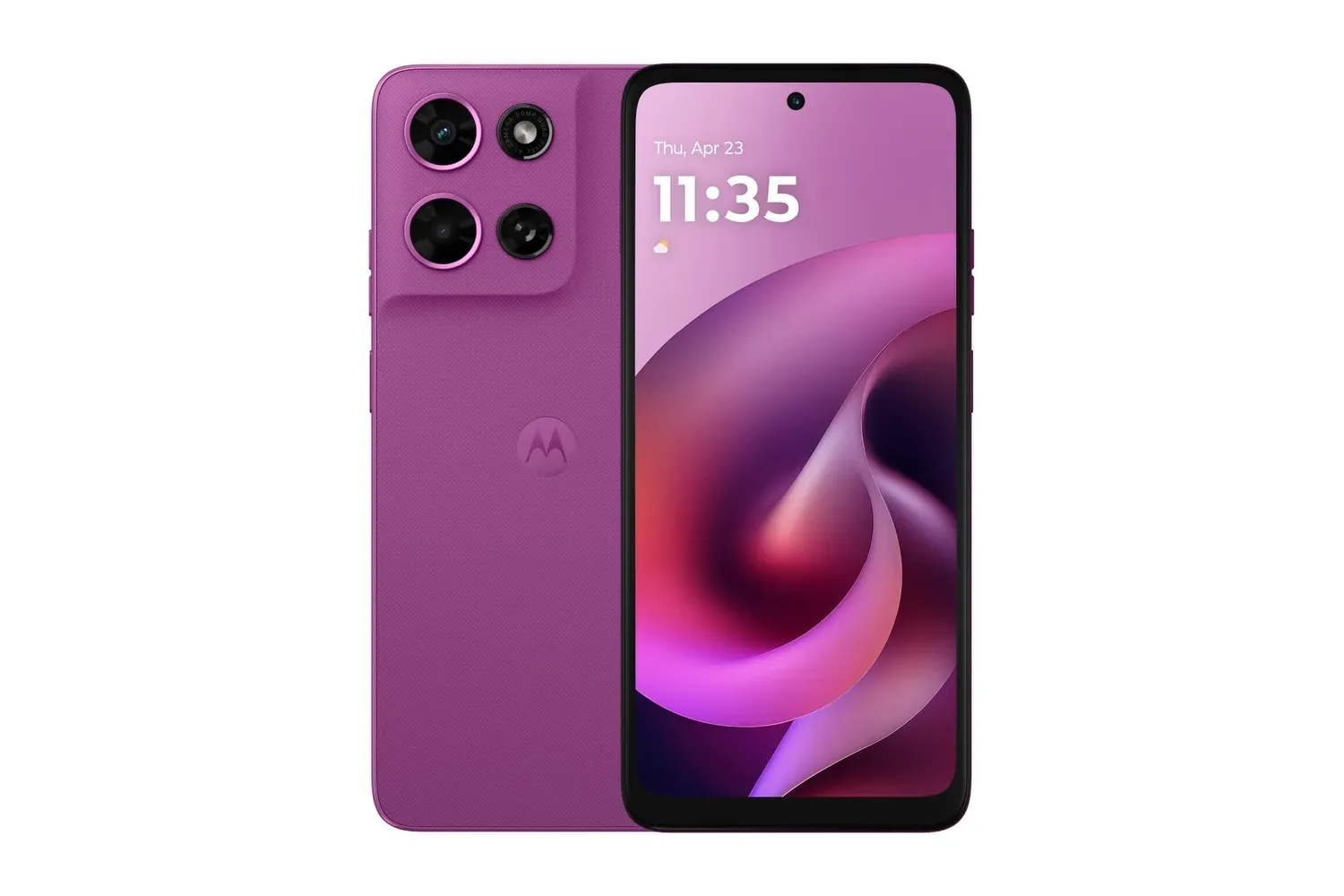
The Motorola Moto g (2026) is listed on Amazon for $250, down $50 from a stated $300 price. That is a 17% reduction for an Android 16 handset aimed squarely at the everyday jobs most phones live or die by: streaming video, social feeds, calls, messaging, browsing, photos and keeping several apps within reach.
Its headline hardware is straightforward. The Moto g has a 6.7-inch display with a 120Hz refresh rate, a MediaTek Dimensity 6300 processor with 5G connectivity, a 5,200mAh battery, 30W TurboPower charging, stereo speakers with Dolby Atmos and Hi-Res Audio support, and a 50MP main camera. It also includes a 32MP front camera, a 2MP Macro Vision camera, USB-C charging, dual-band Wi-Fi, face unlock, a water-repellent design and a vegan-leather rear finish in Pantone Cattleya.
That is a notably broad set of day-to-day specifications at the listed price, but it is important to keep the framing accurate: these are manufacturer-provided features and claims, not a promise of equal results in every network, app, game, lighting condition or battery routine. The useful question for a prospective buyer is less whether every headline number is large and more whether the combination meets the way they use a phone.
A large, fast screen is the center of the package
The 6.7-inch panel is perhaps the clearest reason to consider this model. A display of that size can make video, web pages, group chats and video calls easier to view without immediately reaching for a tablet or laptop. Motorola also describes the screen as bright enough for outdoor viewing and protects it with Corning Gorilla Glass 3 against scratches.
The other key number is 120Hz. A display refresh rate measures how often the screen can update its image per second. At 120Hz, the panel can refresh up to 120 times each second. In practical terms, this can make scrolling through a feed, moving around an interface and compatible on-screen animation appear smoother than on a 60Hz display. It is a visual-fluidity feature; it does not by itself establish the speed of the processor, the responsiveness of a network, or the quality of an app.
For entertainment, the large screen is paired with stereo speakers, Dolby Atmos and Hi-Res Audio support. Stereo means sound is delivered through two speaker channels rather than a single channel. Dolby Atmos is an audio format and processing ecosystem designed to add a sense of spatial placement to sound. Those labels point to an entertainment-oriented setup for music, movies and games without headphones, though personal preference and the material being played will still shape the result.
For readers who use a handset as a second screen while playing elsewhere, a larger display can also make a long objective list or map easier to follow. For example, it is more comfortable to keep a detailed page such as our Gears of War: E-Day campaign-length guide open alongside messages and notes than it is on a compact screen. That is a convenience benefit, not evidence that the Moto g has been evaluated as a gaming phone.
Connectivity and multitasking: what the Dimensity 6300 and RAM Boost mean
The Moto g uses MediaTek’s Dimensity 6300 processor and supports 5G. A phone’s processor is the central chip responsible for running the operating system, apps and many background tasks. 5G is a cellular-network standard; where a compatible network and plan are available, it can support data connectivity for downloads, streaming, browsing and calls away from Wi-Fi.
Neither label guarantees a particular download speed. Real-world mobile performance depends on local coverage, signal strength, carrier service, congestion and the app or service involved. Still, 5G support is a meaningful baseline for someone who expects to stream or download on the move rather than only at home or work.
Motorola also highlights a feature called RAM Boost, which is intended to add available memory for smoother switching between apps. RAM, or random-access memory, is the fast working space a device uses to keep active apps and data ready. When a phone has more room to juggle active tasks, it may be less likely to pause or reload an app when a user jumps from a browser to a message, camera or video stream. RAM Boost is therefore most relevant to multitasking, not a substitute for judging every demanding task by a single feature name.
The supplied specifications position the device as an everyday performer rather than offering detailed claims about high-end graphics workloads, storage capacity or sustained gaming behavior. Buyers whose priority is a particular game, emulator, editing workflow or accessory setup should verify those specific needs independently rather than infer them from the screen refresh rate or 5G badge alone.
Battery claim and charging are practical selling points
Motorola says the 5,200mAh battery can last up to two days on a charge. Milliamp-hours, abbreviated mAh, indicate battery capacity, so 5,200mAh is the stated size of the battery rather than a guaranteed measure of time away from an outlet. Screen brightness, refresh-rate behavior, signal conditions, camera use, streaming, calls and background apps all affect battery life.
Even with that caveat, the combination of a large battery and 30W TurboPower charging addresses a familiar concern: a phone can be more useful if it handles a busy day without forcing a prolonged stop at a socket. Motorola says TurboPower charging can add power in a few minutes, though no specific charge percentage or timed charging result is provided here. It is sensible to treat that as a convenience claim rather than assume a precise refill rate.
USB-C is included for charging. The model also has dual-band Wi-Fi, meaning it can work with both common Wi-Fi frequency bands. That can matter in homes and workplaces where a router offers more than one band, although the quality of a wireless connection still depends on the router, distance, interference and broadband service.
Camera options go beyond the main 50MP sensor
The rear camera system consists of a 50MP primary camera and a 2MP Macro Vision camera. The main camera uses Quad Pixel technology, which is designed to support photography in ordinary and low-light conditions. “MP” means megapixels, a count related to image resolution. It is not a standalone verdict on photo quality: lens design, image processing, lighting and motion all matter, too.
The 2MP macro camera is meant for close-up shots of small objects. It is a specialized option rather than a replacement for the primary camera. At the front, the Moto g has a 32MP selfie camera for self-portraits and video-call use.
Motorola lists several software-assisted camera tools: Night Vision, Portrait mode and Auto Smile Capture. Night-focused modes are intended to help in dim scenes. Portrait modes generally try to emphasize a subject and soften the background. Auto Smile Capture is designed to respond when a subject smiles. The device also includes Pro Mode for more manual control, Panorama for wide images, Scan for documents and Google Lens for identifying items by pointing the camera at them and tapping the Lens function.
There are a couple of more playful front-camera options as well. Gesture Selfie lets the user trigger a photo by moving a hand side to side, while Photo Booth is designed for group pictures and novelty shots. These are not core purchase criteria for everyone, but they broaden the camera app beyond a basic point-and-shoot setup.
Design, protection and the limits of “water-repellent”
On the exterior, Motorola gives the Moto g a vegan-leather back and offers the finish in Pantone Cattleya. The material choice aims to provide a more premium feel than a plain, smooth rear panel. Whether that texture is a benefit will be subjective, especially for anyone who plans to use a case from day one.
The phone is described as water-repellent, with protection for spills and light rain. That wording matters. Water-repellent is not the same as an assertion that the device should be submerged or deliberately exposed to water. The supported takeaway is modest: it is designed to offer some help around accidental splashes and light rain, not an invitation to treat it as waterproof.
For access and security, the Moto g supports face unlock and includes Motorola ThinkShield security. Face unlock provides a quick way to open the phone using facial recognition. ThinkShield is Motorola’s security umbrella, intended to help protect user data. As with any phone, security also relies on everyday choices such as using a strong passcode, keeping software current and paying attention to account protections.
Who the $250 Moto g listing makes sense for
At the listed $250 price, the Moto g’s strongest argument is its balance of practical features: a big 120Hz display for media and scrolling, 5G for mobile connectivity, a high-capacity battery, quick-charge support, stereo sound, a versatile camera app and Android 16. It appears built for someone who values screen space and general-purpose convenience over a narrowly specialized feature set.
It may be especially worth considering for users replacing an older phone that struggles with app switching, has a smaller or less fluid display, or requires frequent charging. The camera tools, document scanning, front-facing 32MP camera and video-call focus also make the handset relevant for routine communication and casual content creation.
Before buying, it is still prudent to confirm the listing’s current price, variant details and compatibility with the buyer’s carrier. Check the needs that cannot be settled by the provided information as well, including storage requirements, the exact behavior of an essential app, preferred case options and any network-specific considerations. The stated $50 reduction is meaningful, but the better deal is the phone whose known specifications match the jobs it will actually be asked to do.
Shop the products
Check current price, model and availability at the retailer.