Monster Hunter Wilds: Ascendance is shaping up as a deliberately tougher second act for Capcom’s 2025 hunting game. Due in 2027 for PC, PlayStation 5 and Xbox Series X, the expansion moves its campaign forward by several years, sends the Hunter’s Guild into the newly revealed Skybound Eyrie, and gives veteran players a fresh reason to scrutinize their timing, positioning and teamwork.
The broad pitch is familiar in the best possible Monster Hunter sense: a new region, new equipment, monsters to learn and a bigger threat to bring down. But the details currently available suggest Ascendance is not treating those additions as a simple pile of extra hunts. Its new battlefield is built around severe verticality. Its Alpha Araketa encounter asks players to respond to a coordinated monster group rather than focusing exclusively on one creature. And the new Boost Bracer introduces weapon-specific super attacks that can create spectacular openings—or be wasted with one bad read of the fight.
That combination matters because Wilds arrived with an ambitious foundation: a more seamless, systemic open world. Ascendance appears designed to build its identity around the part of Monster Hunter that endures after the novelty of a new world has worn off: repeatedly studying dangerous opponents until a squad can turn a disorderly brawl into a controlled hunt.
A campaign built after Wilds’ main story
Ascendance takes place several years after the defeat of Gogmazios in Wilds’ main story. The Hunter’s Guild is dealing with the return of elder dragon Lao-Shan Lung, which destroys the guild’s stronghold. The campaign then follows a more experienced and better-prepared Guild as it moves into the forbidden lands and the Skybound Eyrie.
The stakes extend beyond one enormous returning monster. A tar-based affliction is again spreading across the Windward Plains and affecting its ecosystem. The Guild’s objectives are therefore intertwined: confront Lao-Shan Lung and halt that corruption’s spread. That framing gives Ascendance a story reason to revisit the consequences of Wilds’ existing conflict while moving hunters toward a strikingly different environment.
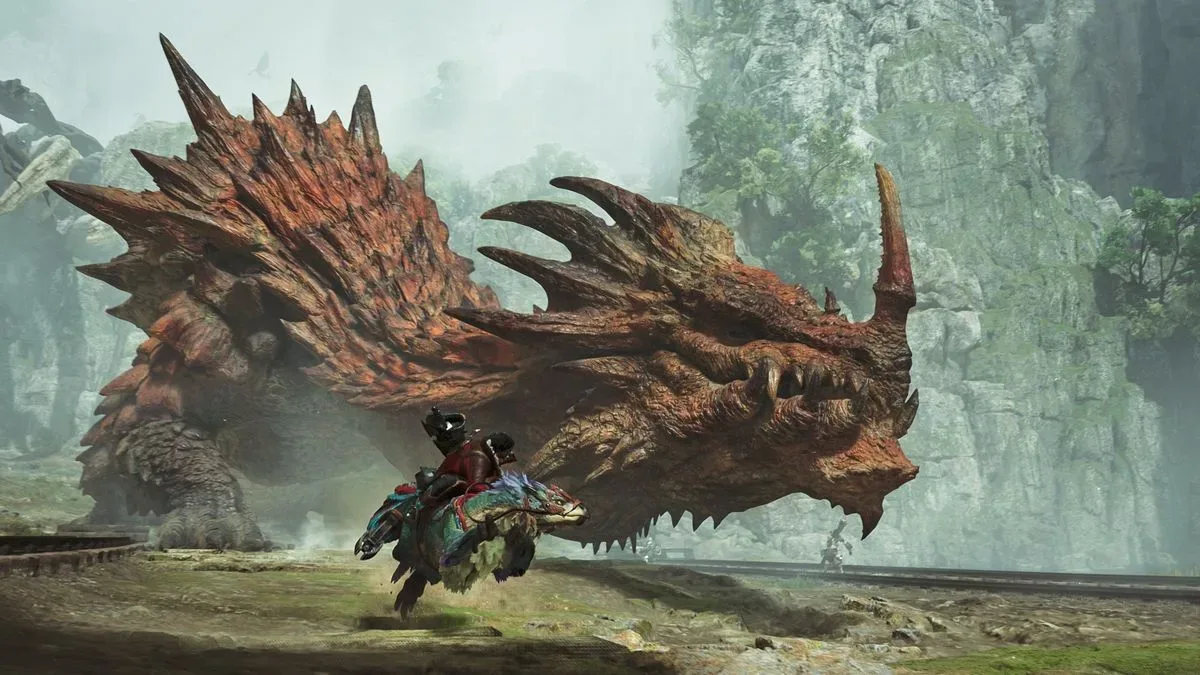
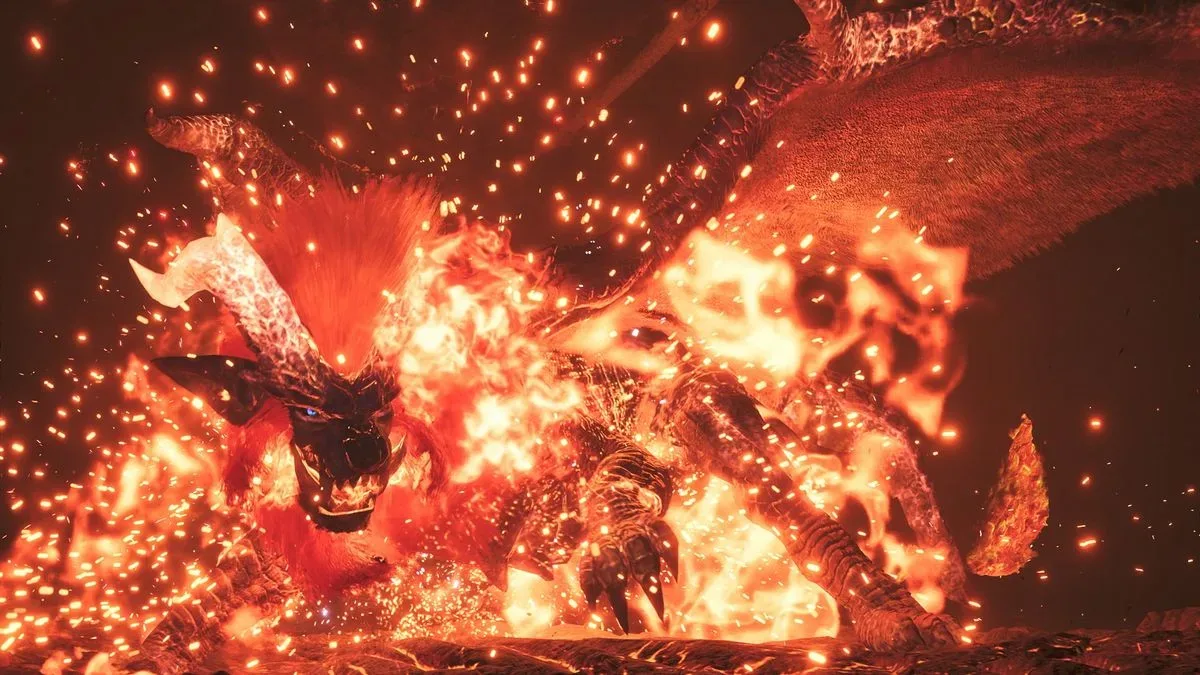
Calling Lao-Shan Lung an elder dragon is significant in Monster Hunter terminology. The label denotes a particularly formidable class of monster rather than merely an especially large target. Ascendance also puts Teostra, another returning elder dragon, into its early selection of showcase hunts. Together, those encounters make clear that this is a post-main-story expansion aimed at players expected to understand their weapon and the basic rhythm of hunts already.
That is an important distinction from simply saying the expansion has “more content.” Ascendance is presented as a rise in the game’s upper-end challenge. In practical terms, the focus is not only on seeing another biome or crafting another weapon set. It is on having more demanding situations in which those tools and learned habits must hold up.
Skybound Eyrie makes movement part of the danger
The Skybound Eyrie is described as Wilds’ most vertical location, built around aerial islands and noticeably varied terrain. It is also a sharp visual shift from the Windward Plains. Yet its role is more substantial than serving as pleasant scenery between hunts. Its height and layout introduce serious pitfalls during combat, including the possibility of falling from the map.
In a Monster Hunter fight, terrain can determine whether an opening is genuinely safe. A hunter may recognize that a monster has paused, staggered or committed to an attack, but still be unable to capitalize if the route is awkward, the ground is unstable, or the group has been pushed into the wrong place. In the Skybound Eyrie, vertical space adds another factor to that equation. The squad must maintain awareness of a creature’s attacks while also respecting the edges and elevation changes around it.
This is especially relevant to battles against monsters able to use both ground and air. A high-mobility enemy can force hunters to look up, track its path, avoid a rush at ground level and preserve enough space to evade what follows. The setting is therefore not a neutral arena. It is an active source of pressure, one that can punish overcommitment before the monster lands a direct blow.
Ascendance’s use of a vertical zone also seems positioned to refresh familiar hunting instincts. Players who have already grown comfortable moving through the Windward Plains will have to learn a new set of safe approaches, escape routes and dangerous corners. That process of learning a place is closely connected to learning a monster; knowing an attack is coming only helps if there is room to respond.
Alpha Araketa turns one target into a team problem
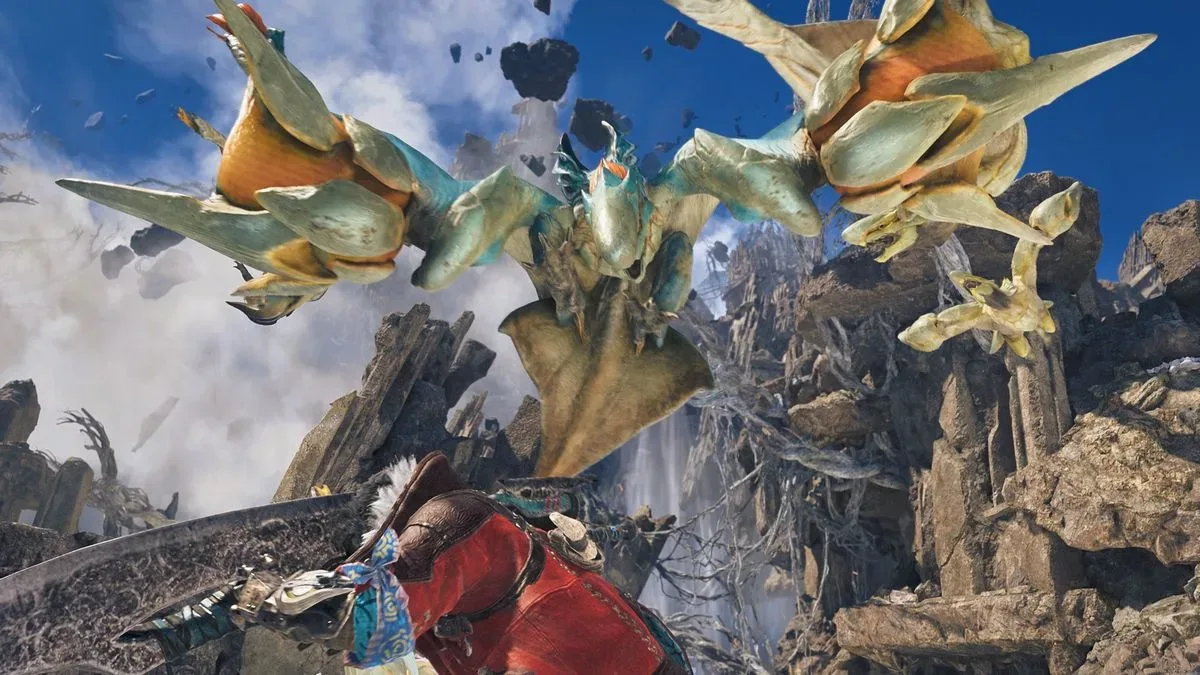
The new Alpha Araketa hunt is the clearest early example of Ascendance’s more coordinated monster behavior. The Alpha leads a smaller group of minions and can organize them against the hunters. Rather than functioning as incidental background threats, the group can rush players on the ground together and take to the air for synchronized dive-bombs.
That changes the tactical question facing a hunting party. A conventional large-monster encounter already requires the group to watch attack patterns, avoid disrupting one another and seize limited windows for damage. When the target has associated minions acting in concert, awareness has to expand. A player concentrating on the Alpha’s immediate position may be exposed to a follow-up from above or a group rush from another direction.
The Araketa’s mixed movement is particularly useful as a test of the Skybound Eyrie. Its ground and aerial attacks give the new zone’s vertical hazards a clear gameplay purpose. The threat is not merely that hunters might wander off an edge; fast-paced action and synchronized attacks can force them into bad positions. Coordination becomes essential because teammates must not only pursue the target but also avoid becoming a cluster that is easy for a grouped enemy to overwhelm.
One noted attack uses the creature’s wings and naturally occurring gases to create an impact likened to a jet-powered strike. The useful takeaway is not that hunters will need a lore lecture on monster aerodynamics. It is that Araketa has attack variety that should reward observation over impatience. A combo with an unusual setup becomes a moment to recognize, respect and eventually exploit—assuming the party has survived enough attempts to identify its rhythm.
That loop is core to what makes Monster Hunter’s high-level encounters satisfying. Initial failure is information. An unfamiliar sequence feels chaotic at first; after repeat attempts, its warning signs, range and recovery period become legible. Ascendance appears to want that learning curve to matter more, and Alpha Araketa’s organized assaults offer an immediate test for squads that have become too accustomed to treating every threat as a solitary target.
Boost Bracer adds power, but not a free escape hatch
The headline combat addition is the Boost Bracer. It becomes available upon entering the new story and lets hunters activate a boosted state. During that state, each weapon receives a new super attack and access to powered-up combos.
The system runs on a meter filled through attacking monsters, with up to three charges available. A ready charge can be spent on a super move, either in the form of a combo or a heavy single strike. That makes the Boost Bracer a resource-management mechanic: it gives the player more offensive potential, but only after they have built the meter and only if they identify the moment to use it well.
Resource management can sound dry beside the fantasy of launching a massive weapon technique at a dragon, but it is the idea that gives the system teeth. The charge is not limitless. It takes time to earn. Spending it while a monster is moving, turning away or about to counterattack can leave a hunter with neither the desired damage nor the resource needed for a better opening. A missed super attack is more costly than missing an ordinary swing because it represents a lost opportunity accumulated over the fight.
This puts the Boost Bracer in an interesting position. On the surface, it is a flashier, more aggressive way to fight. When several hunters use their high-impact moves against a staggered monster, the scene is understandably explosive. But it does not automatically remove the need for precision. If anything, a powerful move that can be squandered increases the value of knowing when a monster is truly vulnerable.
The system may draw debate among long-time players because Wilds has faced criticism that its balance can be overly generous. More player power can sound counterintuitive in an expansion promising heightened difficulty. The counterargument is visible in how the Boost Bracer is structured: strength is being added alongside tougher behavior, more hazardous terrain and encounters that ask more of the group. The real issue will be whether the full expansion makes using that power a meaningful choice rather than an automatic solution. The early description supports caution on either side; the Bracer looks potent, but it is neither instant nor consequence-free.
Teostra and quicksand show the intended endgame pressure
Ascendance’s other demonstrated hunt features Teostra, a returning elder dragon that has been powered up for the expansion. Teostra brings powerful flame attacks and heavy strikes, while its battle zone adds quicksand that makes traversal difficult.
Quicksand is another example of the expansion making the environment part of a hunt’s difficulty rather than dressing around it. If movement is impaired or routes become harder to use, traditional defensive options become less dependable. Fire attacks and heavy blows are dangerous on their own; the terrain’s job is to narrow the margin for error around them.
There is a pattern across the material revealed so far. Alpha Araketa uses coordination and aerial assaults to disrupt a party. The Skybound Eyrie threatens reckless positioning with falls. Teostra pairs heavy offense with terrain that hinders traversal. The Boost Bracer offers a dramatic answer, but one that needs a charged meter and a carefully chosen opening. Ascendance’s apparent design philosophy is not simply “more damage for everyone.” It is pressure and counterpressure.
That could be the right direction for players looking for a reason to return after Wilds’ post-launch events and refinements. A strong endgame needs more than a longer list of targets. It needs encounters that give gear, weapon familiarity and squad communication a job to do. Ascendance is positioning its campaign around exactly that sort of renewed skill ceiling—the level at which improving execution and understanding creates meaningful gains.
What the expansion means for returning hunters
The practical promise of Ascendance is a clearer destination for experienced hunters. Players entering its story should expect an environment where footing counts, enemy groups may coordinate, returning elder dragons can be upgraded threats, and a new offensive meter creates another decision to make in every major opening.
- Learn the terrain early: In a vertical zone, safe routes and hazardous edges are combat knowledge, not sightseeing trivia.
- Watch the whole encounter: Alpha Araketa’s minions mean the immediate target is not the only danger worth tracking.
- Bank Boost Bracer charges with purpose: A stagger or a reliably recognizable recovery window may be more valuable than firing the moment a charge appears.
- Expect environmental interference: Quicksand and high-risk drops can turn an otherwise manageable attack pattern into a costly mistake.
- Prepare for endgame-style demands: This is a post-main-story campaign, not a reset of the learning curve for newcomers.
The PC release is also notable in an era when the platform is increasingly central to major game publishing; PC’s growing industry importance remains a wider topic well beyond any single release. For Ascendance, though, the important point is straightforward: the expansion is planned for PC alongside PS5 and Xbox Series X, so the revived high-level hunt is intended to reach all of Wilds’ listed platforms.
There is still plenty not established about the full expansion, including its complete monster lineup and every upgrade it will bring. But the early picture is unusually coherent. Lao-Shan Lung provides a large-scale narrative threat; Skybound Eyrie changes how players must navigate; Alpha Araketa tests coordinated team responses; Teostra reinforces the elder-dragon challenge; and Boost Bracer creates a new high-commitment offensive tool. If those pieces hold together in the final release, Ascendance could give Monster Hunter Wilds the sharper, more demanding late-game identity its most dedicated hunters are likely to want.