Mike Tomlin’s Minecraft city is not making the case that every block game needs a dragon, a redstone catastrophe, or a gleaming monument to a franchise mascot. Its argument is much stranger and, apparently, much more powerful: somebody has to make sure the boutique hotel has enough bathrooms.
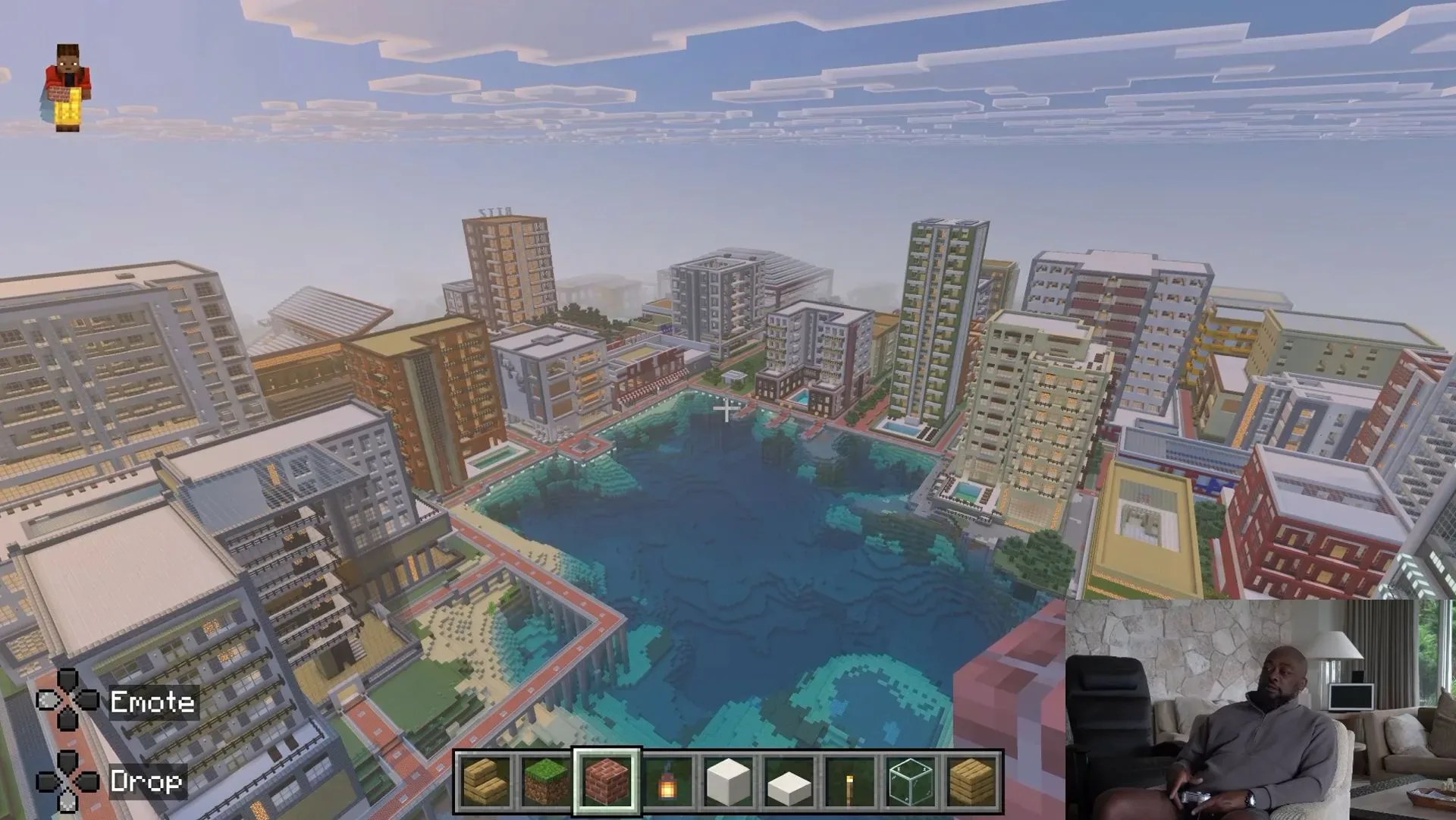
The former Pittsburgh Steelers head coach, now an NBC Football Night in America analyst, has shared the first video from a Minecraft project he says has occupied 12 years. The result is a substantial city assembled in Creative Mode, Minecraft’s building-focused mode, where players can construct without the usual survival pressure of gathering resources and avoiding danger. Tomlin’s focus is less on spectacle than the daily machinery of an inhabited place: residential buildings, luxury apartments, workplace areas, a baseball stadium nearby, lighting, room arrangements, public facilities, and even a CVS.
That premise has caught on precisely because it is so earnestly unglamorous. Tomlin is not presenting a city that exists only to deliver a dramatic reveal from the sky. He is showing how he has thought through the interiors, the use of space, and the small decisions that make structures feel as though people could plausibly work or live there. The attention is intense, but it is directed at things many builders would skip in favor of a skyscraper silhouette or a huge exterior landmark.
A Creative Mode project that outlasted the family starting point
Tomlin explains that he did not see himself as a competitive player because he lacked the controller skills for that style of game. Watching his children play led him to Minecraft’s Creative Mode, and the building process became something he could share with them. His children helped at various points during the 12-year run.
That origin matters. The project began as family time rather than a public-facing showcase or a plan for a video series. Over time, his children moved on from the game while Tomlin continued developing the city. His son Dino ultimately persuaded him to put the work online. In that sense, the first episode is not only a tour of a virtual urban environment. It is also a record of a hobby that changed shape as a family changed around it.
There is an especially approachable lesson in that trajectory. Games do not have to be played in the same way forever to remain meaningful. A shared activity can become a personal creative routine; a familiar world can become a long-term canvas. Tomlin later described Minecraft as “therapeutic,” a description that fits the deliberate, methodical way he discusses the build.
There is also an appealing lack of defensiveness in the presentation. Tomlin does not claim mastery of every traditional gaming skill, then try to force the city into a competition-shaped narrative. He found the part of Minecraft that suited him: planning, placement, iteration, and detail. That is a useful reminder that a game as broad as Minecraft accommodates radically different definitions of play.
The city’s secret weapon is mundane infrastructure
Tomlin’s first building was a boutique hotel. It includes lighting appropriate to its spaces, employee areas, and what he considers an adequate quantity of bathrooms. That last detail quickly signals what kind of tour this is going to be. The city’s charm is rooted in function, or at least in the convincing appearance of function.
Related coverage includes Mike Tomlin's 12-Year Minecraft City Is Winning Fans With Its Meticulous Everyday Details.
From there, the project expands into housing and tall apartment buildings. Some of the luxury units feature individual aquariums. A hotel ballroom has a glass ceiling. Tomlin points out high-rises and notes the appeal of one building’s closeness to the baseball stadium, which he intends to explore in a future installment.
None of these elements is inherently unusual in Minecraft. Countless creators have made apartments, stadiums, and hotels. The difference is the amount of conversational space Tomlin gives the connective tissue between them. He is concerned with where workers might operate, how rooms are arranged, what lighting accomplishes, and how a building relates to another building down the street. He has made the sort of city where a convenience store is not a gag or a background texture; it is a sensible amenity.
That perspective is why the project has prompted comparisons to a model train layout. The comparison is not about scale alone. Both hobbies reward patient arrangement, the construction of miniature systems, and the satisfaction of making a scene feel complete rather than merely impressive from one camera angle. The pleasure comes from believing the tiny world has routines.
Why interior design changes the feel of a Minecraft build
Exterior-first construction is natural in a block-building game. Big forms are easy to recognize and satisfying to share: towers, bridges, castles, arenas, or giant pixel-art characters. Interior design asks a different question: why is this room here, and who is it for?
Tomlin’s video repeatedly returns to that question. In the apartments, he talks about bedroom concepts, open-plan living areas, and the number of bedrooms assigned to different unit types. He discusses bathroom layouts as an interest in their own right. These details can make a virtual building feel less like a shell and more like a place with a purpose, even if no simulated resident will ever complain about the plumbing.
The approach also reveals why Minecraft can support long-term projects. A builder need not always add outward scale. They can revisit an existing tower, revise the distribution of rooms, alter a lighting treatment, or fill in a service space that makes the larger structure feel coherent. For a creator drawn to process over finish lines, those are not insignificant chores. They are the hobby.
“Lighting-conscious” is a whole design philosophy
One of Tomlin’s clearest recurring interests is lighting. He describes himself as “really lighting-conscious” while showing the glass ceiling over the hotel ballroom. In a virtual city, lighting is doing more than making corridors visible. It guides attention, separates public rooms from more private ones, and establishes whether an interior feels airy, warm, formal, or purely utilitarian.
In Minecraft terms, lighting can also be a structural part of a build rather than a late decorative pass. A ceiling, window, lamp placement, or open atrium affects how a room reads. Tomlin’s city appears to treat these choices as core planning concerns. The ballroom ceiling is not just an ornament laid over a completed room; it is part of the room’s identity.
This is one reason the slow pace works. Tomlin is not attempting to convince viewers that every individual block placement is astonishing. He is explaining why he made choices that connect into a larger spatial idea. The presentation has the calm, exacting rhythm of someone walking a guest through a home they have spent years improving, except the home happens to be a Minecraft metropolis and the guest is an internet audience.
That tone has become a major part of the video’s appeal. Tomlin delivers his observations with dry steadiness, including a promise that he will not bore viewers with too much detail shortly before continuing to discuss bedroom counts. The comedy comes from the total sincerity of the detail, not from a wink at the audience.
The paintings interruption tells the whole story
At roughly 13 minutes into the video, Dino interrupts the ongoing discussion of rooms and bathroom configurations to ask what his father thinks of Minecraft’s paintings. It is a perfect contrast of priorities: an opportunity to discuss a conspicuous decorative game feature arrives in the middle of a presentation devoted to the less conspicuous logistics of apartment living.
Tomlin says he did not necessarily like the paintings, though he wanted to represent interior design. He identifies one depicting a man’s silhouette as his favorite. Then the tour soon returns to suites, bedroom spacing, and open-plan areas.
The exchange is funny because it is so revealing. A less focused project might regard wall art as the essential proof that a room is finished. Tomlin’s apparent concern is that the room’s layout works first. Decorative details have a role, but they do not get to derail the zoning meeting.
Later, when Dino asks whether he wants to discuss landscaping, the question lands as another affectionate prompt toward a rabbit hole that the city’s creator may be more than ready to enter. This family dynamic keeps the tour from becoming sterile. The build may be unusually careful, but its public debut still has the shape of relatives gently teasing someone whose favorite topic has become wonderfully specific.
Why viewers are responding to the banality
The first video has passed 1.5 million views, and the response includes enthusiasm from the official NFL and Minecraft accounts. Many of the reactions focus on the very material that might sound least likely to travel online: public bathrooms, apartment layouts, and the idea that Tomlin has become an urban planner inside a block game.
That response makes sense. Online attention is often organized around escalation: bigger projects, faster reactions, stranger stunts, more devastating challenges. Tomlin’s city moves in the opposite direction. It offers commitment without chaos. Its maker has spent years returning to the same world, not to build a single overwhelming visual punchline, but to give it the texture of ordinary life.
There is a genuine comfort in that. The city has room for a baseball stadium, but it also has room for employee workspaces and retail convenience. It has luxury apartments, but also an interest in whether their bedrooms and bathrooms are sensibly arranged. The scale is ambitious; the imagination is domestic.
For people who build in Minecraft, the tour may also validate a frequently overlooked creative instinct: caring deeply about things that will never be the thumbnail. The service corridor, the office, the lobby lighting, the floor plan, and the landscape transition can be the point. A project does not become less imaginative because it imagines an ordinary place carefully.
What comes next for Tomlin’s city
Tomlin closes the first episode by promising a look at something he believes viewers will find interesting and “really cool.” The baseball stadium is one obvious subject still waiting in the wings, since he specifically says it will receive its own detail. Whatever the next focus is, the initial tour has made the terms of engagement clear: viewers should probably prepare for more municipal seriousness than may reasonably fit inside a YouTube Minecraft tour.
His new analyst role places him in a changing football-broadcast landscape, a subject also visible in recent NFL booth developments. But the Minecraft video offers a very different kind of public performance. It is not about rapid analysis or an argument to win. It is about explaining why a particular building is located where it is, and why the rooms inside have the configuration they do.
That may be the project’s most unexpected success. Tomlin did not become a viral Minecraft figure by pretending to be someone else’s idea of a gamer. He showed the game he actually plays: measured, architectural, patient, and intensely devoted to the question of whether the city has enough bathrooms.