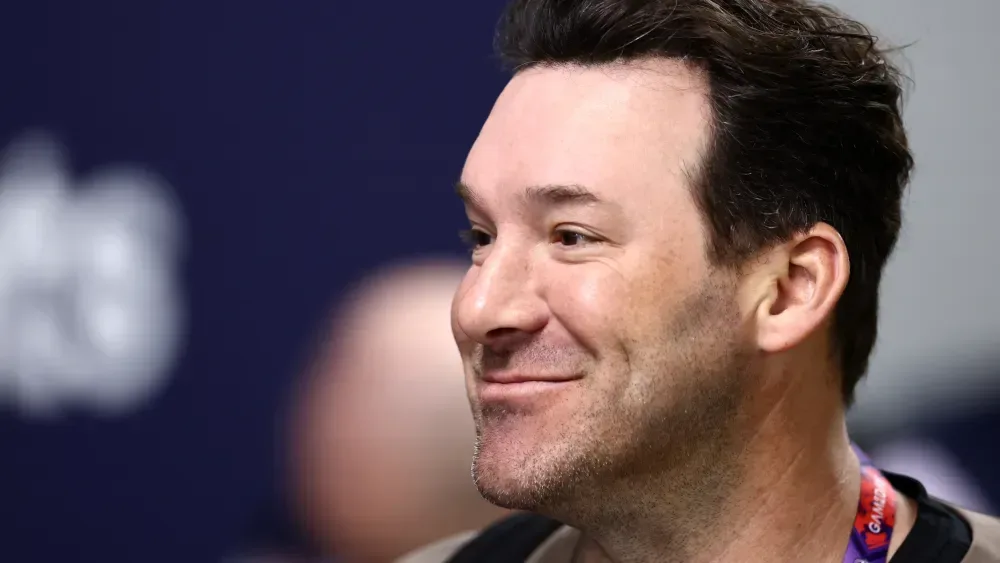
CBS Sports and Tony Romo have mutually agreed to part ways, ending a nine-year run that helped redefine the modern market for NFL game analysts. The company thanked Romo for his contributions, while Romo said he plans to take time away to focus on his health and family before considering his next opportunity.
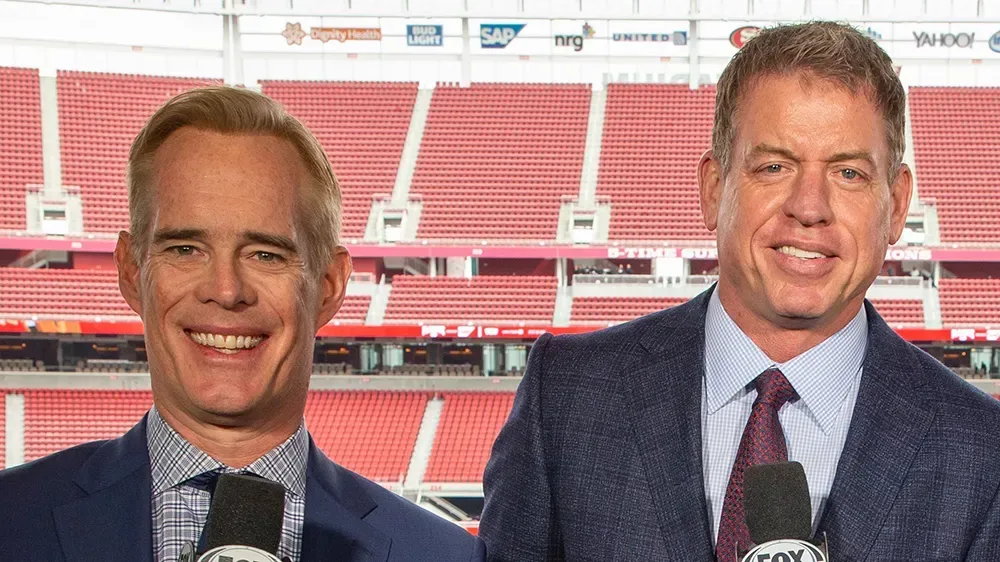
For viewers, the immediate on-air consequence is clear: JJ Watt will continue in the booth with Jim Nantz and Tracy Wolfson, a role he had already been filling this season. For the wider sports-media business, the change creates a much bigger question. Romo’s departure removes one of the defining and most highly paid voices of the NFL’s recent broadcast era at a moment when networks and streaming services are still competing intensely for recognizable booth talent.
What changes for CBS’s NFL presentation
Romo arrived in CBS’s top NFL booth in 2017 after retiring as a quarterback for the Dallas Cowboys. His early work drew broad attention for anticipating plays before they unfolded, a skill rooted in identifying formations, personnel groupings, quarterback tendencies, and likely defensive responses.
That role is generally called a color commentator or game analyst. Whereas the play-by-play announcer guides viewers through the action as it happens, the analyst supplies football context: why a formation matters, what a quarterback may be reading, where a matchup can be exploited, or why a particular call worked or failed. The sideline reporter adds information from the field and wider game-day reporting.
With Nantz handling play-by-play and Wolfson continuing as the regular sideline reporter, Watt’s ongoing presence means CBS has continuity in two of the three principal positions. Still, a lead NFL booth is more than three individual jobs. It is a rhythm developed across broadcasts: when an analyst speaks, how quickly the crew explains a pivotal moment, which details get foregrounded, and how the group handles the quieter stretches between snaps.
Watt’s assignment therefore has practical significance beyond a one-week substitution. The former defensive star’s perspective differs from Romo’s quarterback lens. A quarterback-turned-analyst may naturally center presnap reads and offensive decision-making; a former defensive player can direct viewers toward pass-rush plans, protection problems, coverage structure, leverage, and the adjustments that affect an offense before the ball is thrown. Neither approach is inherently better, but each changes the texture of the explanation viewers receive.
Romo’s exit follows leave after Wisconsin incident
The separation follows Romo’s September no-contest plea to a charge of operating while intoxicated related to an incident in Milwaukee in July. CBS Sports had placed him on leave after his arrest following a traffic stop on Interstate 43 in Wisconsin.
Romo has connected the incident to continuing pain following multiple back surgeries that led to his retirement from the NFL. He said that chronic, debilitating pain led to dependence on pain medication and that attempts to stop using those medications led to an over-reliance on alcohol. He also stated that this was not an excuse, accepted responsibility for his failures, and said he would use this period to focus on his health and family.
Those statements are important context, but they do not erase the distinction between explanation and excuse—a distinction Romo himself explicitly made. The business result, at least for now, is a mutual split rather than a return to the booth.
The end of a contract that helped reset the market
Romo’s first years at CBS coincided with a sharp escalation in what major television and streaming companies were prepared to pay for marquee NFL announcers. CBS re-signed him in 2020 to a multi-season agreement reportedly worth about $17 million annually, after his predictive style made him a prominent example of the value executives placed on elite former-player analysts.
That value proposition is straightforward. NFL rights cost enormous sums, and the league’s games remain among the most consequential pieces of live programming in American television. A network that holds those rights wants each major window to feel distinct, authoritative, and worth watching live. Famous, credible announcers can become part of that pitch—particularly when viewers know exactly which booth they will hear for the week’s biggest matchups.
The resulting market has included several headline-making hires:
- ESPN brought Joe Buck and Troy Aikman to Monday Night Football in 2022.
- Amazon recruited Al Michaels and Kirk Herbstreit for Thursday Night Football.
- Fox signed Tom Brady, a move that displaced Greg Olsen from the top position.
People familiar with the market have estimated that the very top football-booth figures can make between $15 million and $20 million per season. That does not mean every former player or experienced broadcaster commands those figures. It does illustrate how rarefied the leading role has become: elite announcers are treated as major entertainment talent as well as sports journalists and analysts.
Romo’s CBS agreement is a meaningful part of that history. It helped establish that a recently retired player with a distinctive on-air skill could command compensation comparable to the biggest names in the booth. His departure now arrives while several other high-profile deals are in focus, including contracts associated with Aikman, Olsen, and Michaels that are expected to lapse after this season.
A changing financial backdrop for sports media
The market no longer exists in quite the same conditions as the early rush to assemble high-priced NFL booths. The NFL signed an 11-year media-rights deal in 2021, intensifying the importance of securing both games and the people who present them. But the companies carrying those games also face changing corporate priorities and financial pressure.
CBS’s parent company is set to become part of Skydance through the merger of Paramount and Warner Bros. Discovery. The combined company is expected to carry billions in debt, a factor that could constrain its appetite for another exceptionally costly talent deal. It would be premature to treat Romo’s departure as proof of a single cost-cutting strategy; the immediate circumstances around his leave are central to this particular decision. Even so, the timing guarantees fresh scrutiny of what the company can and will spend to fill such a visible role.
That scrutiny reaches beyond football. Media businesses are increasingly balancing expensive live-sports rights, production budgets, streaming commitments, advertising pressure, and the need for personalities who can stand out in a fragmented attention economy. The same competition for attention also shapes the games business, as explored in the changing relationship between entertainment advertising and game discovery. Live NFL broadcasts have a particular advantage because their audience is assembled in real time, but that advantage comes with immense costs.
Why the booth is a strategic asset, not merely a lineup card
It can be tempting to frame announcer movement as a celebrity shuffle. The deeper issue is that a lead broadcast team has strategic importance for a rights-holder. Football broadcasts are long, complex productions that need to make immediate sense to devoted fans, casual viewers, and anyone tuning in for one defining game.
A strong analyst bridges the gap between the field and the audience. “Presnap” analysis refers to what can be gleaned before a play begins—alignment, motion, formation, matchups, and potential pressure. “Post-snap” explanation considers what actually happened after the ball was snapped: whether a defense disguised coverage, whether a blocker missed an assignment, or whether a quarterback’s decision was altered by pressure. The best analysis makes those concepts clearer without turning a broadcast into a clinic.
Romo’s early forecasting of likely calls became a signature because it made that bridge visible. It gave viewers a window into the predictive process rather than only a retrospective explanation. Watt’s continued role presents CBS with an opportunity to establish a different kind of insight drawn from his own career and expertise.
There is also a human factor. Nantz has been a central voice in CBS sports coverage for years, and a booth’s tone depends on trust among colleagues. Keeping Watt in place alongside Nantz and Wolfson limits disruption during the season, while allowing the company to evaluate the long-term shape of its presentation without abruptly rebuilding the entire team.
The next personnel questions
Romo’s role is not the only CBS Sports talent matter to watch. Ian Eagle, who calls secondary NFL games for the company and also works NBA games for Amazon Prime Video, is believed to have a contract nearing its end. His status is separate from the Romo situation, but it adds to the sense that CBS could face several consequential decisions involving on-air talent.
Across the industry, the picture is similarly unsettled. ESPN has reportedly reached a new agreement with Buck, while Amazon has reportedly set provisional terms with Herbstreit. ESPN and Amazon declined to comment on the status of those deals. With leading contracts under discussion or nearing expiration, a single opening in a top NFL booth has the potential to affect choices elsewhere—even if no immediate successor has been identified.
For now, the confirmed development is narrower: Romo’s tenure at CBS has ended, Watt will remain with Nantz and Wolfson, and one of television’s most valuable sports jobs has become a subject of renewed attention. The season will continue, but the economics and identity of NFL broadcasting are again in motion.