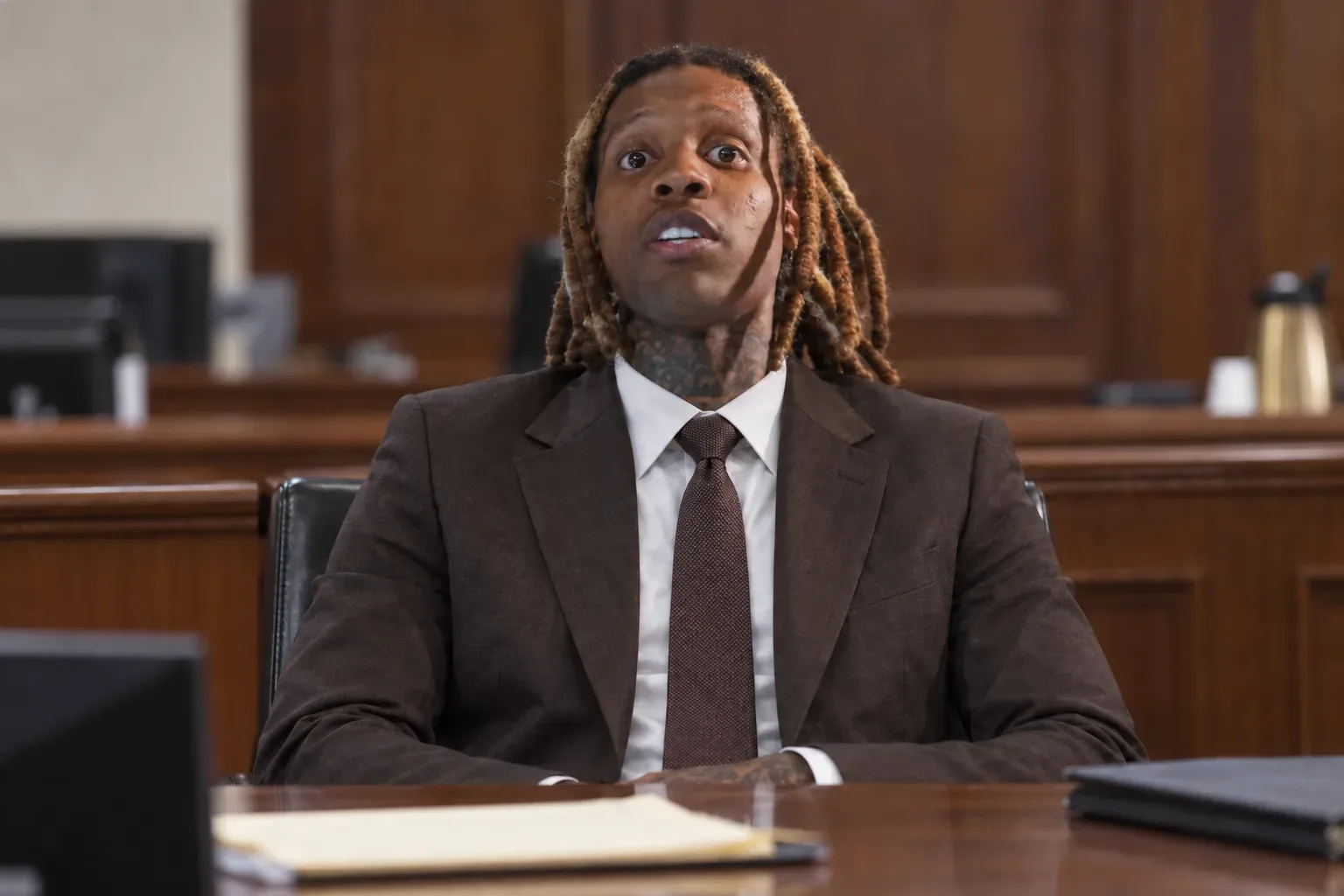
An anonymous juror who served in Lil Durk’s murder-for-hire case says the panel’s acquittal followed a detailed, three-day review of the government’s evidence—not a quick or casual decision. Lil Durk was acquitted on all five counts on Sept. 11, while co-defendants Deandre Wilson and David Lindsey were also cleared of the murder-for-hire charges.
In a post-verdict interview, the juror described working through two large exhibit binders as well as digital material. The panel later requested electronic access to the exhibits, the juror said, because reviewing physical binders around a table was inefficient. His account offers a narrow but notable look at what jurors believed mattered most: whether prosecutors had demonstrated that Durk exercised meaningful authority over the people alleged to have carried out the plot.
The central issue: what did the evidence prove about authority?
The government’s case alleged that Durk arranged retaliation against Quando Rondo, tied to a 2022 attack that killed Rondo’s cousin, Saviay’a “Lul Pab” Robinson. But the juror said the panel focused closely on the practical question of control: did the evidence establish that Durk was actually directing the alleged participants?
One point that generated doubt involved travel arrangements. The juror referenced evidence that Durk allegedly told people not to book flights under names associated with him. Yet the people involved still traveled using their own real names. For the juror, that apparent disconnect raised a straightforward question: if an instruction was disregarded in that way, how much authority had been shown?
That distinction matters in any allegation built around coordination. An accusation that someone was the organizer is broader than proof that they knew other people or expressed anger about an event. The prosecution’s theory, as described by the juror, required the panel to conclude that Durk was directing an organized response. The juror’s comments indicate that the evidence did not persuade the panel that the necessary level of direction or command had been proven.
What an acquittal does—and does not—mean
An acquittal means the jury found the government had not proved the charged offenses beyond a reasonable doubt. It is not a finding that every event discussed during a trial did not happen, nor does it settle every possible allegation surrounding the broader circumstances. It is a verdict on the specific counts and the proof presented to that jury.
Here, the anonymous juror’s explanation centers on unresolved doubt rather than a claim that jurors ignored the allegations. He said the panel reviewed every item it received, including substantial physical exhibits and digital evidence, before reaching its decision. That framing is important because it separates the volume of material from its persuasive force. A large record can still leave a jury unconvinced on a key element of the case.
The travel evidence, in the juror’s telling, became a test of the government’s larger narrative. If prosecutors were asking jurors to infer that Durk called the shots, evidence suggesting alleged associates acted independently could weaken that inference. The panel’s role was not to choose the most dramatic possible account; it was to decide whether the government’s account met the high criminal standard of proof.
Why the jury asked for digital exhibits
The juror said the group initially worked from two thick binders but later wanted the evidence in electronic form. That request was presented as a practical solution, not a shortcut. When many jurors need to examine the same pages, crowding around a small number of physical binders can slow review and make it harder for everyone to inspect the material individually.
Digital access can make a deliberation room more workable by allowing jurors to revisit documents and other exhibits without waiting their turn. It does not, by itself, tell the public which particular exhibit decided the case. Still, it supports the juror’s broader claim that the panel took time to examine the record rather than simply skimming it.
Three days of deliberations also should not be read as a mathematical measure of how difficult a case was. The length of deliberations alone cannot reveal why jurors voted as they did. The juror’s account is more useful because it identifies a specific issue that he felt affected the assessment: the gap between alleged instructions and the conduct of the people who allegedly received them.
A podcast interview did not carry much weight for this juror
The juror also addressed a DJ Akademiks interview introduced by prosecutors. He characterized it as an anecdotal and humorous piece of media rather than evidence that substantially shaped his decision. In his view, remarks made in a podcast setting could be influenced by online “meme culture” and the incentives of attention-driven content.
That observation does not establish a universal rule about podcast clips or online interviews. Such material can have different significance depending on its words, context, corroboration and the legal questions before a jury. But this juror said the interview did not meaningfully affect his own assessment of the case against Durk.
The practical takeaway is that public-facing media can be interpreted differently inside a courtroom than it is online. A statement that attracts attention in a viral, entertainment-oriented setting may not answer the legal question a jury must decide. Jurors are asked to assess admitted evidence in context, including whether it demonstrates a particular fact rather than merely seeming provocative or suggestive.
For readers following the wider story involving Quando Rondo, recent reporting on Rondo’s response to a separate jail rumor provides additional context on how quickly unverified claims can circulate around figures connected to high-profile cases.
Co-defendants received mixed verdicts
Wilson and Lindsey were acquitted on the murder-for-hire allegations, but the verdicts were not blanket clearances on every charge. Both men were convicted on stalking-related counts. That mixed outcome underscores the count-by-count nature of a criminal verdict: jurors can reject one set of allegations while finding that the proof supports another.
It also cautions against reducing the result to a single simple narrative. The jury’s decisions differed depending on the charge and the evidence attached to it. For Durk, the ultimate result was acquittal on each of his five counts. For the co-defendants, the murder-for-hire theory did not result in convictions, while the stalking-related charges did.
Durk remains in custody in a separate case
The Sept. 11 verdict does not end Durk’s legal matters. He remains in custody ahead of a separate racketeering-related trial scheduled for Oct. 5. That proceeding is distinct from the murder-for-hire case discussed by the juror, and the acquittal on the five counts should not be treated as a resolution of the separate racketeering-related allegations.
For now, the juror’s comments offer one participant’s explanation of the deliberative process behind the murder-for-hire verdict. His description points to a jury trying to reconcile a substantial body of exhibits with an unresolved question at the heart of the prosecution’s case: whether the evidence proved Durk had the authority prosecutors said he exercised over the alleged plot.