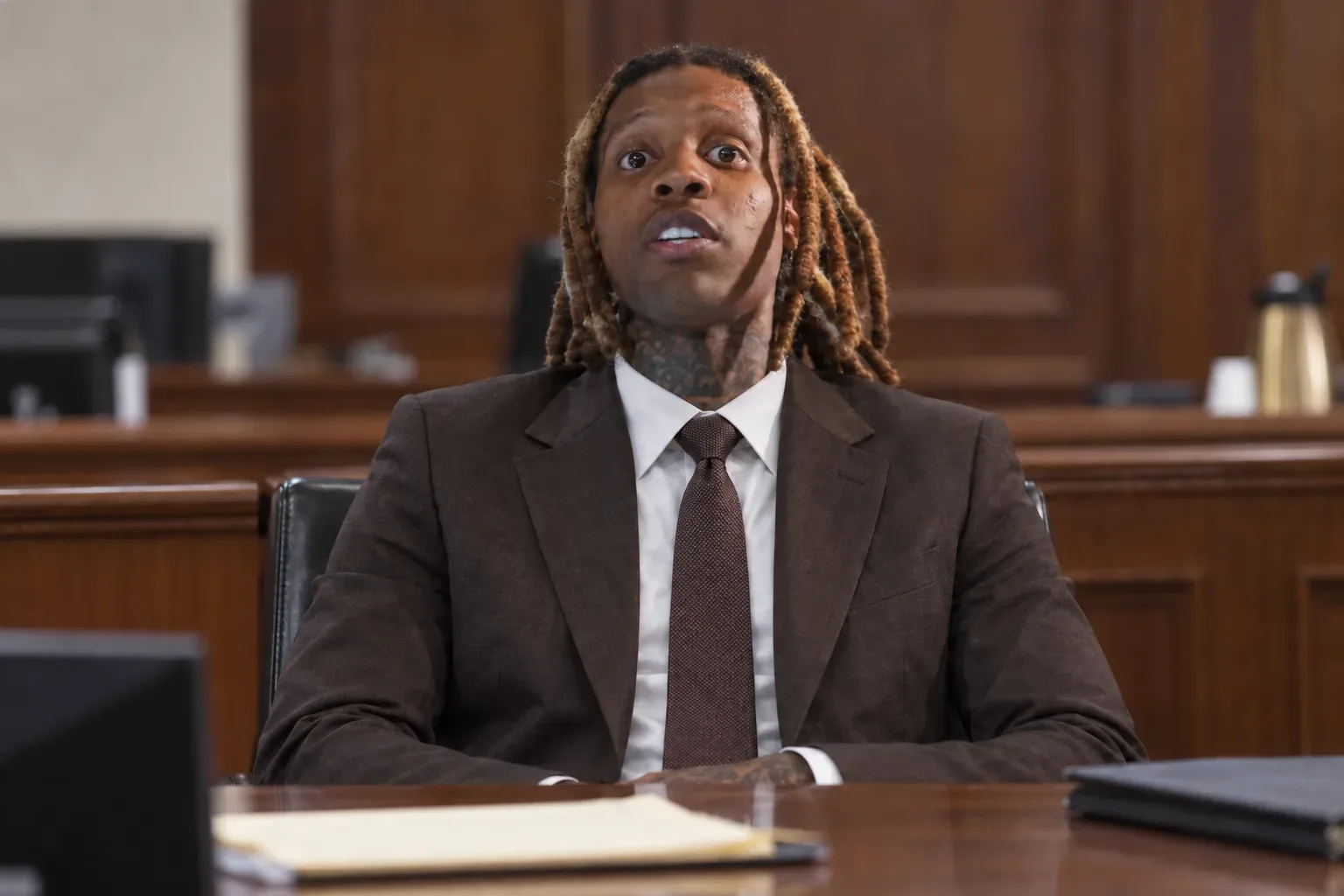
Lil Durk, born Durk Banks, has been found not guilty on all charges in a federal case that alleged he financed a plot targeting rapper Tyquian “Quando Rondo” Bowman. The verdict arrived Friday, September 11, after jurors spent three days deliberating in the courtroom of U.S. District Judge Michael Fitzgerald.
The case stemmed from the August 19, 2022 shooting near Los Angeles’ Beverly Center. Quando Rondo survived, while his cousin, 24-year-old Saviay’a “Lul Pab” Robinson, was killed. Federal prosecutors alleged that the shooting was part of a retaliatory plan connected to the 2020 death of Dayvon “King Von” Bennett.
While Banks was acquitted across the board, the jury delivered a split result for two other defendants. Deandre “DeDe” Wilson and David “Browneyez” Lindsey were convicted of stalking and conspiracy to commit stalking. Both were found not guilty on the murder-for-hire counts.
The verdict distinguishes the jury’s assessment of alleged surveillance and pursuit conduct from the government’s broader claim that an enforceable murder-for-hire arrangement existed, or that Banks authorized such an operation. It is also a major development in a case that put private messages, travel records, cooperating witnesses and rap lyrics under extraordinary scrutiny.
What the government alleged
Prosecutors presented the case as a long-running revenge effort following King Von’s death outside an Atlanta nightclub on November 6, 2020. King Von had confronted Quando Rondo before the shooting that killed him. The government alleged that Banks’ grief and anger ultimately developed into a conspiracy to locate and kill Quando Rondo, with the 2022 Los Angeles shooting representing the fatal culmination of that effort.
The indictment involved five charges for each defendant. They included conspiracy to commit stalking; stalking Quando Rondo with a dangerous weapon; stalking Robinson resulting in death; conspiracy to use interstate facilities in a murder-for-hire resulting in death; and using interstate facilities to commit murder-for-hire resulting in death.
The evidence described by prosecutors included cellphone and GPS data, transportation and flight records, lodging expenses, and other documentation intended to reconstruct movements around the shooting. Surveillance video showed two vehicles following Quando Rondo’s Escalade before gunfire broke out.
Those records established a detailed timeline around a real and devastating attack. But the defense insisted that movement data, charges on cards, and travel logistics could not independently reveal who knew what, who gave orders, or whether anyone made a deal to exchange money or another economic benefit for murder.
Why the alleged payment arrangement mattered
The murder-for-hire accusations required proof of more than anger, association or a hope that money might be received. The government had to establish an agreement involving murder in exchange for payment or some other financial benefit. Judge Fitzgerald instructed the jurors that travel costs by themselves could not prove a bounty existed.
That issue became central to the defense case. Keith “Flacka” Jones testified that he expected he could receive as much as $1 million, but the defense emphasized that no document showed a promise or a payment. Kacey “OTF Jam” Hester also offered testimony tying Banks to an alleged financial reward, but lawyers focused on the evolution of Hester’s statements during a recorded interview.
Defense attorney Brian Steel highlighted that Hester initially denied discussions with Banks concerning Quando Rondo or Timothy “Lul Tim” Leeks. More than two hours later, Hester connected Banks to the alleged payment. The defense urged jurors to consider why the account changed during that interval.
For Lindsey, the defense further argued that there was no evidence he had been offered money before the attack. It also noted testimony indicating that OTF Vonni had not met or spoken to Lindsey before the weekend in question. The defense position was that sharing a flight or riding in a vehicle could not, without more, prove awareness of a murder plot.
Cooperating witnesses faced intense challenges
The government’s narrative depended in substantial part on testimony from Kavon “OTF Vonni” Grant, Hester and Jones. Each had admitted criminal conduct and testified while hoping that their cooperation would lead prosecutors to support more favorable outcomes at sentencing.
Grant provided the prosecution’s most direct alleged connection to Banks, saying the artist approved and directed the operation. The defense countered by portraying Grant as a former assistant who had access to Banks’ financial information, cards, passwords and transportation. It argued that this access gave Grant room to operate independently while later attributing his actions to Banks.
One recorded call became especially important to that argument. In it, Grant discussed doing certain things alone and said others had not discovered them because he was handling them correctly. Findling characterized that statement as a strong basis for reasonable doubt: in the defense’s telling, it suggested a person capable of managing wrongdoing without direction from Banks.
The defense also criticized the scope of the investigation. It said investigators did not interview Justin Gibson or Devonte “DJ Bandz” Richmond, people who traveled with Banks and Grant during relevant periods between California and Florida. The lawyers contended that agents also did not ask other people at Banks’ Encino home—among them family members and security personnel—about key subjects such as visitors, firearms, Grant’s activity, or conversations about Quando Rondo.
Another witness, Shekema Springfield, the mother of King Von’s son, disputed the alleged origin story for the conspiracy. She testified that she stayed around King Von’s family in the days after his death and did not see Banks or several accused conspirators there, nor did she hear discussion about killing Quando Rondo. The defense said that account conflicted directly with Grant’s version of how a revenge plan began.
Messages, music and context were at the heart of the defense
Findling’s closing argument asked jurors to separate grief, aggressive expression and artistic performance from criminal agreement. He said that investigators had approached Banks’ communications with a preexisting assumption that he was a wealthy gangster, a phrase that emerged from an LAPD detective’s interview with Jones. The defense argued that this outlook could have affected how authorities read messages, photos and other material.
Lawyers pointed to examples where excerpts looked more sinister in isolation than they did within fuller conversations. One image involving Lul Tim, the defense argued, contained no instruction or threat. Another thread included material such as a tribute to LeBron James and an image of King Von with his son, context the defense said had been stripped away when particular items were shown to the jury.
Rap lyrics presented another contested category. Producer Justin Gibson testified about the music business and the ways labels approve, market and profit from violent lyrical content. Prosecutors argued that Gibson acknowledged some lyrics concerned revenge against Quando Rondo. The defense responded that recognizing a song’s subject matter did not prove an agreement to stalk someone or offer payment for murder.
That argument carries implications beyond this particular proceeding. Music can be emotionally direct, confrontational, fictionalized, autobiographical, commercial, or some blend of all four. A jury still must decide whether any particular lyric demonstrates the legal elements of a specific criminal charge. Banks’ defense maintained that the lyrics at issue did not identify a concrete deal, a bounty, or a plan targeting Robinson.
The same dispute over incomplete context applied to an interview with DJ Akademiks. An FBI agent referenced roughly 56 seconds from the interview while acknowledging that he had not reviewed the remaining three and a half hours. The defense used that admission to argue that prosecutors repeatedly relied on fragments rather than the full context of statements, videos, songs and messages.
Hip-hop remains a major force in popular culture, and coverage of artists can move rapidly between music, public disputes and courtroom developments. For another current story at that intersection, see Drake’s “FOMO” trailer and its planned September 15 YouTube premiere.
The jury’s questions and the split verdict
Deliberations began Wednesday, September 9, once final arguments and instructions had concluded. Jurors had to assess each defendant separately across five charges, including distinct questions of knowledge, intent and agreement.
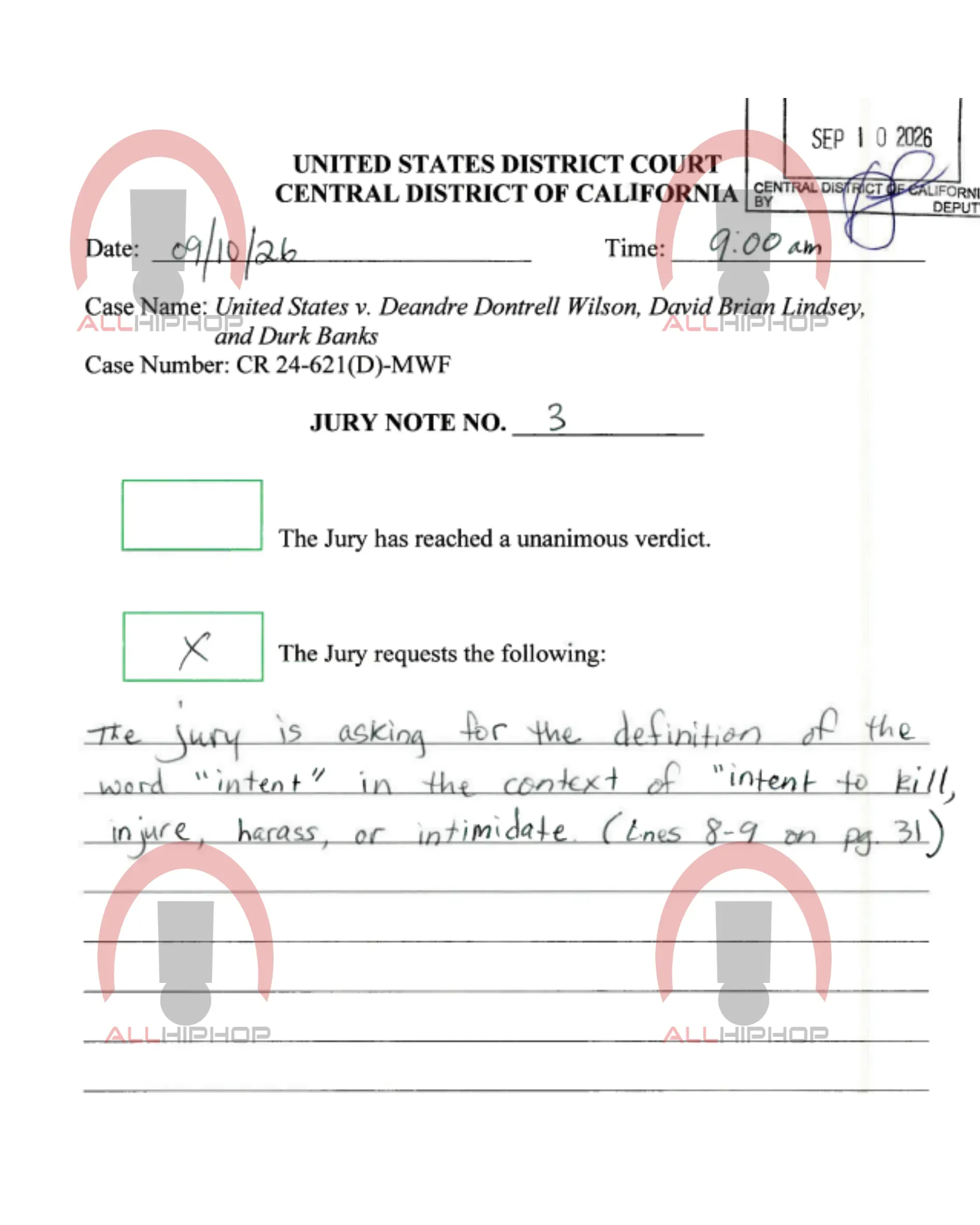
On Thursday, September 10, the jury requested clarification of Instruction No. 18, which addressed conspiracy to commit stalking. After both sides agreed that no additional explanation was needed, Judge Fitzgerald reread the existing instruction. The jury later asked for the meaning of “intent” in the phrase “intent to kill, injure, harass, or intimidate.” Fitzgerald said no special legal definition applied and told the panel to use the word’s ordinary meaning.
Those notes did not reveal how jurors were leaning, but they showed close attention to the mental-state requirements behind the charges. The eventual outcome reflects that charge-by-charge review. Wilson and Lindsey were convicted on the stalking-related allegations, but the murder-for-hire allegations against them did not meet the jury’s standard for conviction. For Banks, the jury found the evidence insufficient on every count.
What remains unresolved for Lil Durk
The not-guilty verdict ends this federal prosecution for Banks, but it does not necessarily mean an immediate release. He is still expected to face a separate murder-for-hire case tied to the 2022 killing of Stephon Mack outside the Youth Peace Center.
That pending matter is separate from the shooting involving Quando Rondo and Robinson, and its allegations will have to be evaluated on their own evidence and under their own legal process. A verdict in one case does not decide the facts in another.
For now, the September 11 result is clear: the federal jury acquitted Lil Durk of all charges in the alleged Quando Rondo murder-for-hire plot. The same jury convicted Wilson and Lindsey on stalking and stalking-conspiracy counts, while acquitting both men of murder-for-hire. The legal consequences for all involved will continue to develop as sentencing and the separate pending case proceed.