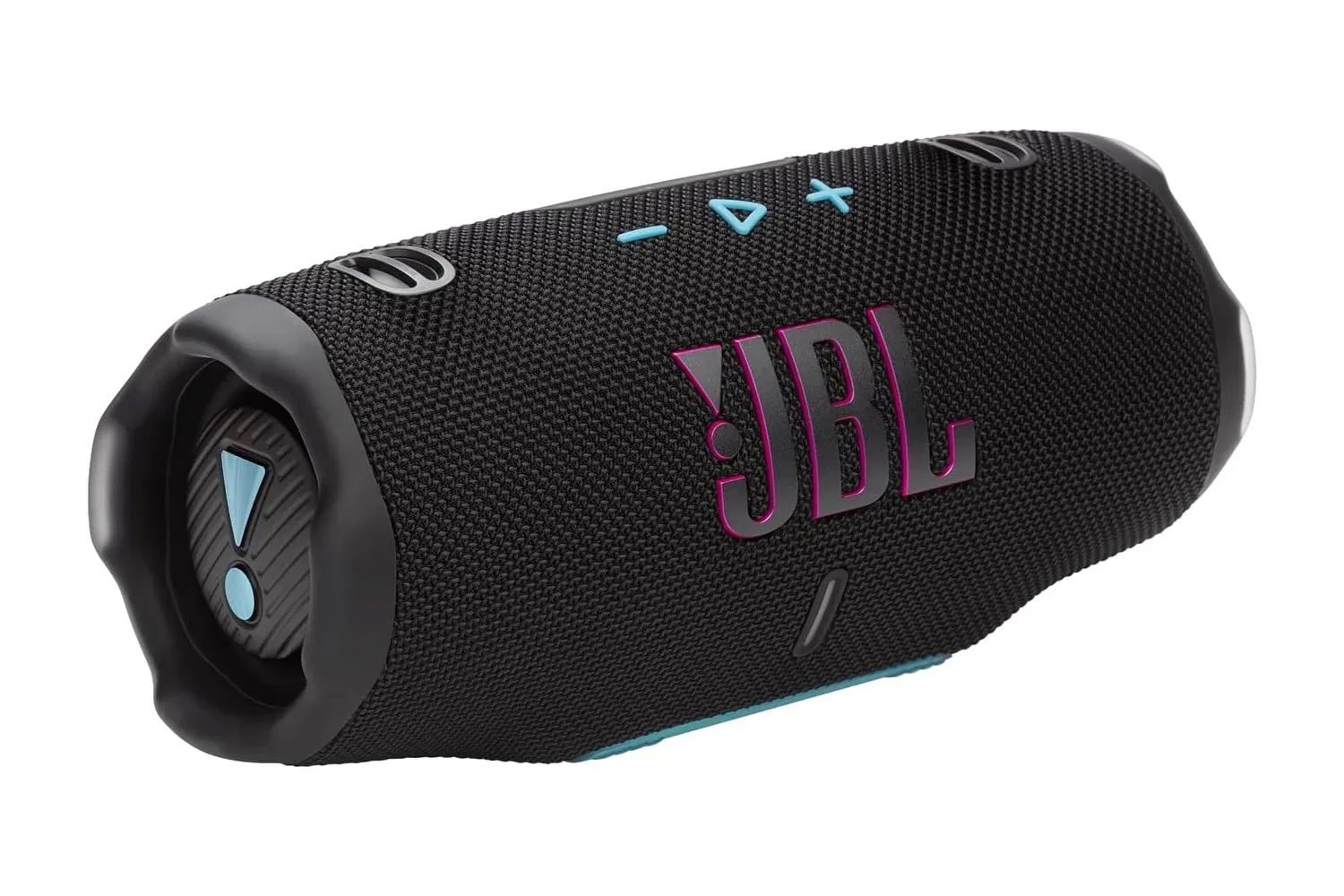
The JBL Charge 6 portable Bluetooth speaker is listed at $150, down $50 from its $200 list price. That is a 25% reduction for a compact speaker whose pitch is less about one headline specification than about combining several useful outdoor and everyday features: a 45W two-way speaker layout, approximately 24 hours of battery life, IP68 water and dust protection, a USB-C phone-charging function, and a removable carrying strap.
For people who want one speaker that can move between a desk, backyard, beach trip and campsite, that blend is the important part. Portable audio often asks buyers to trade loudness against battery capacity, or portability against durability. The Charge 6 is positioned to cover the practical basics at once, while retaining a wired USB-C listening option for users who want to bypass Bluetooth audio compression from a compatible laptop.
What the $150 price applies to
The $150 figure represents a $50 cut from the stated $200 list price. A sale price is useful only if the speaker’s specific mix of functions matches the job at hand, so the more meaningful question is not whether a portable speaker can play music. It is whether its size, claimed endurance, protection rating and connectivity solve the annoyances that arise when music leaves the living room.
The Charge 6 measures roughly 9 inches long and weighs about 2.2 pounds. That puts it in a grab-and-go category rather than the pocketable end of portable audio, but the attached removable strap is intended to make moving it simpler. The reported build also uses recycled plastic and fabric, with FSC-certified paper packaging.
Its outdoor credentials are particularly central to the package. JBL rates the Charge 6 at IP68 and says it can withstand drops of up to 1 meter onto a hard surface. Those claims do not make any electronic device invincible, but they are useful distinctions for anyone planning to use a speaker around sand, rain, a pool or a crowded patio where accidental knocks are a realistic possibility.
Breaking down the 45W two-way speaker design
The Charge 6 is rated for 45W total output through a two-way configuration: a 30W woofer and a 15W tweeter. A woofer is the driver tasked with lower-frequency sound, including much of the weight and impact listeners associate with bass. A tweeter handles higher-frequency detail, such as the crisp edges of percussion and brighter elements in vocals or instruments.
Using separate drivers for those areas is what “two-way” means here. In straightforward terms, the design assigns different parts of the audible range to components built for different jobs. It is a sensible approach for a speaker meant to produce fuller sound in social settings than a tiny single-driver unit can generally manage.
JBL also includes AI Sound Boost, which analyzes music in real time and adjusts the energy sent to the speaker with the goal of maintaining sound quality while reducing distortion. Distortion is unwanted alteration in the reproduced sound; it can become more noticeable when a speaker is pushed near its limits. The practical promise is not that every track will sound identical at every volume, but that the speaker is designed to manage its output more carefully as listening demands rise.
There is also a seven-band equalizer in the JBL Portable app. An EQ, or equalizer, lets a listener alter selected frequency ranges rather than accepting one fixed tuning. Seven bands provide several separate areas for adjustment, which can be helpful when personal preference, room acoustics or a particular genre call for less bass, more vocal presence or a different overall balance.
Battery claims, Playtime Boost and quick charging
JBL lists approximately 24 hours of playback before the Charge 6 needs charging. Battery estimates depend on usage, particularly volume and sound settings, so “about” is the key qualifier. Still, a claimed full-day playback figure is significant for the speaker’s intended use: it potentially reduces the need to pack a charger for a day outside or to interrupt a long gathering.
Playtime Boost can add up to four more hours, bringing the claimed maximum to 28 hours. There is an explicit trade-off: the mode reduces bass. That is an important detail rather than a footnote. Lower frequencies require energy, so the feature offers a choice between a longer run time and the fuller low-end presentation the woofer is there to deliver.
A 10-minute fast charge is claimed to provide about 2.5 hours of playback. That makes the feature most useful as a recovery option: enough time to get music playing again after discovering the battery is low, rather than a replacement for a full charge before an extended trip.
A speaker that can charge a phone
The Charge name is especially literal in this generation. Its USB-C port can work as a power bank for recharging a phone. That could be valuable where power outlets are scarce, though using the speaker’s battery to charge another device naturally draws from the energy available for playback. Buyers should view it as a practical backup function, not as a free extra battery with no impact on listening time.
USB-C has a second role. Connecting a compatible device, such as a laptop, to the Charge 6 through USB-C enables lossless audio up to 24-bit/96kHz. Lossless audio refers to audio data delivered without the quality-reducing compression associated with a typical Bluetooth connection. The stated 24-bit/96kHz specification describes the depth and sampling rate the wired connection can support.
This option will matter most in stationary listening situations, where plugging in a laptop is convenient and the listener wants to avoid Bluetooth compression. Bluetooth remains the more natural choice for casual portability, but a wired mode makes the Charge 6 more flexible as a compact home speaker. It may also be a useful pairing for laptop users following the wider hardware conversation around machines such as the rumored touchscreen OLED MacBook Pro, provided the device and setup support the necessary USB-C audio connection.
What IP68 and drop resistance mean in practice
IP68 is an ingress-protection rating. The “6” indicates dust protection, while the “8” denotes water resistance under the rating’s testing conditions. For Charge 6 owners, the practical takeaway is that the speaker is designed to handle exposure to dust and water, including poolside and beach use, rather than requiring the careful indoor treatment of a conventional desk speaker.
Even with that rating, sensible handling remains worthwhile. The supplied information supports that it is waterproof and dustproof; it does not turn every possible use case into a risk-free one. Charging ports, cables and connected devices are separate considerations. A phone plugged in to use the speaker as a power bank is not magically protected by the speaker’s rating, and a wired USB-C audio setup is most logical away from water.
The up-to-1-meter drop resistance adds a separate layer of reassurance. It addresses impacts rather than water or dust, and should be understood as a durability claim for accidental falls rather than an invitation to test the limits repeatedly. Combined with the removable strap, it does suggest a device built to be carried and used rather than left in one carefully managed location.
Linking speakers: wider coverage or stereo separation
The Charge 6 can connect with compatible JBL speakers through Auracast. In broad terms, that creates a route to expand audio coverage across a larger space with compatible equipment. For a backyard, patio or multiple-room setup, the appeal is straightforward: one speaker does not have to do all the work from a single location.
Two Charge 6 speakers can also be paired for left and right stereo separation. Stereo separation means allocating the left and right channels to different speakers. When those speakers are placed apart appropriately, it can create a wider sense of placement in music than a single unit can provide. This is a different benefit from merely increasing volume. The arrangement may be more compelling at home, where placement can be deliberate, than in a fast-moving outdoor gathering.
That distinction helps clarify who benefits from buying a second unit. One Charge 6 is the simpler option for portable sound, long battery life and emergency phone charging. Two units are for listeners who specifically value a broader stereo presentation or want wider coverage through speaker linking.
Who the Charge 6 configuration fits
At the listed $150 price, the Charge 6 makes the strongest practical case for someone who values durability and flexibility as much as headline audio specifications. The combination of IP68 protection, one-meter drop resistance, a roughly 24-hour claimed battery estimate, quick-charge support, strap and power-bank capability is well aligned with travel, poolside listening, casual outdoor events and rooms where a speaker might be moved often.
It also offers a more considered path for at-home listening than many portable speakers by including the seven-band EQ and USB-C lossless playback up to 24-bit/96kHz. Neither feature requires every buyer to become an audio tweaker, but both broaden the options beyond a basic Bluetooth connection.
- Choose it for mobility: It is about 9 inches long, weighs around 2.2 pounds and includes a removable strap.
- Choose it for resilience: The stated IP68 rating and up-to-1-meter drop resistance suit messy or active environments.
- Choose it for endurance: JBL claims about 24 hours of playback, with up to four extra hours through Playtime Boost at the expense of bass.
- Choose it for utility: The USB-C port can recharge a phone and support wired lossless audio from a compatible device.
- Consider a pair for stereo: Two Charge 6 speakers can provide separate left and right channels.
The caveat is equally simple: the source material provides feature claims and the current listed price, not comparative measurements against rival speakers. Anyone deciding between models should weigh the Charge 6’s defined strengths—battery, protection, USB-C functions, stereo pairing and 45W two-way architecture—against the particular environment where it will spend most of its time.
For buyers who need a speaker that can handle more than an occasional indoor playlist, the $50 reduction makes that multifunctional approach easier to justify. The Charge 6 is not presented merely as a loud Bluetooth cylinder; it is a portable audio device designed to keep playing, tolerate a little chaos and lend some battery power to the phone that is selecting the music.
Shop the products
Check current price, model and availability at the retailer.