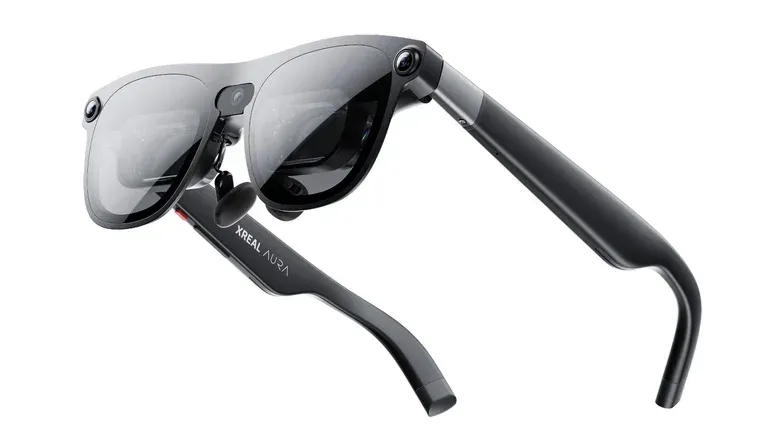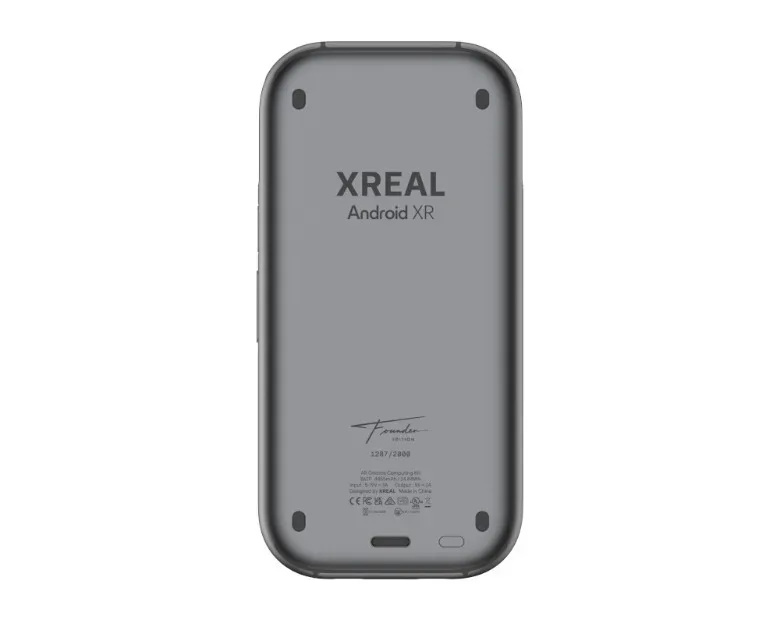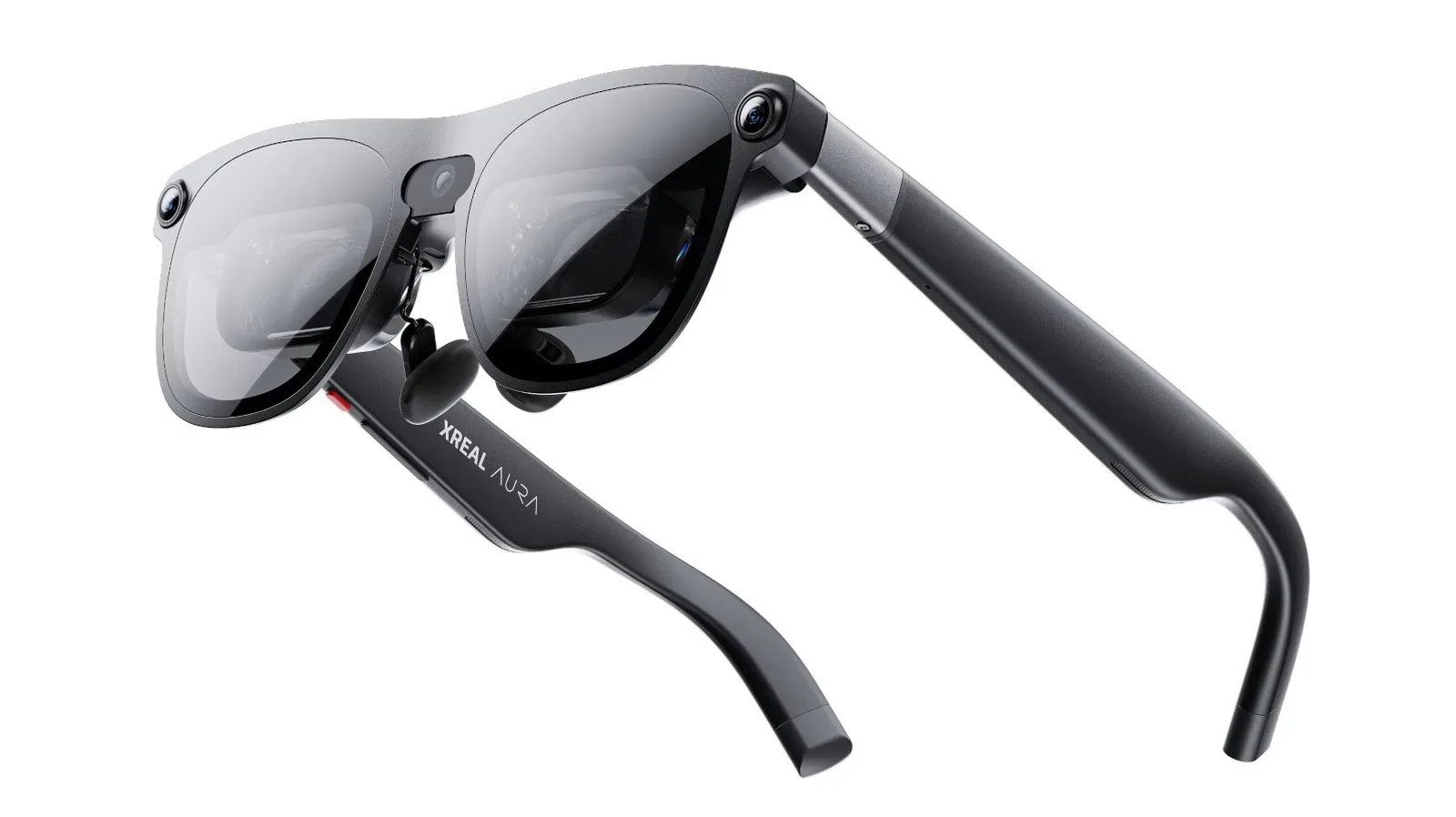
Xreal’s Aura smartglasses are entering pre-order with a starting price of $1,279, positioning the Android XR device as a premium personal display rather than a casual accessory. The glasses weigh under 95 grams, but Aura is not a self-contained pair of glasses: it connects to a separate compute puck that handles Android XR, processing, app access and navigation controls.
That split is the central idea behind Aura. Putting the main hardware in a puck rather than entirely on a wearer’s face is intended to make the glasses themselves lighter. In exchange, users will need to carry, wear or clip on the companion unit. Xreal suggests using a lanyard or attaching the puck to clothing or belongings, so the experience is explicitly built around a two-piece setup.
Reservations have moved to pre-orders for people who already paid a deposit. General orders are expected to open in the coming weeks, with shipments set to begin soon in the United States, Canada, Japan and South Korea. Wider market availability is planned for 2027.
What the Aura package includes
Aura runs Android XR through its companion puck. Android XR is Google’s software platform for extended-reality devices: hardware that places digital interfaces in front of the user while potentially retaining awareness of the real room around them. On Aura, the puck includes Google Play for apps and Gemini for AI capabilities.
The glasses use see-through lenses, meaning the wearer can see their surroundings beyond the projected digital image. This is an important distinction from a closed virtual-reality headset. Rather than enclosing the user’s view, Aura is designed to layer a virtual screen into a view of the physical world.
The supplied information specifies a 70-degree field of view. Field of view describes how much of a wearer’s vision is occupied by the displayed image. It is a useful specification, but not a complete verdict on comfort, clarity or immersion by itself. The final experience also depends on factors such as a person’s fit, viewing position and the software being used.
Aura uses Qualcomm’s Snapdragon Reality Elite chip, a platform designed for augmented- and mixed-reality capabilities in smaller, lighter headsets. In this design, that compute hardware resides in the puck rather than being loaded into the glasses frame.
The system also has cameras for precise hand tracking. Hand tracking is a form of input in which cameras follow a user’s hand movements and gestures, allowing actions in a virtual interface without requiring a traditional handheld controller. As with any gesture-based interface, its practical value will depend on the apps and controls available for the platform, but the stated goal is clear: Aura has more than one way to navigate.
The puck is more than a battery-shaped accessory
Calling the companion hardware a “puck” can make it sound like a passive power module. Aura’s puck is instead the operational center of the product. Along with running Android XR and providing the system’s computing power, it has a built-in trackpad and a fingerprint sensor.
The trackpad gives the device a familiar physical navigation option. That matters because hand tracking is not necessarily the best control method for every task. A trackpad can be useful for simple interface movement and selection, while the fingerprint sensor provides a biometric method of identifying the user. The supplied details do not establish how individual apps use either capability, so buyers should avoid assuming controls or authentication behavior beyond what has been specified.
The two-part design creates a practical trade-off. Keeping the eyewear below 95 grams may help Aura feel less like a conventional headset, but the wearer must account for a connected puck. A lanyard, a clipped attachment point and cable management become part of daily use. For someone prioritizing lighter glasses, that may be an acceptable compromise. For someone hoping for an entirely standalone glasses experience, the tether is a significant design limitation rather than a footnote.
There is also a conventional-computing angle. Aura can be plugged into a computer and used as an external monitor. That makes the glasses potentially relevant to PC users who want a private display arrangement, though the information available does not specify supported resolutions, refresh rates, computer compatibility or the behavior of particular desktop software. “External monitor” establishes the intended role, not every technical detail that prospective buyers may want before ordering.
Display, audio and outdoor visibility
The glasses’ see-through display was observed as sharp and bright during a demonstration, including in sunny outdoor conditions. That is an encouraging detail for a wearable display, where bright environments can compete with projected imagery. It should still be read as an early observation rather than a universal guarantee: visual results can vary with environment, fit and what is being shown on screen.
Aura’s audio uses Bose-engineered technologies. The provided information does not name the speaker configuration, describe isolation or provide a sound-quality comparison, so it would be premature to draw conclusions about music, voice chat or game audio. Still, the Bose engineering reference signals that audio is a deliberate component of the hardware package, not an unmentioned afterthought.
For game-adjacent uses, the most concrete feature is the ability to act as a computer display. That could make Aura relevant to players who already use a PC and are interested in a wearable screen. But the announcement does not identify specific games, gaming services, controller support or performance expectations. Android XR and Google Play may broaden the software menu over time, yet an app store is not the same thing as confirmation that a particular game or use case is available.
Google’s wider work on interactive software remains worth watching alongside new Android XR hardware. For example, Google’s experimental game-idea playground illustrates how the company is exploring different ways to make and interact with software. Aura, however, should be judged on its stated hardware and platform capabilities, not on presumed connections to other Google projects.
Two sizes and two memory configurations
Xreal will sell Aura in medium and large sizes. Medium is listed for 60–66 mm, while large is listed for 66–72 mm. The measurement is a meaningful purchasing detail because wearable displays have to sit correctly on a person’s face for both comfort and visual alignment. The announcement does not provide a fitting guide beyond those ranges, so buyers should use the company’s sizing information carefully when it becomes available to them.
There are also two memory and storage configurations. The entry version has 12GB of RAM and 256GB of storage, while the higher-tier model has 16GB of RAM and 512GB of storage and costs $1,499.
RAM is short-term working memory: it helps a device keep active software and system tasks available while it is running. Storage is long-term space for installed apps and saved data. Those are different resources, and the bigger configuration increases both. The supplied specifications do not say how much of the storage is available after the operating system is installed, nor do they set out a performance comparison between the 12GB and 16GB versions. The clearest confirmed difference is capacity, along with the $220 increase from the $1,279 starting price to $1,499.
What buyers can confidently weigh now
Aura’s known proposition is unusually specific. It is a lightweight-for-its-category pair of see-through Android XR glasses, attached to a separate computing and control unit. It combines a 70-degree field of view, camera-enabled hand tracking, a physical trackpad, fingerprint sensing, Google Play access, Gemini capabilities and the option to connect to a computer as an external monitor.
That is a substantial feature set, but it is also a premium-priced one. The $1,279 entry price puts the device in a category where prospective buyers will reasonably want more detail about their exact software needs before committing. The available information leaves several questions open, including the breadth of compatible computer setups, app-specific controls, exact display behavior and the real-world implications of carrying the puck throughout a session.
For now, Aura is best understood as a modular Android XR system whose lower glasses weight comes with the deliberate responsibility of a tethered companion device. That approach could appeal to people who value a lighter face-worn display and want Android XR, hand input and PC-monitor functionality in one package. It also means the comfort and convenience calculation extends well beyond the frames themselves.