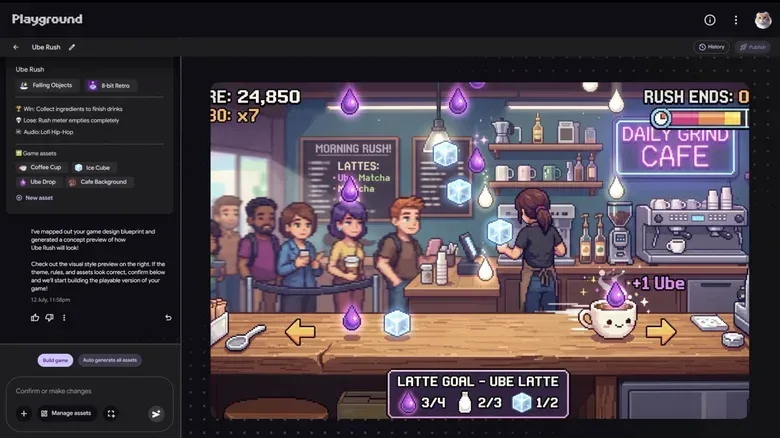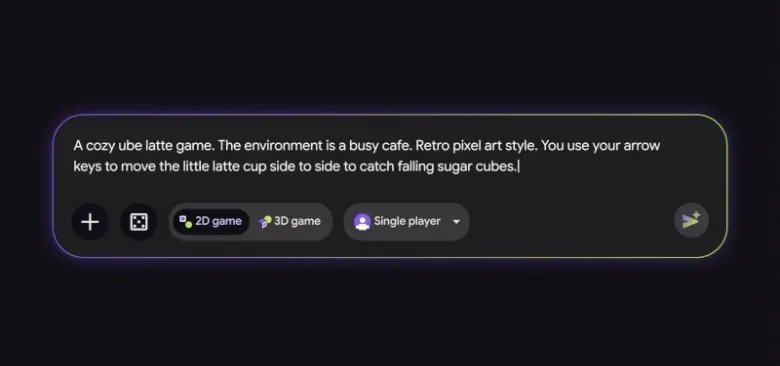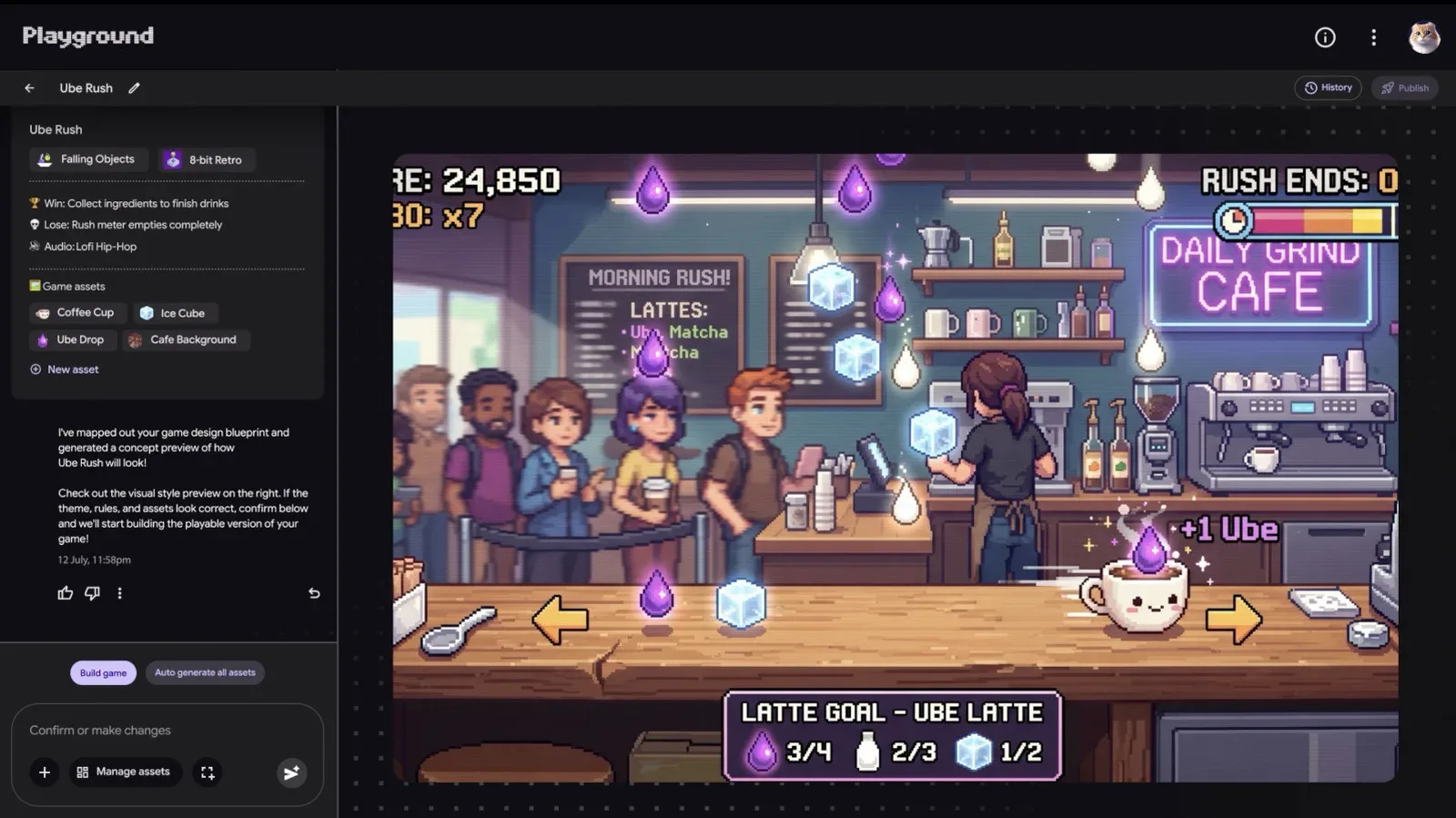
Google has launched Playground, an experimental AI-powered platform intended to let people make games by describing what they want instead of beginning with code or artwork. The premise is deliberately approachable: type a request into a chatbot-style interface, choose between 2D and 3D, and—when a selected genre supports the option—choose single-player or multiplayer.
That makes Playground less a conventional game engine in the hands of the user and more a prompt-driven starting point for game creation. A person can begin with an original description, alter a provided starter prompt, or use guided support. Once the platform produces an initial game, further prompts can change its mechanics, physics, and visual presentation.
The example supplied for the platform is a platformer: a creator can request a double-jump so the player can access heights that a normal jump cannot reach. It is a small instruction, but it illustrates the core ambition. Rather than requiring someone to identify, edit and connect the systems behind a character ability themselves, Playground is designed to translate a plainly stated gameplay rule into the project.
What Playground is—and what it is not
Playground is currently experimental. That label matters because it signals that the service is expected to change, rather than presenting its current feature set as finished or fixed. Google has said more changes are planned, and it also says Unity Spark integration is coming soon.
For now, the confirmed workflow is focused on prompt-based creation and iteration. The user describes a game, receives an initial result, then continues shaping it through requests. The platform supports choices that are central to a game’s basic form:
- Perspective and presentation: 2D or 3D.
- Player structure: single-player or multiplayer for select genres.
- Mechanics: the rules and player actions that govern play, such as a double-jump.
- Physics: the behavior of movement and interactions in the game world.
- Graphics: the game’s visual appearance.
Those terms can blur together in ordinary conversation, but they describe different creative levers. Mechanics establish what the player can do and what rules apply. Physics is one way those rules become tangible: jump height, falling, collision and momentum are common examples of the kind of behavior players feel as they move through a game. Graphics concern how the project looks. A useful prompt workflow should make it easier to separate those choices, because a creator may want to adjust the jump behavior without changing the world’s visual identity, or revise the visuals without rewriting the play rules.
There is an important limit to the available details: Playground’s public description establishes that it can respond to prompts affecting those areas, but does not spell out the full range of genres, controls, editing tools, export options, or technical constraints. Treat it as a platform for making and revising playable projects through natural-language requests, not as a fully specified replacement for every established development workflow.
Iteration is the meaningful part of the pitch
The initial prompt is only the opening move. The more consequential feature is the ability to keep refining the result. Game ideas are rarely complete when they first appear in a notes app or a conversation. A person may know they want a platformer before they know whether the character needs a double-jump, how high the platforms should be, or what visual style best fits the movement.
Playground’s model is built around that back-and-forth. A creator can start from scratch, remix a starter prompt, or lean on guided support. Each route lowers a different barrier. Starting from scratch is useful for a more specific concept. Starter prompts give people something concrete to alter when the blank-page problem is the obstacle. Guided support can help someone who does not know which design decision to make first.
In practical terms, the platform could be especially useful for quick prototypes: small versions of an idea that make a rule playable enough to evaluate. “Prototype” does not mean a finished commercial game. It means testing whether an idea has a workable shape. If a higher jump changes how a level is navigated, for example, the creator can judge the feel of that adjustment in context rather than merely imagining it.
That is also where prompt precision becomes valuable. “Make the character more mobile” is a broad request; “add a double-jump to reach higher platforms” identifies a specific action and its intended level-design purpose. The latter gives the system a clearer target and gives the creator a clearer basis for deciding whether the result is right. Playground does not eliminate the design choices involved in a game. It shifts more of the interaction toward describing and evaluating those choices.
Sharing is contained within Playground for now
Creators have three stated visibility options. They can keep a game private, send a shareable link to friends, or publish it to the Playground Explore gallery for the community. Published games will support in-game leaderboards.
That structure is significant because it distinguishes sharing from a broad commercial store release. There is no indication that Playground creations are being sent directly to Google Play. The available information instead points to links and a dedicated Explore gallery as the ways games reach other people, at least at this stage.
Leaderboards add a familiar competitive layer to published games. In general, a leaderboard ranks players by a tracked result, such as a score or time, but the details of what Playground’s leaderboards measure have not been specified. Their presence does suggest that games in the gallery are meant to be played and revisited by other users, not simply viewed as static AI demonstrations.
The gallery approach also creates an obvious curation question. Lowering the barriers to creation can produce more experiments, but volume alone does not guarantee that the most inventive or enjoyable projects are easy to find. The platform description acknowledges the possibility of low-quality titles. For players browsing Explore, the useful test will be whether the gallery makes discovery manageable as more projects appear. For creators, the challenge remains the same as it is in any crowded creative space: a prompt can generate a beginning, but a memorable game still needs clear rules and a reason for someone else to spend time with it.
Unity Spark is the next technical piece
Google says Playground will soon integrate Unity Spark. The company describes Spark as bringing professional-level mechanics, high-fidelity 3D capabilities, and the flexibility of the Unity runtime.
“Runtime” is a technical term for the environment that runs an application or game while it is operating. In this context, the reference to the Unity runtime points to a route toward more sophisticated game behavior and 3D presentation than a lightweight prompt-to-game experience might otherwise imply. The planned integration is not yet described as currently available, so it should be viewed as an announced next step rather than a feature people can assume they can use today.
Its potential importance is straightforward. Playground’s appeal begins with accessibility: no need to already know how to code or draw before trying an idea. Unity Spark is positioned as a way to extend that starting point toward more robust mechanics and higher-fidelity 3D work. Whether that combination works well will depend on how understandably the additional capability is exposed to users. More power is useful only if creators can still make intentional choices and understand the results of their requests.
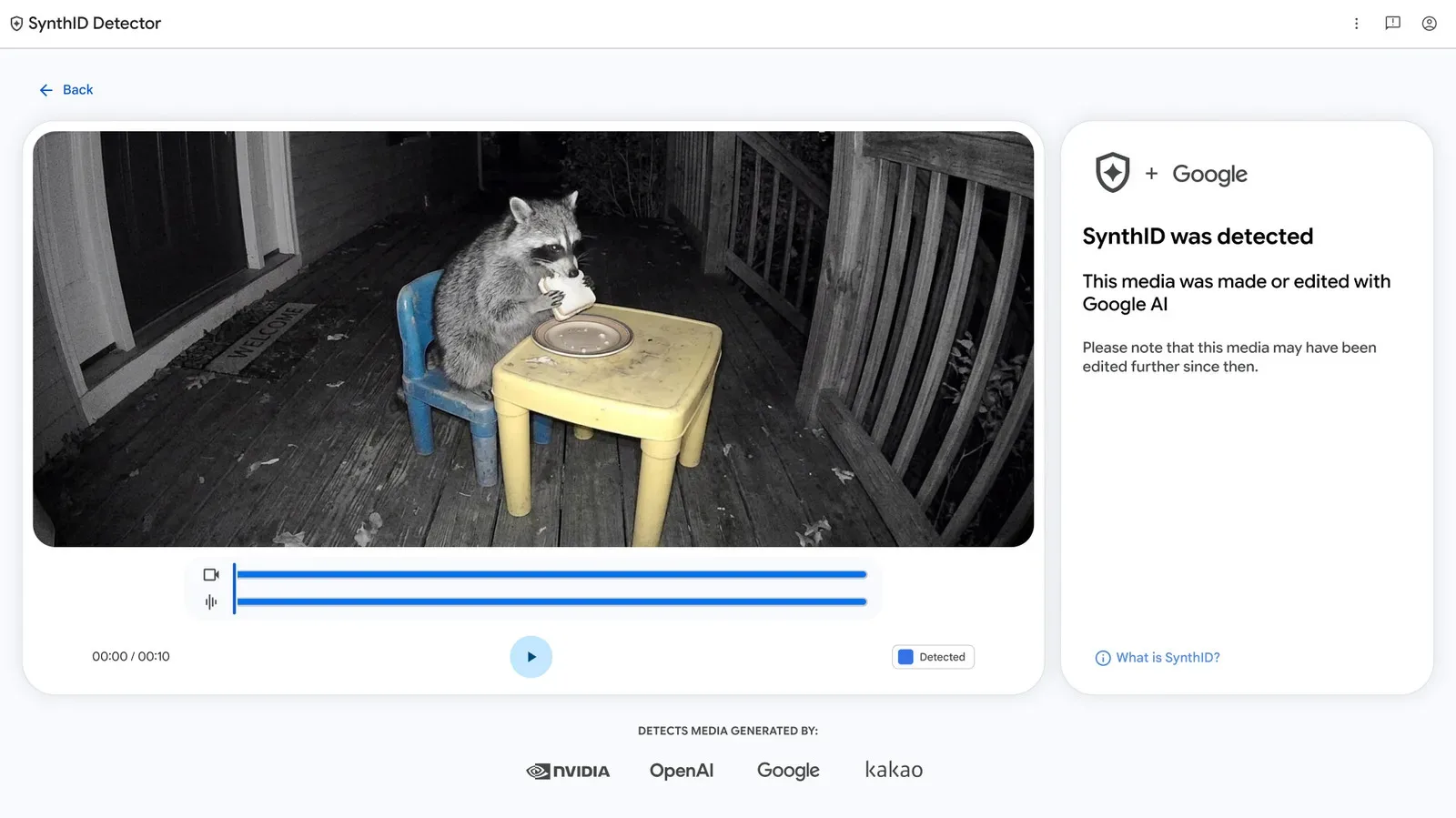
The rise of tools that convert natural language into creative output also puts a premium on knowing what a system can and cannot reliably convey. Readers interested in the surrounding AI ecosystem may also want to consider the limits of verification tools, as explored in Google’s public SynthID Detector rollout and its blind spots. Playground is about generating game projects, not detecting generated material, but both subjects sit within the broader question of how people understand and evaluate AI-assisted work.
Availability and the practical catch
Playground is available through its official website for users in the United States who are 18 or older. Access is tiered according to Google One membership. The description does not provide the exact membership tiers or explain the differences between their levels of access, so eligibility is not simply a matter of being able to visit the site.
That limitation is worth keeping in mind when judging the launch. Playground is not being presented as universally available software. It is an experimental service with geographic, age and membership conditions. Those boundaries can help Google phase access while the product develops, but they also mean that many would-be creators cannot assume immediate entry.
For eligible users, the clearest way to approach Playground is to begin with a focused, small idea. Choose whether the game should be 2D or 3D, use a starter or a fresh prompt, then make one purposeful change at a time—an action, a physics adjustment, or a visual revision. That makes it easier to see what each prompt changed and whether it improved the game’s central loop.
Google’s experiment is most interesting not because it claims to make every user a finished-game developer overnight, but because it puts the earliest stage of game design—turning an idea into something playable—behind a conversational interface. The remaining work still matters: deciding what is fun, communicating a specific goal, refining what the system returns, and choosing whether the result is worth sharing. Playground may reduce the distance between an idea and a first playable version. It does not make the creative judgment after that version any less important.