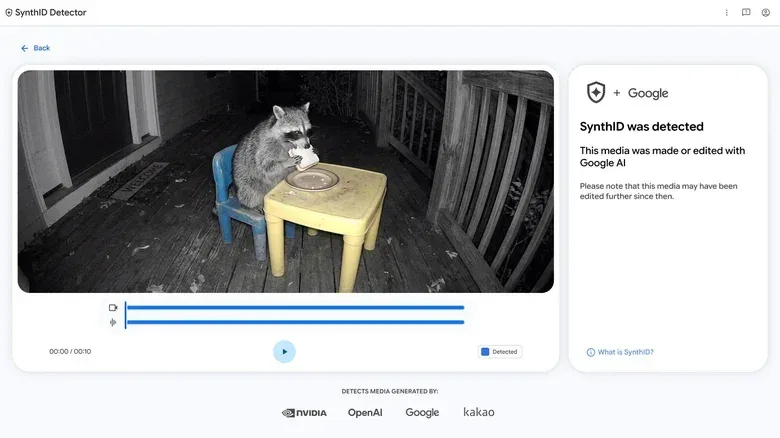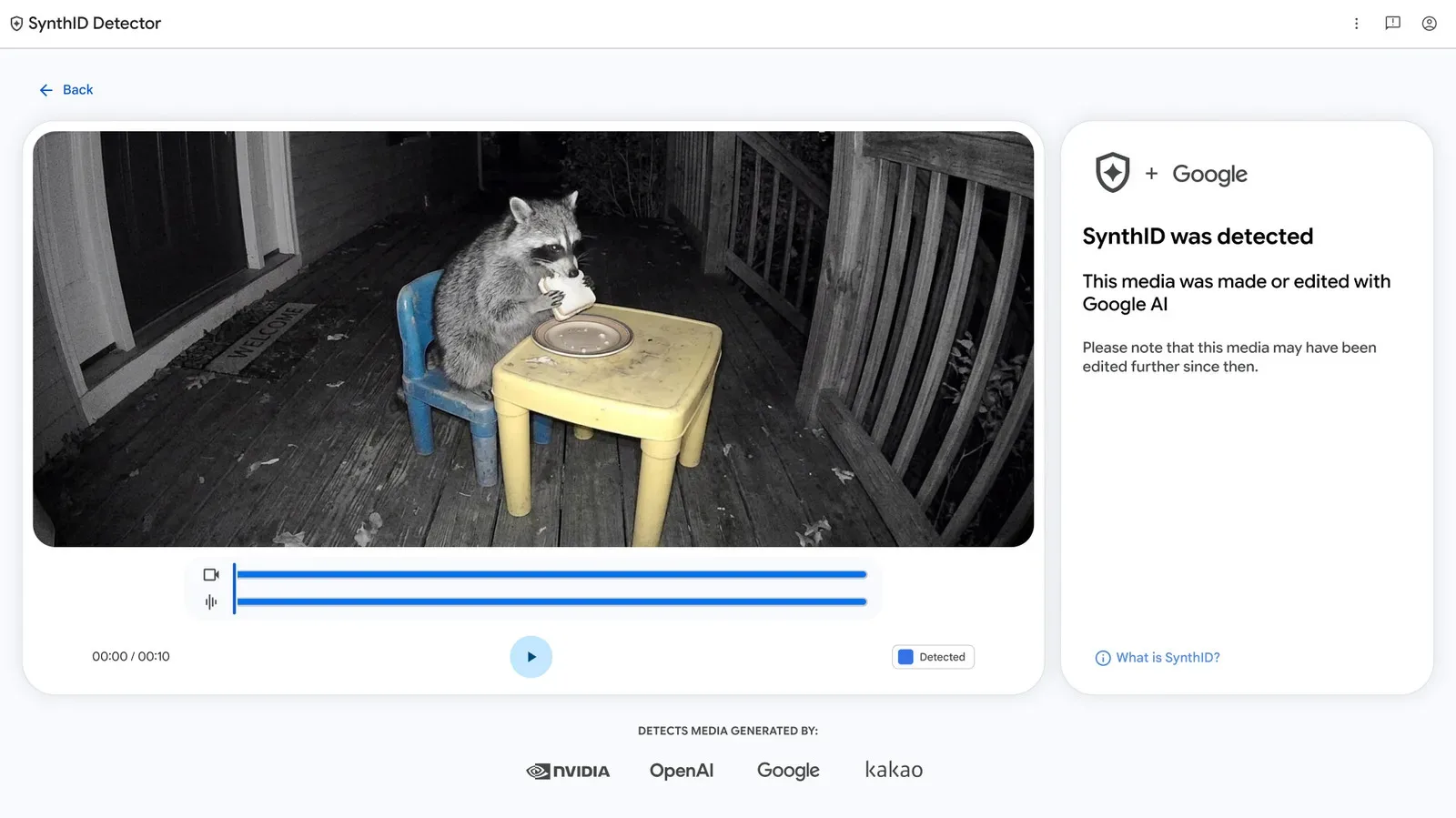
Google has opened SynthID Detector, a web-based tool for checking whether a piece of media carries a supported AI watermark, to the public. The service can flag compatible images, video clips and audio generated or edited by AI tools from Google, OpenAI, NVIDIA and Kakao. It is free, although users must sign in with a Google, OpenAI or Apple account.
That wider availability matters because identifying synthetic or AI-altered media is quickly becoming a basic verification task rather than a specialist one. A dedicated website gives people a more direct route to a watermark check than features embedded in a particular phone, app or AI assistant. But the crucial qualification is right in the nature of the service: SynthID Detector checks for supported provenance signals; it does not settle whether every file without a result is human-made or authentic.
For players, creators and communities, that distinction is important. A clip, screenshot, piece of art or voice recording may circulate without clear context. A positive result can offer useful evidence that supported AI tooling was involved. A negative result, however, cannot prove that no AI was used. The technology is a useful addition to the verification toolkit, not a magic “real or fake” button.
What SynthID Detector is designed to find
SynthID is Google’s watermarking technology for AI-made media. A watermark, in this context, is information associated with generated or edited content that can be detected by compatible tools. It is not simply a visible logo stamped into a corner of an image. The practical goal is to provide a technical signal that helps identify media made with participating AI systems.
The public site lets users check content for a SynthID watermark. Google says the detector supports images, video and audio clips associated with AI tools from Google, OpenAI, NVIDIA and Kakao. That multi-company support is the meaningful part of this launch: the checker is not limited to media from one company’s own generator.
Google has previously offered versions of the detector to journalists and other media professionals after developing it for more than a year. Making it broadly accessible lowers the barrier for anyone who needs to run a basic provenance check, including moderators, artists, community managers and people trying to assess material before sharing it.
The company already has other routes for identifying SynthID watermarks and C2PA content credentials, including Circle to Search and the Gemini app. The new web destination, synthid.com, separates the checking process from those existing products. That can be useful for people who do not otherwise use Google’s AI tools, even though account sign-in remains required.
Apple support is planned, not yet active
The detector is also positioned to become one of the first tools able to identify images produced through Apple’s AI features, including Image Playground. Google says support for images created and edited with Apple Intelligence is coming “soon.”
That wording is worth taking literally. Planned support is not the same as current coverage, and users should not assume that an Apple-generated or Apple-edited image can already be checked successfully. In a space where compatibility depends on which system embedded which signal, the list of supported generators at the time of a check matters.
The same caution applies to the phrase “AI-created and AI-edited.” Those are not interchangeable descriptions. A fully generated image and a conventional photo that received an AI-assisted edit can have very different implications for a viewer. Yet the detector does not tell users whether a work was entirely generated or merely edited, nor does it identify which elements were synthetic.
A detection result can indicate that supported AI tooling was involved. It does not explain the full creation history of the file.
That limitation should shape how results are described. Saying “this file was flagged for a supported watermark” is more accurate than declaring that every pixel, frame or sound in it was made by AI. It is equally important not to turn a lack of a flag into an assertion that a file is untouched.
Watermark detection is not universal AI detection
The biggest limitation is coverage. SynthID Detector cannot find all AI-generated material because AI companies do not all use the same watermarking standard. Some tools may use different systems; others may not provide a compatible signal at all. A detector can only recognize the marks and credentials it has been built to read.
There is a second limitation: watermarks can be removed from content in some circumstances. That means even media originally carrying a detectable marker may not retain it through every copying, editing or publishing path. The absence of a result is therefore an absence of detected supported evidence, not proof of a human origin.
C2PA content credentials are another type of provenance information that Google says its products can detect. In plain terms, provenance concerns the documented origin and handling of a file: information meant to help answer where it came from and what happened to it. These credentials and watermarks can be valuable signals, but they are not identical systems, and neither creates a complete record for every image, video or sound file online.
This produces a patchwork rather than a universal registry. Another company has experimented with a web checker for images created or edited using its latest Muse Image models, but that checker does not cover material from other companies or even the company’s earlier models. The problem is not merely that a single tool needs more entries in a database. Different models, formats and generations of technology may leave different kinds of evidence—or none that a given checker can inspect.
Why the nuance matters for game communities
Gaming spaces are particularly likely to encounter media that needs context: fan art, trailers, supposed leaks, mod showcases, character concepts, promotional mock-ups and voice clips can all be copied rapidly between platforms. A readily available provenance check can help a moderator or viewer gather one more piece of evidence before amplifying a claim.
Its best use is narrow and disciplined. If an uploaded visual or clip returns a supported SynthID detection, that is relevant context for a discussion about whether AI tools were involved. It may justify asking the uploader for clarification about how the work was made or edited. It does not by itself establish authorship, permission, intent, accuracy, or whether a purported announcement is legitimate.
Likewise, a non-detection should not be used to clear a suspicious claim. Credibility still depends on the surrounding evidence: the account posting it, corroborating information, original context and other available records. SynthID Detector adds a technical provenance signal; it does not replace ordinary source evaluation.
This is especially relevant when AI-generated code and content are part of a larger dispute. The questions raised by AI assistance can stretch beyond whether a tool participated in producing an asset. They may involve documentation, attribution, ownership and technical provenance, as seen in the broader issues discussed in the debate around AI-generated homebrew code and reverse engineering. A watermark checker addresses only one slice of that much wider picture.
A practical way to use the new checker
People using SynthID Detector should treat its output as a clue that needs careful wording, not a final ruling. A sensible process looks like this:
- Check the original file when possible. Reposts, edits and conversions may affect whatever provenance information a file retains.
- Read a positive result narrowly. It indicates detection of a supported watermark, not necessarily that the entire item was generated from scratch.
- Read a negative result even more narrowly. It does not rule out AI use, particularly where another watermarking system was used or a signal was stripped.
- Separate origin from truth. Whether AI helped create a clip is different from whether the clip’s claim is accurate.
- Ask for disclosure where appropriate. For a creator sharing work, a direct explanation of the tools and edits used can be more informative than a binary detection label.
That approach also avoids a common failure of emerging detection technology: treating uncertainty as though it were certainty in the opposite direction. A positive result has limited, specific meaning. A negative result has limited, specific meaning. Good moderation and reporting should preserve both limits.
What broader access changes—and what it does not
Opening SynthID Detector to everyone gives more people access to a capability that was previously aimed at a narrower group of media professionals. That is a practical improvement in accessibility, especially for users who want a browser-based check instead of relying on Circle to Search or Gemini.
It does not solve the interoperability problem. The detector’s value will depend in part on the number of generators and partners that adopt compatible watermarking. Google has previously said ElevenLabs committed to adding support for the watermarks, and Google says it is continuously working to extend partnerships that allow more generated media to be detected.
That is a promising direction, but it should not be confused with universal coverage. Until there is broad, durable alignment across the AI ecosystem—and a way to preserve provenance information reliably through ordinary sharing and editing—no single website can conclusively classify every piece of media.
For now, SynthID Detector is best understood as an accessible way to check one growing set of signals across supported image, video and audio tools. It gives the public a useful new method to investigate AI provenance. The responsible next step is not to hand every decision to the detector, but to use its result alongside context, disclosure and careful verification.